


Multisig is rarely a personal security upgrade for the readers of this guide. It is a governance control: the wallet layer where treasury policy, fraud prevention, and audit evidence converge.
Regulated operators evaluating multisig in 2026 face wider chain coverage, stricter compliance scrutiny, and a deeper bench of platforms than two years ago. The question is no longer which wallet is safest, but which infrastructure fits the way your business moves money.
Key Takeaways
- Multisig wallets use an M-of-N approval model that requires a preset number of independent signatures before any transaction can execute.
- For regulated businesses, multisig can support internal fraud controls and audit readiness, but it does not automatically satisfy qualified custody requirements.
- Evaluating the best multisig wallets for business use requires assessing chain coverage, custody model, policy engine capabilities, and API integration readiness.
- Enterprise platforms such as Fireblocks and BitGo combine multisig governance with broader infrastructure layers, making them distinct from self-managed open-source options like Safe or Electrum.
- Businesses managing high transaction volumes can often reduce deployment risk and operational costs by adopting a purpose-built WaaS solution rather than building multisig infrastructure in-house.
What Is a Multisig Wallet?
A multisig wallet is a cryptocurrency wallet that requires multiple independent approvals before any transaction executes. Where a single-signature wallet collapses if one key is compromised, a multisig wallet distributes signing authority across several holders. For businesses, that structural property is the foundation of treasury governance, audit trails, and internal fraud prevention.
The model is sometimes confused with multi-party computation, where keys are split into shares and signatures are reconstructed off-chain. Our explainer on multi-party computation (MPC) wallets walks through how shared key management differs from on-chain multisig enforcement.
How M-of-N Approval Models Work
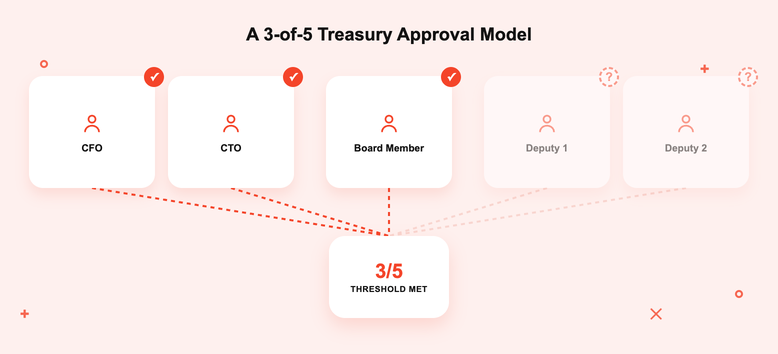
M-of-N is a configurable threshold. A 3-of-5 setup means three valid signatures from a five-signer set must be present before the network accepts the transaction. In practice, a corporate treasury might configure 3-of-5 across the CFO, CTO, a board member, and two operational deputies, so no two compromised devices can release funds without explicit board involvement.
Multisig Types and Custody Models
Bitcoin-native multisig uses script types such as P2SH and P2WSH, with approval logic enforced by the Bitcoin protocol itself. EVM ecosystems instead rely on smart-contract wallets like Safe or Squads, where the contract code holds the M-of-N rules. Both are different from qualified custody, which requires a regulated entity to hold the assets under defined legal and capital standards. Multisig alone, however well configured, does not meet that bar.
Why Multisig Matters for Businesses
Multisig moves treasury governance from policy memo to enforced wallet behavior. Three angles matter most for regulated operators. First, treasury security: distributed signing reduces the single-point-of-failure exposure that plagues single-key setups.
Second, audit readiness: every approval is recorded on-chain, giving auditors a verifiable trail of who approved what and when. Third, the limits of multisig alone: it does not replace insurance, qualified custody, KYT screening, or sanctioned-address monitoring.
Most top-ranking guides on this topic still write for retail Bitcoin holders. Exchanges, payment processors, and funds need wallet controls that interoperate with policy engines, compliance tooling, and back-office systems.
[[aa-cta]]
Ready to move treasury governance from policy memo to enforced controls?
Open a B2BINPAY business account to access multisig-enabled WaaS and custody infrastructure.
[[/a]]
How to Evaluate Multisig Wallets
Selecting a multisig wallet for business use requires more than checking supported assets. Evaluation must cover custody model, policy controls, API readiness, and compliance tooling. Use the framework below before applying it to any specific product in the comparison that follows.
Supported Chains, Assets, and Custody Models
Chain coverage is the first filter. The 2026 competitive landscape spans EVM mainnet, Arbitrum, Avalanche, Base, Solana, Bitcoin, and TRON, and your wallet should match the assets your business actually holds.
Custody model is the second filter. Self-custodial multisig keeps keys with your team, preserving direct control but placing all operational risk inside the company. Custodial or co-custodial multisig involves a regulated third party, which changes the regulatory treatment, recovery options, and audit responsibilities significantly.
Policy Engine, Workflows, and Integrations
A policy engine is the rules layer above the M-of-N threshold. It defines spending limits, whitelisted destination addresses, time delays, tiered approval workflows, and exception handling. API availability is equally critical for any business embedding wallet flows into payment platforms, exchanges, or back-office systems. Without programmatic access, every transaction becomes a manual ticket.
Best Multisig Wallets in 2026
The wallets below represent the strongest options across personal, open-source, and enterprise tiers. Each entry covers core architecture, supported chains, and business suitability so you can read the comparison table in the next section against a consistent benchmark.
Safe, Casa, Electrum, and Squads
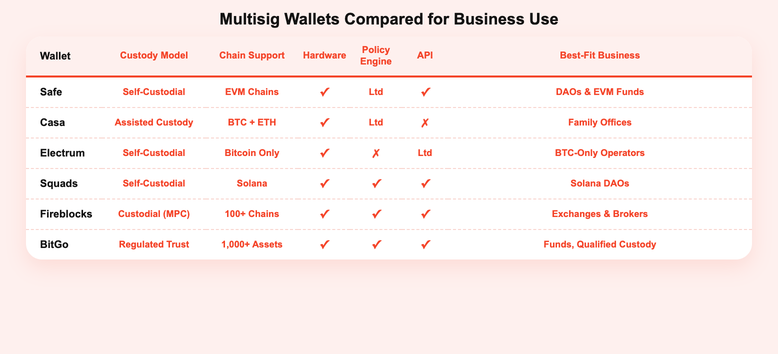
Safe, formerly Gnosis Safe, is the dominant smart-contract multisig on EVM chains. The contract has processed more than $1 trillion in volume and supports configurable N-of-M signing, transaction simulation, role-based spending limits, and extensibility through guards and fallback handlers. It is the default choice for DAO treasuries and EVM-native funds across Ethereum, Polygon, Arbitrum, Optimism, and Base.
Casa runs a managed multi-key vault service originally focused on Bitcoin, now extended to Ethereum and stablecoins. Plans include managed key recovery, inheritance planning, and human-supported configuration. T
he platform reports more than 40,000 clients and over $10 billion in protected assets, with vaults that can include up to five keys for higher-redundancy setups. It suits small teams and family offices that want assisted custody without giving up self-custody control.
Electrum is the open-source Bitcoin wallet released in 2011 under the MIT licence. Multisig is native, hardware wallets such as Ledger and Trezor plug in directly, and keys are encrypted locally. It fits Bitcoin-only operators who want auditable open-source code and no managed service in the path.
Squads is the Solana-native multisig program used by Solana-based protocols and treasuries. The team has broadened into business accounts and stablecoin APIs, but the multisig contract remains the canonical governance option on Solana.
Fireblocks and BitGo
Fireblocks is institutional digital-asset infrastructure built on MPC-CMP cryptography rather than pure on-chain multisig. The platform pairs distributed signing with a configurable policy engine and supports treasury, wallet-as-a-service, payments, and tokenization workflows. Customers include ABN AMRO, Revolut, Bridge, and GSR. Treat it as a governance platform where threshold signing is one layer among several, not a drop-in replacement for an on-chain multisig wallet.
BitGo operates as a federally chartered trust company, listed on the NYSE as BTGO, with regulated custody alongside self-custody options. The platform pioneered three-key multisig for institutional Bitcoin custody and now offers hot, cold, and qualified custody across many chains. For funds, registered advisers, and other entities with explicit custody obligations, BitGo Trust is structurally different from a self-managed wallet.
Multisig Wallet Comparison Table
Use the table below to compare wallets across the criteria that matter most for business deployment. Columns cover custody model, supported chains, hardware compatibility, policy controls, API availability, and best-fit business type. Apply the evaluation framework above as you read each row.
Multisig for Specific Business Use Cases
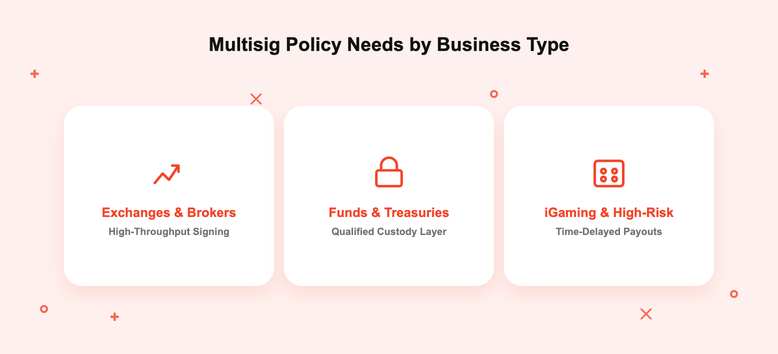
Multisig requirements vary significantly by business type. An exchange managing hot-wallet reserves has different threshold and policy needs than a fund handling quarterly treasury disbursements. The callouts below identify which wallet features apply to each operational context.
Exchanges, Brokers, and Payment Processors
These operators need hot-cold wallet segregation, high-throughput signing, and API-driven approval workflows. Manual signature collection per transaction is incompatible with payment-grade latency. Spending limits per asset, whitelisted withdrawal addresses, and tiered approvals above defined thresholds are essential policy controls.
Payment processors using B2BINPAY's WaaS benefit from built-in multisig controls and address duplication across Ethereum, Polygon, Avalanche, and other chains, which removes one of the most common operational risks: customers sending the wrong asset to the wrong network address.
Funds and Institutional Treasuries
Funds and registered investment advisers should weigh multisig against qualified custody obligations. SEC Rule 206(4)-2 typically requires a regulated qualified custodian, not a smart contract, to hold client assets. Self-managed multisig may serve operational governance well, but it does not by itself satisfy that rule.
Institutional platforms such as Fireblocks and BitGo Trust are designed to layer multisig or MPC governance inside a regulated custody framework, with audit trails and insurance coverage attached.
Gaming, Gambling, and High-Risk Platforms
iGaming operators, prediction markets, and casinos face elevated fraud exposure and need rapid transaction processing alongside strong internal controls. Configurable spending limits, whitelisted withdrawal addresses, daily caps, and time-delayed releases for large payouts are the policy controls that matter most.
The aim is to maintain settlement speed for legitimate payouts while preventing single-operator drains. B2BINPAY supports these requirements through KYT screening on every transaction and audit-ready transaction logs across its supported jurisdictions.
Security Best Practices for Multisig
A well-configured multisig wallet reduces single-point-of-failure risk, but configuration errors can undermine that protection entirely. Key distribution, hardware integration, and recovery planning are the three areas where most teams make avoidable mistakes. The guidance below should be in place before any production deployment, and it pairs well with broader operational hygiene covered in our guide on crypto wallet security tips.
Key Distribution and Hardware Integration
Distribute keys across geographically separated signers. Two keys on the same laptop, or even on the same office network, defeat the purpose of an M-of-N model. Pair at least one signer role with a hardware wallet such as Ledger or Trezor, which holds the private key in a secure element and signs transactions offline. Safe, Electrum, and Casa all support hardware-backed signing.
Recovery Planning and Threshold Design
Threshold design is a trade-off. A 2-of-3 setup balances security and availability for small teams, while 3-of-5 supports succession risk and larger governance structures. Document recovery procedures before going live, including the exact steps for replacing a signer who leaves the organization and for rotating keys after any suspected compromise. Test the procedure with a low-value transaction before relying on it.
Build vs. Buy: Enterprise Multisig Infrastructure
Building multisig infrastructure in-house looks deceptively simple. The visible cost is the smart-contract deployment. The hidden costs are larger and recurring:
- Smart-contract development and ongoing maintenance against chain upgrades.
- Third-party audits before each material change, plus formal verification for high-value setups.
- Key management infrastructure such as HSMs, geographic distribution, and signer onboarding and offboarding.
- Incident response capability, monitoring, and 24/7 operational coverage.
- Compliance integration for KYT, sanctions screening, and reporting.
Buying a regulated WaaS stack collapses most of that overhead. B2BINPAY combines multisig controls, address duplication across chains, gas-fee optimization, and a full payment-processing API into a single account. The platform processed $5.1 billion in incoming volume by 2025 across 6.7 million transactions for 983 business customers, operates under CNAD PSAD authorisation in El Salvador and an FSC VASP licence in Mauritius, and applies KYT screening on every transaction.
If your treasury, exchange, or payment platform needs multisig governance as part of a regulated payment stack, open a B2BINPAY account today and move from infrastructure project to live operations in days, not quarters.
For additional layered security guidance, the team's checklist on how to protect your crypto wallet is a useful companion read.
Frequently Asked Questions about Best Multisig Wallets
What is the best multisig wallet for Bitcoin?
For individual or small-team Bitcoin custody, Casa and Electrum are the most widely trusted options, each supporting native Bitcoin multisig via P2SH and P2WSH scripts. Casa adds a managed key recovery service, making it practical for operators who need redundancy without running full infrastructure.
Businesses processing high volumes of Bitcoin should also evaluate whether a WaaS platform with built-in multisig controls better fits their operational and compliance requirements.
Are multisig wallets safer than single-signature wallets?
Yes, multisig wallets reduce single-point-of-failure risk by requiring M approvals from N authorized signers before any transaction executes. A compromised single key is not sufficient to move funds, which directly limits both external attack vectors and insider-threat exposure.
That said, security outcomes depend heavily on how keys are distributed, whether hardware devices are used for signing, and whether recovery procedures are documented and tested.
What is the difference between a multisig wallet and an MPC wallet?
A multisig wallet enforces its approval threshold on-chain, either through Bitcoin script or an EVM smart contract, making the governance logic auditable and verifiable by any party. An MPC wallet distributes cryptographic key shares across multiple parties and reconstructs a single signature off-chain, which avoids on-chain overhead but moves trust into the MPC protocol and its implementation.
For regulated businesses, the choice between the two often comes down to audit requirements, chain compatibility, and whether on-chain enforceability is a compliance priority.
How many signers should a multisig wallet have for a business treasury?
A 2-of-3 configuration is a common starting point for small teams, balancing security with operational availability if one signer is unavailable. Larger organizations or those with formal governance requirements may prefer a 3-of-5 setup, which provides redundancy against both key loss and a single compromised signer. The threshold should reflect your team structure, succession risk, and any internal control policies required by auditors or regulators.
Do multisig wallets meet institutional or qualified custody requirements?
Multisig wallets, including widely used platforms like Safe and Squads, are legitimate treasury management tools but do not by themselves satisfy qualified custody requirements under stricter regulatory regimes.
Qualified custody typically requires a regulated entity, such as a trust company or licensed custodian, to hold assets under defined legal, capital, and audit standards. Businesses subject to those requirements should evaluate institutional platforms like BitGo Trust or Fireblocks, which layer multisig governance within a broader regulated custody framework.
Disclaimer: The service has legal and jurisdiction limitations. Please check T&Cs on https://b2binpay.com/en/risk-disclaimer

.svg)


