


Exchanges, brokers, prop firms, and OTC desks face a structural problem with crypto treasury operations. When one private key controls a hot wallet processing millions in daily flows, a single phishing email or one rogue employee can move the entire balance before anyone notices.
The multi-signature wallet model spreads authorization across several keyholders, turning each transfer into a policy event rather than a private decision.
This article evaluates the multi-signature wallet as a treasury control layer: how M-of-N works, where single-key wallets fail, how multisig maps to existing approval workflows, how it compares with MPC, what an in-house build costs, and how B2BINPAY embeds these controls into regulated crypto payment infrastructure.
Key Takeaways
- A multi-signature wallet uses an M-of-N approval model, meaning several authorized keyholders must sign before funds can move.
- For business treasuries, a multi-signature wallet reduces the single point of failure that makes one compromised or lost key unacceptable.
- Multisig controls support dual-control policies by separating approval rights across roles such as treasury, finance, and compliance.
- When comparing multisig with MPC, businesses should assess chain support, auditability, transaction costs, and how approvals fit internal workflows.
- Building multisig infrastructure in-house creates operational overhead, so many teams evaluate API-driven custody or WaaS layers instead.
What a Multi-Signature Wallet Actually Does
A multi-signature wallet replaces one signing key with shared authorization, so every treasury transfer follows policy rather than individual discretion. The wallet requires a predefined number of approvals from a defined group of signers before any transaction broadcasts to the blockchain. For operational teams, each payout becomes a controlled event with visible approvers, timestamps, and an on-chain record.
In a business context, this matters for payout approvals, treasury rebalancing, exchange withdrawal queues, and OTC settlement. On EVM chains, Safe smart-account infrastructure shows how on-chain policy enforcement can be programmed directly into the contract, with modular rules controlling who can sign and under which conditions.
The M-of-N Threshold Model Explained
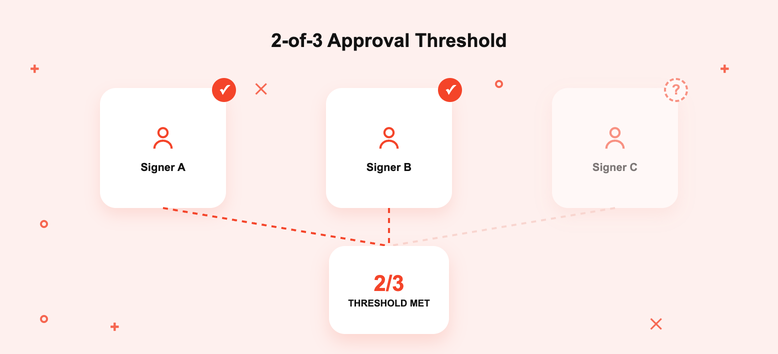
The threshold model uses two numbers. N is the total number of authorized signers across people, devices, or jurisdictions. M is the minimum number of approvals required.
A 2-of-3 setup means three signers exist and any two must approve. A 3-of-5 setup raises the bar to three approvals from five total signers, useful when treasury balances justify higher friction.
Redundancy matters. If one signer loses a device, travels without connectivity, or leaves the company, the others can still meet the threshold.
According to the Bitcoin wiki, native SegWit (P2WSH) multisig supports up to 20 co-signers, giving treasury teams substantial flexibility on signer composition.
How a Transaction Gets Authorized Under Multisig
A signer proposes a transaction. Policy checks run, including velocity limits, address whitelists, and AML/KYT screening. The transaction enters a pending queue visible to all authorized approvers. Each signer reviews destination, amount, and purpose, then adds a signature.
Once the threshold is met, the transaction broadcasts and settles on-chain. The approval record stays attached to the transaction history for finance and audit teams to pull on demand.
[[aa-cta-grey]]
Ready to give your treasury team visible, policy-driven approval workflows?
Open a B2BINPAY business account and configure multi-signature controls under a regulated VASP licence.
[[/a]]
Why Single-Key Wallets Create Unacceptable Treasury Risk
A single-key wallet concentrates authority and failure in one secret, one device, or one employee. That is acceptable for personal balances. It is not acceptable for an exchange processing customer withdrawals or a broker holding client float. One compromised key can drain the entire balance in one transaction, with no internal challenge or reversal possible.
The consequences are severe: frozen operations during incident response, irrecoverable balance loss, unauthorized payouts that hit regulatory reporting, and failed internal controls when auditors review payment governance.
Shared accountability through multisig replaces that fragility with distributed authorization, which is what regulated finance functions already expect from their fiat treasury controls.
Four Treasury Risks That Multisig Controls Directly Eliminate
Multisig matters because it removes specific failure modes, not because it sounds more secure on a feature list. The four risks below cover most loss scenarios in crypto treasury operations: external compromise, insider abuse, signer unavailability, and weak segregation of duties across teams handling hot wallets, settlement balances, and OTC transfers.
Unauthorized Withdrawals From a Single Compromised Key
Phishing, malware, SIM swaps, and leaked API secrets can drain a single-key wallet within minutes. Multisig inserts additional human and device checkpoints, so one compromise produces a pending transaction rather than a completed loss. Geographically separated keys and hardware-backed signing give treasury teams more time to detect and reject malicious proposals before the threshold is met.
Internal Fraud and Rogue Transfers
Multisig enforces dual control, so no single privileged insider can move treasury funds alone. This maps directly to segregation-of-duties principles finance teams already enforce on fiat.
A treasury operator who initiates a payout cannot also approve it. A compliance reviewer who blocks a destination cannot be overridden by one engineer. That separation is the foundation of an auditable approval workflow.
How Multisig Maps to Real Business Approval Workflows
Multisig should mirror the payment approvals a business already runs, not force the team into crypto-native habits. Good policy design starts with roles, limits, exceptions, and escalation paths before any keys are provisioned.
The right question is not "how many signers do we add" but "which approvals already exist in our finance manual, and how do we encode them on-chain." Programmable financial infrastructure is drawing institutional attention through projects like BIS Agora, making auditable approval controls increasingly important for regulated payment teams.
Role-Based Signing: CFO, Compliance Officer, and Treasury Lead
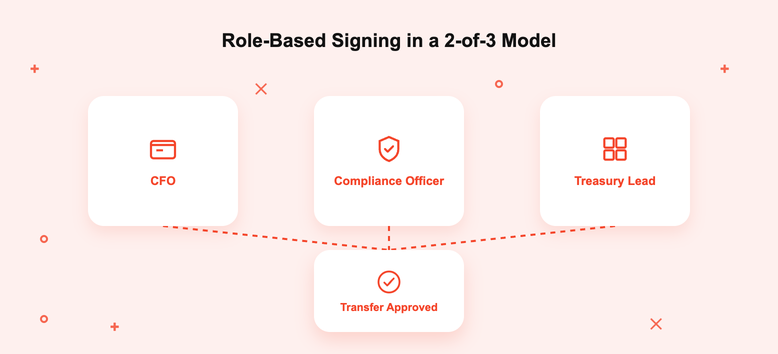
A clean 2-of-3 model assigns one key each to finance, compliance, and treasury. The CFO checks payment purpose and cash-management impact, the compliance officer reviews sanctions and KYT flags, and the treasury lead confirms destination and amount. If any one signer is unavailable, the other two can still execute, so governance does not collapse during holidays or staff turnover.
B2BINPAY's treasury management platform supports this pattern, with role-based access, real-time AML/KYT scoring, and approval workflows in a unified dashboard.
Configuring Thresholds for High-Value vs. Routine Transfers
Tiered thresholds reduce friction without weakening governance. Routine payouts below a defined amount can clear with two signers. Treasury sweeps and transfers to new destinations require an additional approver. Velocity rules sit alongside signer rules: a $50,000 payout to a whitelisted exchange behaves differently from a $50,000 payout to a first-time address. Amount, asset, chain, and counterparty risk all justify different approval levels.
Multisig vs. MPC and Cross-Chain Models: Choosing the Right Approach
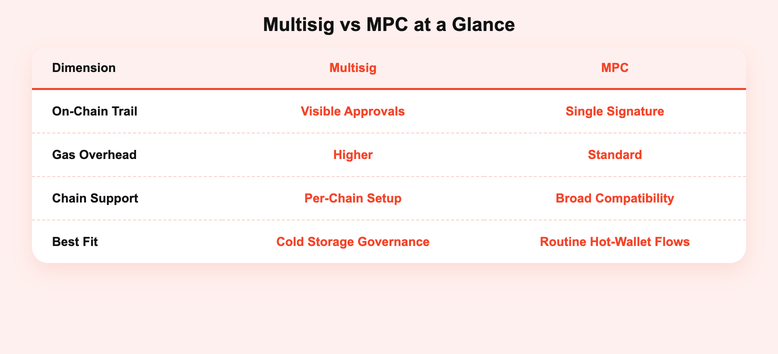
Multisig and MPC solve overlapping problems with different mechanics. Traditional multisig records multiple approvals on-chain, producing a public approval trail that improves auditability. MPC combines parties into one cryptographic signature, so the resulting transaction looks like a standard wallet transfer and avoids extra gas overhead.
B2BINPAY's MPC wallet explainer describes how key shares are distributed without a single private key ever existing.
Native Bitcoin multisig, EVM smart-contract multisig such as Safe, and MPC each have trade-offs. Choose multisig when visible approval trails and explicit on-chain governance matter. Consider MPC when chain efficiency, privacy, or broader wallet compatibility outweigh the value of an on-chain audit record. Cross-chain treasury operations often combine both, with multisig governing cold storage and MPC powering routine hot-wallet flows.
[[aa-cta]]
Want to compare multisig and MPC against your real payment volume?
Talk to a B2BINPAY specialist about a setup that fits your treasury, compliance, and chain mix.
[[/a]]
The Operational Cost of Building Multisig Infrastructure In-House
Building multisig internally is more than writing a smart contract. The hidden workload covers policy design, key ceremonies, signer recovery procedures, real-time monitoring, audit logs, and incident response runbooks. Non-crypto-native finance teams routinely underestimate cross-chain compatibility, gas optimization, callback handling, and approval UX for distributed signers across time zones.
Regulatory documentation adds another layer. Auditors expect dual-control evidence, signer access reviews, and 24/7 operational support matching the always-on nature of blockchain settlement. Most treasury teams find the in-house path absorbs engineering capacity that should be funding the core business.
How B2BINPAY Delivers Multisig Controls Through Its Custody and WaaS Layer
B2BINPAY is regulated payment infrastructure, not a wallet brand. The platform processed $5.1B in incoming volume across 6.7M transactions for 983 business customers by 2025, operating under B2BINPAY EL SALVADOR S.A. DE C.V. (CNAD PSAD, SSF supervised) and B2BINPAY MAURITIUS LTD (FSC VASP licence GB24203002). KYT screening runs on every transaction across 350+ supported currencies.
Businesses access multi-signature controls through three operational layers. Custody provides institutional storage with multi-signature wallets, MFA, and video-confirmed transactions. Wallet as a Service embeds wallet operations through API, with multi-signature security, callback URLs, configurable confirmations, and roughly 48% lower gas fees through batched outgoing transactions.
For DeFi-native teams, B2BINPAY's non-custodial multisig product supports N-of-M approval queues, signer and rule management, and full payment lifecycle tracking without B2BINPAY holding private keys. Outgoing fees are 0%, sandbox testing is fee-free, and incoming coin fees start at 0.25%.
Multisig Is a Treasury Control Decision, Not Just a Security Feature
Multisig is a governance tool first and a cryptography tool second. It works best when signing policy, compliance process, and wallet infrastructure are designed together rather than bolted on after a security review. Treasury teams that treat the M-of-N model as a way to encode existing finance controls on-chain capture the full operational value.
[[aa-cta-grey]]
Does your business move significant crypto volume and still depend on individual key custody?
The risk is concentrated where it should be distributed. Open a B2BINPAY business account and configure regulated multi-signature treasury controls aligned with your approval policies, compliance team, and chain mix.
[[/a]]
Frequently Asked Questions about Multi Signiture Wallets
What is a multi-signature wallet?
A multi-signature wallet is a shared crypto wallet that requires multiple private keys to approve a transaction instead of one key alone. For treasury teams, the M-of-N model removes a single point of failure and enforces dual control over outgoing transfers.
What is a 2-of-3 multisig wallet?
In a 2-of-3 setup, any two approved signers can authorize a transaction, while the third key acts as backup or separation. Businesses often assign those keys by role, such as CFO, treasury lead, and compliance officer, to match existing approval workflows.
Is a multi-sig wallet safe?
It can be significantly safer than a single-key wallet because one compromised device or insider cannot move funds without additional approvals. Safety still depends on key distribution, hardware security, signer procedures, and recovery planning across the people and systems involved.
What is the difference between multisig and MPC wallets?
Traditional multisig records multiple approvals on-chain, which can improve auditability but may increase operational complexity or gas costs on some networks. MPC combines parties into one cryptographic signature, so it often looks like a standard wallet transaction and can be more private. Choose multisig when visible approval trails matter, and consider MPC when chain efficiency, privacy, or broader wallet compatibility matter more.
Can multisig wallets be used for team or organizational fund management?
Yes, multisig is well suited to exchanges, OTC desks, payment teams, and DAOs that need shared control over treasury balances. With B2BINPAY Custody and Wallet as a Service, businesses can embed multisig approvals into payment operations without building the signing infrastructure internally. That approach helps align wallet controls with AML, reconciliation, and role-based back-office processes from the start.
Disclaimer: The service has legal and jurisdiction limitations. Please check T&Cs on https://b2binpay.com/en/risk-disclaimer

.svg)


