


Ask any treasury manager what a cross-border payment really costs, and the honest answer is rarely the headline fee. It's the wire that leaves on Friday and lands the following Wednesday, the correspondent bank that shaves off a cut you never see, the reserve capital parked against chargebacks, and the supplier email asking where the money is. For finance teams running always-on businesses, that friction is the actual product of legacy rails.
Stablecoin payment settlement for business is the practical response. It treats digital dollars like USDC and USDT as settlement rails, not speculative assets, so value can move to on-chain finality in minutes rather than days.
This article skips the crypto primer and gets to the decisions that matter: how finality works, what settlement costs, whether to hold funds with a custodian or keep your own keys, which stablecoin to route through, and how integration fits your existing stack.
Key Takeaways
- Stablecoin payment settlement for business means value transfers can reach on-chain finality faster than SWIFT, ACH, or card flows in many cross-border scenarios, often in seconds to minutes rather than business days.
- The main settlement decision for operators is usually custodial versus self-custody, because each model changes control, counterparty exposure, and treasury risk.
- Businesses in iGaming, forex, e-commerce, and other cross-border sectors use stablecoin settlement to cut delays, chargeback exposure, and banking friction.
- Choosing between USDC and USDT means weighing liquidity, geographic acceptance, issuer structure, and de-peg risk before routing settlement flows.
- Reliable settlement depends on API integration, AML and KYB controls, and reporting that holds up under accounting and regulatory review.
What Stablecoin Payment Settlement Actually Means for Operators
For operators, settlement is the moment ownership of funds becomes final and usable, ready for payout, treasury allocation, or an invoice you can mark as paid. It is not the moment a processor shows a hopeful "pending" status. Confirmation quality matters more than raw speed here, because a payment that looks complete but later reverses breaks reconciliation and erodes supplier trust.
That distinction is the whole point. A card authorization or a SWIFT acknowledgment is a message that a payment should happen. On-chain finality is the payment itself, recorded and irreversible. Once you internalize that gap, the rest of the stack maps cleanly: a confirmed transfer posts to a wallet balance, closes the invoice, and feeds a ledger entry your accountants can actually rely on.
On-Chain Finality vs. Traditional Payment Confirmation
On-chain finality and blockchain confirmation are related but not identical, and the difference is where operational risk hides. A transaction can be included in a block quickly, yet true finality depends on each chain's confirmation rules and its tolerance for reorganizations. Solana reaches finality in roughly 13 seconds, Ethereum in about 12.8 minutes, and Ethereum Layer 2s such as Base settle in seconds, according to network documentation tracked through 2025.
Compare that with traditional rails. A card authorization can be reversed through chargebacks for months. A SWIFT message may be acknowledged in hours but only settles once correspondent banks clear it, often one to several business days later. For business settlement, irrevocability is worth more than message delivery, because it is the property that lets you release goods, fund an account, or pay a partner without holding your breath.
How Funds Move: From Sender Wallet to Settled Balance
Here is the practical flow. Your system generates an invoice and a unique deposit address. The payer sends USDC or USDT from their wallet. The network confirms the transaction to your configured threshold, and the settled balance posts to your merchant or treasury wallet, where it can be auto-swept, converted, or held.
Picture a broker funding scenario. A client in another region needs to fund a trading account on a Sunday. Over card rails, that deposit might wait for Monday processing and carry reversal risk.
With stablecoin settlement, the transfer confirms in minutes, the treasury wallet reflects a final balance, and your back office can trigger conversion to fiat or auto-sweep the funds into a settlement account, with the transaction hash sitting in your records as an audit trail.
Stablecoin Settlement vs. SWIFT, ACH, and Card Networks
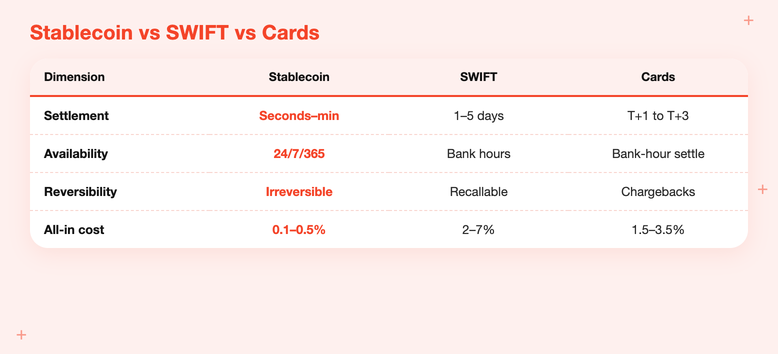
Treated as payment rails, stablecoins compete directly with banking and card infrastructure on the metrics operators actually budget around: availability, cost, and finality. The business case usually turns on cross-border collections and payouts, where legacy rails are slowest and most expensive. The table below frames the comparison finance teams tend to build.
Speed and Availability
Stablecoin rails settle around the clock, which is the structural advantage over banking-hour systems. An on-chain transfer can complete in minutes on a weekend, while a SWIFT wire initiated Friday afternoon may not settle until midweek. That gap is not cosmetic for treasury teams.
Faster settlement shortens the cash-conversion cycle, improves supplier timing, and closes the weekend and holiday liquidity gaps that force businesses to prefund accounts. When money moves on the same day you invoice, you hold less idle capital against timing risk, and you can pay partners when the work is done rather than when the next clearing window opens.
Cost and Fee Structure
Comparing rails on headline percentages alone hides the real number. The honest cost of a cross-border payment includes network fees, processor fees, FX spreads, correspondent charges, and the reserve capital you tie up against reversals.
On this fuller basis, U.S. Federal Reserve analysis published in 2026 found stablecoin cross-border transfers can run near 0.1–0.5% all-in against roughly 2–7% for traditional wires once fees and FX are counted. A U.S.-to-Mexico transfer illustrated the point at roughly $35–80 via stablecoin versus $115–200 via SWIFT.
As a concrete benchmark, the B2BINPAY Merchant Wallet applies flat processing fees in the 0.25–0.40% range with a 0% rolling reserve for eligible merchants. The reserve figure is often the one that matters most, because retained holds are working capital you cannot deploy.
Chargeback Exposure and Rolling Reserve Requirements
Stablecoin settlement is push-based and irreversible, so it generally removes the chargeback exposure that defines card acceptance. The payer initiates the transfer, the network settles it, and there is no issuer-driven clawback weeks later. For merchants who have lived through friendly fraud, that alone reshapes the risk model.
The reserve side is where high-risk sectors feel the difference most. Card processors frequently impose rolling reserves, holding a percentage of revenue for months against potential reversals, which traps serious working capital. Stablecoin rails settle without the same retention model.
The tradeoff to be honest about: irreversibility cuts both ways, so a mistaken or fraudulent outbound payment cannot be clawed back either, which puts more weight on approval controls and address verification.
Custodial vs. Self-Custody Settlement: a Risk Management Decision
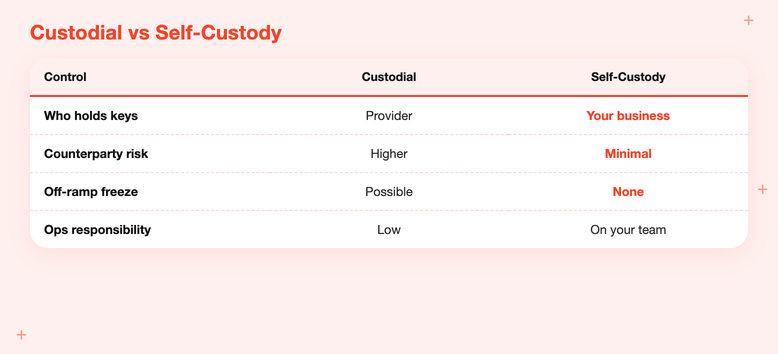
Custody is the settlement decision most buyers underweight, and it is fundamentally about who controls the keys, the liquidity, and the recovery path when something goes wrong. Every enterprise buyer should weigh convenience against counterparty exposure, a lesson reinforced by exchange failures and processor account freezes over the past few years.
The two models diverge on the controls finance teams care about: approvals, reporting, wallet ownership, incident response, and policy enforcement. Neither is universally correct. The right answer depends on how much operational control you are willing to delegate, and how much counterparty risk your treasury policy can tolerate.
How Custodial Settlement Works and Where Counterparty Risk Enters
In a custodial model, the provider receives, holds, converts, and releases funds on your behalf. It is operationally simple, and for many merchants that convenience is the appeal. The catch is that counterparty risk enters at three points: while the custodian holds your balance, at the off-ramp where crypto converts to fiat, and at the withdrawal stage.
Recognizable custodial arrangements include processor and exchange-based models from providers like Stripe or infrastructure such as Fireblocks. The point is not to rank brands but to see where risk sits: when a custodian holds your settled funds, an account freeze, a liquidity problem, or an off-ramp delay on their side becomes your problem.
How Self-Custody Settlement Works and What Control It Preserves
Self-custody settlement keeps private-key control with your business, preserving direct access to funds, asset segregation, and withdrawal autonomy. No custodian stands between you and your balance, so there is no third-party freeze or off-ramp bottleneck to inherit. The trade is operational responsibility: key management and approval discipline become your job.
Self-custody does not have to mean building everything yourself. The B2BINPAY DeFi App and Wallet-as-a-Service model provide API-driven, non-custodial settlement with the approval workflows, multisig controls, and reporting that treasury teams need, so you get the control of your own keys with the tooling that makes it viable at business scale.
Which Business Verticals Benefit Most From Stablecoin Settlement
The value of stablecoin settlement depends on the payment problem you are solving, not just transaction volume. Sectors facing cross-border friction, reserve pressure, banking constraints, or multi-asset treasury rebalancing gain the most, and several are structurally underserved by mainstream payment coverage. Most articles on this topic address generic "businesses" and quietly skip the operators who feel banking friction hardest.
iGaming, High-Risk Operators, and Forex Brokers
For iGaming platforms, high-risk merchants, and forex brokers, three properties align almost perfectly with stablecoin rails: 24/7 settlement, lower processor dependency, and reduced chargeback exposure. These businesses move money constantly, across borders, in sectors where traditional acquirers charge premium rates or decline service outright.
The use cases are concrete. Player withdrawals can settle on weekends without waiting for banking hours. Affiliate payouts go out in batches without correspondent delays. Broker deposits confirm in minutes so clients can trade sooner. And treasury teams can rebalance between stablecoins, fiat, and other crypto assets without routing every move through a hostile banking relationship.
E-Commerce Merchants and Cross-Border Suppliers
E-commerce merchants and cross-border suppliers use stablecoin settlement to collect globally, settle faster, and pay suppliers without correspondent banking delays or card network reversals.
A store can accept payment from a customer three time zones away and see final settlement the same day, then turn around and pay an overseas supplier from the same balance. If you want the foundational case for this, B2BINPAY covers why stablecoins benefit cross-border businesses in more depth.
Operationally, this looks like invoice settlement against unique addresses, automatic conversion to fiat where needed, supplier payouts from a treasury wallet, and clean accounting exports. Checkout can plug into platforms like Shopify, WooCommerce, or a custom flow, so the crypto layer sits behind familiar commerce infrastructure rather than replacing it.
Stablecoin Selection: USDC vs. USDT and De-Peg Risk
Choosing between USDC and USDT is a treasury policy decision, not a popularity contest. Liquidity, redeemability, supported networks, and compliance posture usually matter more than any marketing narrative. Both are fully reserve-backed and dominate B2B usage, but they differ in structure and transparency cadence, which is exactly what a treasury policy should account for. The mechanics of issuer economics are covered in B2BINPAY's explainer on how stablecoin issuers manage reserves and generate revenue.
By early 2026, Circle's USDC stood near $77.6B in circulation, roughly 90% held in U.S. Treasuries and overnight repos with monthly Big-Four attestations. Tether's USDT sat near $189.6B in circulation against $181B+ in reserves, including about $135B in Treasuries and $12.9B in gold. USDC leans more conservative and transparent; USDT offers deeper liquidity and wider reach in some regions.
De-peg risk is the scenario every treasury plan should stress-test. The instructive case is March 2023, when USDC briefly fell to about $0.87 after $3.3B of its reserves were stranded at the collapsing Silicon Valley Bank, then regained its peg within roughly 48 hours once redemptions reopened.
The lesson is that the risk was reserve-based and counterparty-driven, not algorithmic like Terra's UST collapse. USDT held above $0.99 through the same event. Practical mitigation means diversifying settlement assets, monitoring issuer disclosures, and defining in advance how you respond if a peg wobbles.
Compliance, Accounting, and Reporting for Stablecoin Settlements
Compliance belongs in the settlement design from day one, not bolted on after launch. Finance teams need audit trails that show wallet movements, fiat-equivalent values at settlement time, counterparties, and policy checks at every stage. If your records cannot answer an auditor's question about how funds moved on-chain, the efficiency gains are undermined by reporting risk.
In practice that means layering KYB onboarding, KYT transaction screening, sanctions checks, chart-of-accounts mapping, and jurisdictional review into the flow. The regulatory backdrop is maturing quickly: the EU's MiCA framework brought stablecoin issuers under formal rules with enforcement from late 2024, and the U.S. GENIUS Act, signed in July 2025, set a federal standard requiring full reserves and monthly disclosure. Chainalysis research also underscores why KYT is non-negotiable, since stablecoins now carry a large share of illicit on-chain volume that screening is designed to catch.
How to Integrate Stablecoin Settlement Into Your Payment Stack
Integration is a workflow question, not a rip-and-replace project. The real task is connecting invoices, wallets, callbacks, and ledger updates inside systems you already run. For teams operating custom platforms, trading back offices, or embedded payment products, the sequence is what needs to be clear before anyone signs off.
That sequence is consistent: create wallets, generate unique deposit addresses, monitor confirmations to a set threshold, trigger callbacks to your systems, reconcile settled balances, and configure conversion or payout rules. Each step maps to an API call and a webhook, which is what turns stablecoin settlement from a manual treasury chore into automated infrastructure.
API-Based Settlement and White-Label Options for Platforms
API-first settlement fits brokers, exchanges, and wallet providers that need embedded stablecoin collections, payouts, and treasury controls rather than a hosted checkout. The evaluation questions are practical: does one API family cover wallet creation, deposit monitoring, conversion, and reporting, and do the callbacks and wallet controls support your reconciliation and compliance needs?
B2BINPAY covers this through its WaaS, White Label, and accept-crypto-payments products, which expose reporting, callbacks, wallet controls, and built-in compliance tooling. For teams moving from evaluation to build, the practical starting point is accepting stablecoin payments via a crypto payment gateway, then layering in the treasury and payout automation your operations require.
Stablecoin Settlement Is Ready for Business
The operator checklist is short and sequential: choose your custody model, select the stablecoins that fit your liquidity and compliance profile, define approval and reporting controls, test the flows end to end, and align settlement with treasury policy. Get those five right and stablecoin settlement stops being an experiment and becomes reliable infrastructure.
The businesses seeing the clearest gains are the ones treating this as a settlement decision, not a crypto bet. Faster finality, lower all-in cost, less trapped reserve capital, and fewer hostile banking dependencies are operational wins that show up directly in working capital and margin. B2BINPAY builds regulated, self-custody-capable settlement infrastructure for exactly these teams, with the compliance, automation, and reporting depth that treasury and finance leads require to move real money at scale.
[[aa-cta]]
📢 Accept Crypto. Settle Fiat. Protect Your Margin.
Move cross-border payments to on-chain finality with regulated, self-custody settlement infrastructure.
[[/a]]
Frequently Asked Questions about Stablecoin Payment Settlements
How does stablecoin settlement work?
Stablecoin settlement is the point when an on-chain transfer reaches enough confirmations and control of funds passes irreversibly to the recipient. For business flows, you typically issue an invoice, receive USDC or USDT to a unique address, reconcile the transaction hash, and then hold, swap, or off-ramp the funds to fiat.
What is the difference between stablecoin settlement and a wire transfer?
Stablecoin settlement usually reaches finality within seconds or minutes and runs around the clock, while cross-border wires depend on correspondent banks and business hours. That difference can reduce prefunding, intermediary fees, and reconciliation delays, especially for merchants, brokers, and platforms moving funds across several jurisdictions.
What stablecoins are most commonly used for B2B payments?
USDC and USDT are the primary options because they have broad exchange support, deep liquidity, and wide acceptance across wallets, payment gateways, and trading venues. Selection should also weigh network choice, issuer risk, regional compliance, and de-peg planning, since operational reliability matters more than ticker popularity.
Are stablecoin transactions taxable?
In many jurisdictions, receiving stablecoins for goods or services is recorded at the fiat value at settlement time and reported under normal tax rules. If you later swap, dispose of, or revalue those assets, additional accounting or tax treatment may apply, so audit-ready records are essential. Confirm treatment with a qualified advisor in your jurisdiction.
What is stablecoin treasury management?
Stablecoin treasury management is the process of holding, routing, swapping, and settling digital dollars across wallets, exchanges, and bank rails with controlled risk. In practice, businesses set balance policies, counterparty limits, approval rules, and conversion logic so operating funds stay liquid without unnecessary custodial exposure. With B2BINPAY, teams can combine self-custody settlement, swaps, and reporting in one workflow, which helps simplify cross-asset treasury operations.
Disclaimer: The service has legal and jurisdiction limitations. Please check T&Cs on https://b2binpay.com/en/risk-disclaimer

.svg)


