



Wallet-as-a-Service: How It Works and Why It Matters

Wallet as a service (WaaS) is a ready-made crypto wallet infrastructure that you integrate through APIs and SDKs. The provider handles key management, security, and compliance so you can embed crypto deposits, withdrawals, or payouts without building blockchain systems internally.
Building wallet infrastructure from scratch demands cryptographic expertise, repeated security audits, node operations, and ongoing maintenance. That's months of work before your first transaction, and it distracts from the product you actually want to ship. WaaS removes that burden: signup-to-sandbox can happen in a day, and a production integration typically takes two to four weeks.
This guide covers how WaaS platforms operate, what the custodial, non-custodial, and MPC models actually mean for your compliance and user experience, how to evaluate providers, and what a realistic integration workflow looks like.
Key Takeaways
- WaaS platforms abstract blockchain complexity by providing pre-built APIs for wallet creation, transaction processing, and key management, reducing development time from months to days.
- Choosing between custodial, non-custodial, and MPC wallet models directly impacts your compliance obligations and user experience design.
- Evaluation criteria should prioritize multi-chain support, fee transparency, security certifications, and API documentation quality over feature count alone.
- Integration typically follows a four-step workflow: API key provisioning, sandbox testing, backend connection, and production deployment with monitoring.
- Gas fee structures and transaction pricing vary significantly between providers, making cost modeling essential before committing to a WaaS partner.
What Is Wallet-as-a-Service?
Wallet as a service delivers infrastructure and software to create, manage, and operate cryptocurrency wallets through APIs, similar to how Twilio handles messaging or Plaid handles banking connections.
You get wallet creation, key management, transaction signing, and balance tracking as managed capabilities, and your team focuses on product logic instead of blockchain plumbing.
Crypto wallets store cryptographic keys (public and private), not currency. Those keys prove ownership of assets that actually live on a blockchain, which is why key management is where most of the risk and complexity sits. WaaS shifts that complexity onto a provider that has already solved it.
WaaS supports two kinds of buyers. Crypto-native businesses (exchanges, brokers, payment processors) use WaaS to accelerate their own wallet operations. Traditional businesses (e-commerce, iGaming, SaaS, and marketplaces) use WaaS to add crypto payments, payouts , or treasury without hiring blockchain engineers. Both get the same outcome: embedded wallet functionality without the internal lift.
How WaaS Platforms Operate Under the Hood
A WaaS platform typically has four architectural layers: an API layer that exposes endpoints to your application, a key management system that handles secure storage and signing of private keys, a transaction engine that constructs and broadcasts on-chain transactions, and blockchain connectors that maintain node relationships and listen for confirmations.
A deposit or withdrawal flows through those layers in sequence:
- Your application calls the provider's API (for example, a withdrawal endpoint).
- The provider validates the request, checks balances, and invokes the key management system to sign the transaction.
- The signed transaction is broadcast to the relevant blockchain through the provider's node infrastructure.
- The blockchain processes the transaction and the provider sends back confirmation status via webhook or polling.
Transaction signing is the cryptographic authorization of a transfer using a private key. Encryption protects keys at rest. Multi-factor authentication, address whitelisting, and manual approvals sit above that as additional controls.
None of these layers are novel individually, but operating them reliably at scale is where the value of WaaS comes from. That's also why integration can take days instead of months: you inherit a production-grade stack instead of building one.
Business Benefits of Adopting WaaS
WaaS delivers concrete operational outcomes, not just abstract "faster time-to-market" marketing copy:
- Launch crypto wallets in weeks by eliminating node infrastructure, key ceremonies, and monitoring overhead.
- Reduce engineering payroll by removing the need for specialized blockchain and security engineers dedicated to wallet upkeep.
- Avoid repeated security audit cycles that in-house wallet systems require every time code changes.
- Scale transaction volume without capacity engineering: providers handle thousands of transactions per day with documented SLAs.
- Broaden asset support by inheriting multi-chain, multi-token support from day one instead of adding chains one by one.
- Shift compliance burden by leveraging provider-side KYT screening and reporting while keeping your KYC obligations in-house.
For e-commerce platforms, brokers, exchanges, and iGaming operators , those benefits compound. An iGaming operator that adds crypto deposits and payouts through WaaS can go live in weeks and process cross-border player payouts at a fraction of card-rail costs. A broker can offer crypto funding without building an in-house custody team.
Custodial, Non-Custodial, and MPC Models Compared
The custody model determines who controls private keys. That one decision shapes your security posture, regulatory obligations, and user trust in ways that cascade through every downstream feature.
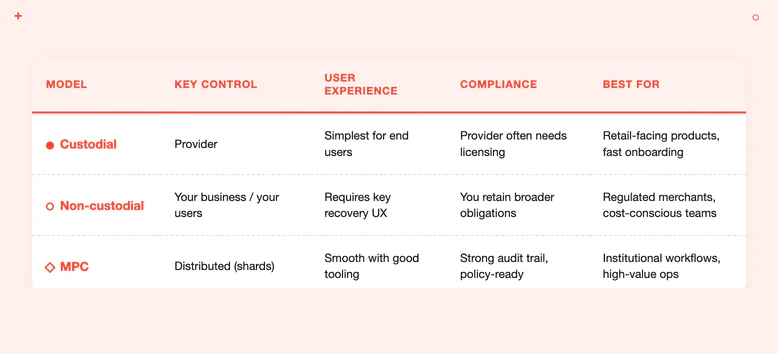
Selection is context-dependent. Geography, user profile, risk tolerance, and regulatory posture all matter more than any universal "best." B2BINPAY's WaaS is non-custodial, which fits businesses that want to retain key control and run a leaner compliance profile while still inheriting enterprise-grade infrastructure.
How to Evaluate Wallet-as-a-Service Providers
Use this as a procurement checklist. Run it jointly with your engineering lead; neither side can evaluate WaaS alone.
- Multi-chain and token support: cover the chains you need today plus a two-year roadmap. Adding chains after launch is expensive.
- Security controls and certifications: SOC 2 Type II, third-party audits, penetration testing cadence, and documented incident response.
- API and SDK completeness: REST, webhooks, SDKs in your language, idempotency support, rate limits that match your volume.
- Documentation quality: clear sandbox, example payloads, error taxonomies. Poor docs predict painful integration.
- Fee transparency: published rates for platform, per-transaction, gas handling, and spread/conversion.
- Compliance tooling: KYT and AML screening, Travel Rule support, exportable reporting.
- Uptime and SLAs: contractual availability, incident transparency, reliable webhook delivery.
- Support model: response times, dedicated engineers for enterprise tiers, access to real operators (not just ticket queues).
Red Flags
- Hidden or non-transparent fees buried in contract footnotes.
- Ambiguous custody terms, or marketing that claims "non-custodial" but stores keys server-side.
- Limited or locked-down sandbox environments.
- Documentation that lags the product or requires "contact sales" for basic API reference.
Top Wallet-as-a-Service Providers
A short market overview to help you shortlist. None of these are universal winners; fit depends on your custody model, chains, and volume profile.
1. B2BINPAY
B2BINPAY delivers institutional-grade, non-custodial WaaS with 350+ supported assets and multi-chain address duplication (BEP20/ERC20, Polygon, Avalanche on a shared address, for example). Differentiators include gas fee optimization with a single commission per transaction, TRX staking for yield and fee reduction on TRON, and API-first integration backed by sandbox, documentation, and 24/7 operations support. Typical fit: e-commerce, brokers, crypto exchanges, and iGaming platforms that want full key control without owning the infrastructure.
2. Fireblocks
Fireblocks is an enterprise-focused WaaS provider known for MPC-based workflows and institutional tooling. Strengths include SOC 2 alignment, a policy engine for granular transaction controls, and broad connectivity to exchanges and trading venues. Good fit for institutional trading desks, large custodians, and enterprises that prioritize MPC architecture and deep venue connectivity.
3. BitGo
BitGo is custody-first with WaaS capabilities layered on top, emphasizing insurance options and multi-signature security patterns. Fits institutions that want regulated custody alongside wallet operations , particularly where insurance coverage or multi-sig is a contractual requirement from end clients or regulators.
4. Circle
Circle offers developer-friendly wallet infrastructure with strong USDC ecosystem integration, programmable wallet capabilities, and smart-contract-adjacent features. Good fit for businesses building on stablecoin flows, particularly around USDC, or teams that want programmable on-chain logic inside the wallet layer.
5. Other Notable Options
Copper, Ledger Enterprise, and CoinPayments each serve specific custody, security, or payment needs. Shortlist based on custody model, supported chains, and operational requirements rather than brand familiarity. A provider that fits a hedge fund's MPC cold-storage profile isn't the right choice for a merchant processing high-volume crypto payments.
Integration Workflow in Four Steps
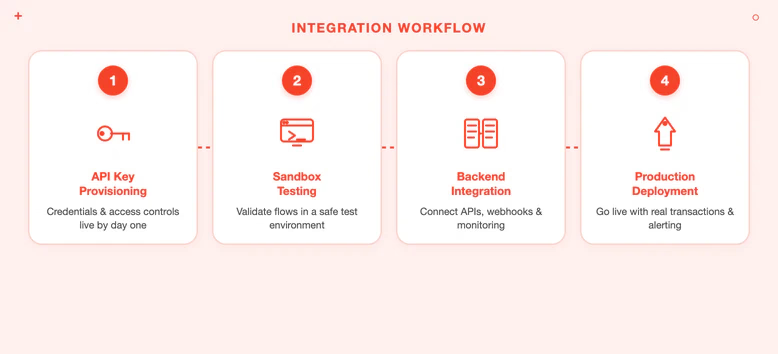
A production-ready WaaS integration follows a predictable four-step pattern. Each step has a defined action and an expected outcome, so you can estimate timelines and allocate engineering resources accurately.
- API key provisioning. Sign up, receive credentials, and set access controls (IP allowlists, role-based permissions) so your development team can use the sandbox securely. Expected outcome: working API credentials and admin access by end of day one.
- Sandbox testing. Validate wallet creation, deposit detection, withdrawals, and webhook behavior in a safe test environment. Use unique memos or tags to map test deposits to specific users. Expected outcome: all core flows tested end-to-end within the first week.
- Backend integration. Connect APIs to your application, configure webhooks with callback URLs, implement idempotency and retry logic on withdrawal endpoints, and set up logging and monitoring. Expected outcome: code-complete integration that passes internal QA.
- Production deployment. Go live with real transactions, enable alerting for failures and latency, validate reconciliation against on-chain data, and confirm reporting exports hit accounting. Expected outcome: first production transactions within two to four weeks of kickoff.
Common WaaS Pricing Structures
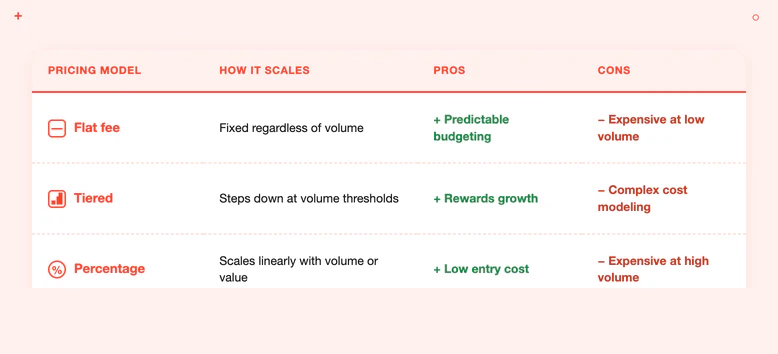
Pricing varies significantly across providers, and understanding fee mechanics upfront prevents budget surprises at volume. Most WaaS pricing includes four components:
- Setup fees: one-time integration or onboarding charges.
- Monthly platform fees: fixed subscription for platform access.
- Per-transaction fees: charged per incoming or outgoing transaction, sometimes with different rates for each direction.
- Gas and network fees: blockchain gas passed through, plus any spread or conversion fees if fiat settlement is involved.
B2BINPAY publishes its fee schedule openly , applies a single commission per transaction, and doesn't apply chargebacks on crypto payments, which removes a category of unpredictable cost common in card-rail processing. Before committing to any WaaS provider, request a detailed fee schedule and model total cost against your expected transaction volume, chain mix, and average transaction sizes.
Migration Tips to Preserve User Experience
Migrating between WaaS providers or from an in-house wallet stack creates risk for user flows. A bad migration loses deposits, breaks withdrawals, or forces users to update addresses. Plan carefully.
- Communicate changes early and clearly. Give users and internal teams lead time so nothing catches anyone off guard.
- Maintain address compatibility where possible. B2BINPAY's address duplication (BEP20/ERC20, Polygon, Avalanche sharing a common address) can reduce user error significantly during migration.
- Run parallel systems during transition. Keep old and new infrastructure active, route new users to the new stack, and phase out the old one gradually.
- Stress-test deposits, withdrawals, and webhooks. Load-test with realistic volumes before cutover, not after.
- Create fallback procedures. Document support escalation paths and have an operational playbook for the first 30 days post-migration.
Move Forward With a Trusted WaaS Partner
WaaS turns crypto wallet infrastructure from a build project into an integration. The decision points that matter are the custody model (custodial, non-custodial, or MPC), the provider evaluation checklist (security, fees, documentation, SLAs), and the integration workflow (credentials, sandbox, backend, production). Get those right and you ship faster with less operational risk.
B2BINPAY is regulated, non-custodial WaaS for businesses that want full key control, 350+ supported assets, transparent fee tiers, and an API-first integration built for developers. If cost predictability, multi-chain coverage, and real operational support matter to your team, B2BINPAY is a strong fit.
Frequently Asked Questions about WaaS
How do WaaS providers handle lost keys and wallet recovery?
Recovery depends on the custody model. Custodial providers typically manage recovery internally, while non-custodial and MPC setups rely on encrypted backups, defined recovery procedures, or key-shard reconstitution to restore access. Custodial models offer simpler recovery but introduce counterparty risk, while non-custodial and MPC trade recovery complexity for stronger sovereignty. Evaluate recovery procedures as part of provider selection using the checklist above.
Can I use wallet-as-a-service for both crypto and fiat?
Most WaaS products focus on crypto wallets, but some providers also support fiat settlement or conversion alongside crypto wallet infrastructure. Businesses that need both should evaluate whether a provider offers integrated settlement or requires separate payment rails. B2BINPAY supports crypto-to-fiat conversion as part of its broader regulated payment platform, removing the need to stitch together two vendors.
What compliance responsibilities remain on my side when using WaaS?
Even if a WaaS provider offers security controls and compliance tooling, your business remains responsible for meeting regulatory requirements in the jurisdictions where you operate. Providers typically offer KYT and AML screening and reporting tools, but you're still accountable for KYC on end users and for following local licensing rules. Compliance obligations vary by business model and geography, so consult legal counsel to confirm your specific requirements.
How long does WaaS integration typically take?
A basic integration can take a few days with strong documentation and a clear scope, while a full production rollout with custom workflows, reconciliation, and compliance checks often takes two to four weeks. Integration time depends on API complexity, existing system architecture, and the level of customization required. Providers with robust sandbox environments and "By Developers for Developers" documentation (like B2BINPAY's approach) can accelerate timelines meaningfully.
What is the difference between wallet-as-a-service and a payment gateway?
WaaS provides wallet infrastructure for storing, receiving, and sending assets, while a payment gateway focuses on checkout transaction processing. Some providers offer both as part of a broader payments stack, which simplifies integration for businesses that need both wallet and payment capabilities. B2BINPAY offers both WaaS and payment gateway functionality, letting businesses manage wallets and process payments through a single regulated platform.
Can off-chain settlement be combined with on-chain audits?
Yes, some setups support off-chain transfers for speed and cost while anchoring or reconciling activity against on-chain transactions to support auditability and compliance reporting. This hybrid approach reduces gas costs and improves transaction speed while maintaining transparency and regulatory traceability.
Subscribe to our channel so as not to miss new publications
SubscribeWallet as a Service — Enterprise
Merchant Wallet
Accept Crypto. Settle Fiat.
Seamless checkout for Forex, iGaming & e-commerce. Auto-convert 70+ tokens to USD/EUR — zero volatility risk.
70+
Currencies
0.25%
Min Fee
0%
Reserve
Enterprise Wallet
Automate Treasury. Cut Manual Work.
Real on-chain wallets with auto-sweeping, auto-payouts, and AML built in. Built for institutional scale.
350+
Currencies
20+
Blockchains
24/7
Support
DeFi App
Non-Custodial On-Chain Payments.
Audited multisig invoicing for DeFi teams. You own your keys, you control your funds. Free UI tier.
8+
Chains
Free
UI Tier
Multisig
Security
Crypto Payment Gateway
Ready to Protect Your Margin?
Join 983+ businesses that use B2BinPay to eliminate payment friction, stop account freezes, and settle in fiat — instantly.
Create an account- Onboarding in <24 hours
- 0% Rolling Reserve
- Regulated VASP · El Salvador

Subscribe
Join our community and stay tuned for the latest news. No spam, unsubscribe anytime
Thank you! Your submission has been received!