



How a White Label Crypto Payment Gateway Drives ROI

Businesses that accept crypto payments face a straightforward build-versus-buy decision: spend $50,000 to $100,000 and six to twelve months constructing payment infrastructure from scratch, or deploy a white-label solution and go live in two to six weeks. The financial case is obvious, but the ROI calculation goes further than upfront cost savings.
White-label gateways unlock two active revenue levers that a custom-built system doesn't automatically provide: fee mark-up income from sub-merchants and the faster revenue capture that comes from compressing time-to-market by months.
This article breaks down both levers, maps the real cost structure (including the hidden fees that erode margins), identifies the essential features that protect your ROI over time, and walks through the launch workflow step by step.
The goal is a complete picture for payment operations managers, CFOs, and platform builders evaluating whether a white-label crypto payment gateway is the right infrastructure decision.
Key Takeaways
- A white label crypto payment gateway lets you offer branded crypto payment acceptance without building the underlying infrastructure — reducing time-to-market from 6–12 months to 2–6 weeks.
- Fee mark-up revenue is the primary income lever: charge sub-merchants 0.75–1% while paying 0.25–0.40% at the provider level, capturing the spread on every transaction.
- Total cost of ownership includes setup fees, licensing, per-transaction processing fees, network fees, and potential FX spreads — evaluate all four before signing a provider agreement.
- Features that directly protect ROI: 350+ asset support, auto-conversion to fiat, KYT/AML screening, unique deposit address generation, and off-chain transaction rails for high-volume flows.
- B2BINPAY's white-label solution includes 0% rolling reserve, flat 0.25–0.40% processing fee, automated KYT, and a full sandbox — designed for regulated industry deployment.
What Is a White Label Crypto Payment Gateway?
A white label crypto payment gateway is a pre-built payment processing platform that a business deploys under its own brand. The underlying infrastructure — blockchain monitoring, deposit address generation, asset conversion, KYT/AML compliance, and API integration — is provided and maintained by the technology vendor. The deploying business handles branding, sub-merchant relationships, and fee configuration.
Understanding what a payment gateway is and how it works is the prerequisite for evaluating white-label options accurately. The distinction matters because not all white-label products cover the full payment stack: some provide checkout widgets only, while others, like B2BINPAY's white-label solution , include enterprise wallet infrastructure, multi-chain support, and compliance tooling.
The contrast with open-source payment gateway alternatives is also relevant. Open-source solutions offer code transparency but require your team to handle security patching, compliance updates, and infrastructure maintenance indefinitely. A white-label arrangement shifts that operational burden to the vendor, freeing your team to focus on product and revenue.
How White Labeling Creates New Revenue Streams
White-label gateways generate revenue through two mechanisms: direct fee income from transactions and earlier market entry that converts to accumulated revenue over time.
Margin From Fee Mark-Ups
Every white-label deployment sits between the infrastructure provider and the end merchants or users. That position creates a spread: the provider charges you a base processing fee, and you charge your sub-merchants a higher rate. The difference is revenue.
At B2BINPAY's 0.25–0.40% flat processing rate, a platform charging its sub-merchants 1% captures 0.60–0.75% on every transaction. At $1 million monthly volume, that spread generates $6,000–$7,500 in monthly fee income without any additional operational cost. At $5 million volume, the same spread yields $30,000–$37,500 per month.
The key constraint is transparency: sub-merchants compare rates across providers, so setting your mark-up requires knowing the market benchmarks. Standard market rates run from 0.5% to 1% for most providers, with some charging above 1%. A low base fee at the infrastructure level — like B2BINPAY's 0.25–0.40% — creates the widest viable spread while remaining price-competitive with sub-merchants.
Sub-merchant account management capabilities matter here. Platforms that allow per-merchant fee configurations independently give you the flexibility to implement tiered pricing structures: lower rates for high-volume sub-merchants, standard rates for smaller ones. This is a revenue optimization feature, not a compliance requirement, but it compounds materially as your sub-merchant base grows.
Faster Market Capture With Ready Infrastructure
Building a crypto payment gateway from scratch means your development team spends months on compliance integration (KYC/KYB flows, AML monitoring), bank connectivity for fiat settlement, security auditing, and PCI DSS certification — before processing a single payment. According to finon.tech's build-versus-buy analysis, the minimum realistic timeline is six to twelve months.
White-label deployment compresses this to two to six weeks. TechStory reports that fintech platforms using white-label gateways typically go live in four to six weeks, with some integrations completing in two. That gap — four to ten months of earlier revenue — is the speed-to-market ROI that cost comparisons often omit.
For a Forex broker adding crypto deposit capability, or an iGaming platform expanding payment options, four months of earlier acceptance translates directly into player deposits, trading volumes, and retention metrics that compounding models show accumulate significantly over a multi-year product lifecycle.
Cost Structure and Hidden Fees to Watch
ROI calculations break down when total cost of ownership is underestimated. White-label gateway costs have four components, and only the first is typically disclosed upfront.
Setup and Licensing Expenses
Entry-level white-label deployments start at $10,000–$15,000 for basic branded solutions, with full enterprise implementations typically ranging from $20,000 to $50,000. Setup costs typically cover API integration work, branding configuration, and initial compliance documentation. Some providers bundle setup into the licensing model; others charge it separately.
Licensing structures vary: monthly SaaS fees, annual license agreements, or revenue-share arrangements. Understand the exit terms — minimum contract lengths and cancellation penalties affect the ROI horizon, particularly if your transaction volume ramps slowly.
Per-Transaction Processing Fees
The per-transaction fee is the most visible cost but rarely the only one. Network fees, conversion spreads, and rolling reserves all affect realized margin.
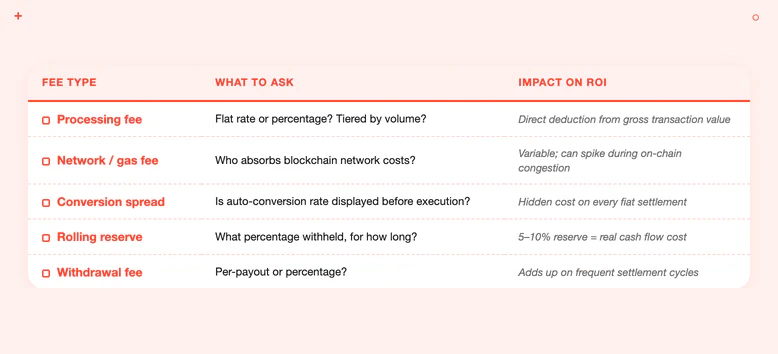
Rolling reserve deserves specific attention. Providers that withhold 5–10% of monthly transaction volume as fraud protection tie up working capital that isn't visible in headline fee comparisons. B2BINPAY operates with 0% rolling reserve — all converted proceeds are immediately available — which materially improves cash flow versus providers with standard reserve requirements.
Essential Features That Protect Your ROI
Not all white-label gateway features are equal from an ROI perspective. These are the capabilities that directly affect margin, conversion rates, and operational overhead:
- 350+ supported cryptocurrencies across 20+ blockchains — broader asset support means fewer declined transactions and wider customer reach; limiting to BTC and ETH leaves a growing share of crypto users unsupported
- Auto-conversion to fiat or stablecoins — converts incoming crypto to USD or EUR at point of receipt, eliminating volatility exposure between payment and settlement
- Automated KYT and AML screening — compliance checks run on every incoming transaction without manual review; clean transactions process instantly; flagged transactions queue for review without blocking clean flow
- Unique deposit address per order — eliminates address reuse errors that generate manual reconciliation tickets; each payment matches automatically; critical for high-volume platforms processing thousands of transactions monthly
- Off-chain transaction rails — reduces or eliminates network fees for transfers between supported wallets; relevant for platforms with internal transfer volumes
- Real-time dashboard and reporting — transaction monitoring, volume reporting, and reconciliation exports that accounting teams can use without manual data aggregation
- Sandbox API environment — test the full payment, conversion, and webhook flow in a replica of production before go-live; reduces integration errors that create post-launch ops work
Step-by-Step Launch Workflow
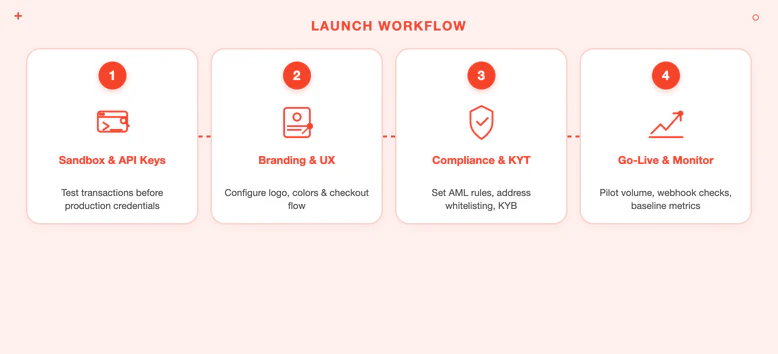
Platforms deploying a white-label gateway follow a consistent workflow regardless of provider. Each stage has specific actions that determine whether go-live is clean or delayed.
Sandbox and API Key Configuration
Start with sandbox access before touching production credentials. Configure your API keys, set up webhook endpoints for payment confirmation events, and run test transactions across the asset types you intend to support. Confirm that conversion rates, fee calculations, and payment status callbacks all behave as documented. A full sandbox that replicates production configuration — not a simplified test environment — is the only way to validate the complete payment flow without risk.
Checkout Branding and UX Testing
Configure your branded payment page: logo, color scheme, supported asset display, and network selection prompts. Network selection is a critical UX element — unclear prompts for multi-chain tokens like USDT (which exists on Ethereum, TRON, and other networks) generate wrong-chain payments that require manual recovery. Test the full checkout flow from the customer perspective across desktop and mobile before production.
Compliance Sign-Off and KYT Settings
Configure KYT screening thresholds, AML monitoring rules, and address whitelisting for outbound payments. Set role-based access permissions so operations staff have the minimum access their function requires. Verify that your KYB documentation is complete and approved before processing any live volume — KYB reviews that complete mid-operation create processing interruptions.
For platforms operating in regulated industries accepting crypto payments, compliance sign-off is a launch gate, not a post-launch task.
Go-Live Monitoring and Reporting
Run a pilot volume — real transactions at low scale — before full migration. Monitor the payment confirmation flow, conversion rate execution, fiat settlement timing, and reconciliation report accuracy. Confirm webhook reliability: missed payment confirmations create support tickets that cost more to resolve than the underlying transaction value. Establish baseline metrics in the first week to enable anomaly detection as volume scales.
Checklist for Evaluating a White Label Payment Gateway Provider
Selecting the wrong provider is the most common ROI error in white-label deployments. The checklist below maps evaluation criteria to the specific mistakes they prevent.
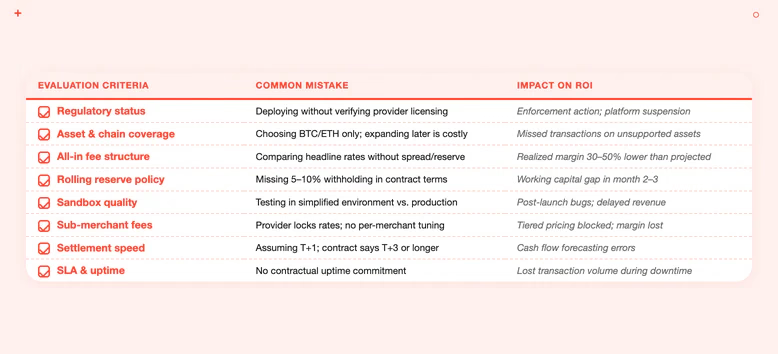
Regulatory status (VASP, MSB, or equivalent): A common mistake is assuming compliance responsibilities are shared automatically and deploying without verifying the provider’s licensing status. The impact on ROI can include regulatory enforcement actions or even platform suspension.
Asset and chain coverage: Many businesses choose a gateway that only supports BTC and ETH, underestimating how expensive it becomes to add new chains later. This can result in missed transactions from customers using unsupported assets.
Fee structure (all-in): Comparing only headline processing rates without reviewing conversion spreads and rolling reserve requirements is a frequent mistake. The result is realized margins that can end up 30–50% lower than projected.
Rolling reserve policy: Some platforms overlook 5–10% withholding clauses hidden in contract terms. This creates unexpected working capital gaps within the first few months of operation.
Sandbox environment quality: Testing in a simplified or limited sandbox environment instead of a production-replica setup often leads to integration discrepancies. The consequence is post-launch bugs and delayed revenue generation.
Sub-merchant fee configuration: Providers that lock fee structures and don’t allow per-merchant customization prevent platforms from implementing tiered pricing strategies. This limits margin optimization opportunities.
Settlement speed: Assuming settlements occur on a T+1 basis when the contract actually specifies T+3 or longer creates inaccurate cash flow planning. The result can be operational shortfalls and forecasting errors.
SLA and uptime guarantees: Operating without contractual uptime commitments exposes platforms to unexpected outages. Downtime directly impacts transaction volume, customer trust, and ultimately revenue.
Common Mistakes That Erode Profit
These are the most frequent errors platforms make after deploying a white-label gateway — each with a specific mitigation.
- Setting mark-up rates without benchmarking competitors — sub-merchants comparison shop; rates above market drive churn. Research current market rates before finalizing your pricing tier.
- Underestimating reconciliation load — platforms that don't configure unique deposit addresses per order spend 2–5% of operations time on manual payment matching. Address this in configuration, not post-launch.
- Treating the rolling reserve as theoretical — 5–10% of monthly volume is real capital withheld for 90–180 days. Model this in your cash flow projections before signing.
- Delaying KYB completion — providers that complete KYB post-deposit create processing holds. Complete verification as a prerequisite, not a parallel track.
- Skipping network fee analysis by chain — Ethereum gas fees during peak congestion can equal or exceed the processing fee on small transactions. Route high-frequency, small-value transactions to lower-fee chains (TRON, Polygon) or off-chain rails where available.
- Using a single wallet address across multiple customers — beyond the reconciliation failure risk, address reuse creates privacy and AML exposure. Unique-per-order address generation is not optional.
Accelerate Growth With a Branded Crypto Gateway
White-label deployment is the ROI-optimal path for platforms that need to add crypto payment capability without absorbing 6–12 months of infrastructure development cost. The revenue mechanics are concrete: fee mark-up spreads on sub-merchant volume generate income from day one, and four to ten months of earlier market entry compounds over the product lifecycle in ways that spreadsheet models consistently understate.
The risk to that ROI sits in provider selection — specifically, in the hidden cost variables that compress realized margin below projected margin. Zero rolling reserve, transparent all-in fee schedules, unique deposit address generation, and automated KYT screening are the features that protect margin over time, not just at launch.
B2BINPAY's white-label crypto payment solution is built for regulated industry deployment: 350+ supported cryptocurrencies, 0.25–0.40% flat processing fee, 0% rolling reserve, automated KYT/AML on every transaction, and a full production-replica sandbox for pre-launch testing. Sub-merchant fee configuration is available for PSPs and platforms managing merchant portfolios. Onboarding completes in under 24 hours.
Frequently Asked Questions about White Label Payment Gateway
How long does white-label gateway integration typically take?
Most platforms complete integration in one to four weeks. Basic API configuration and sandbox testing typically take three to five business days for an experienced developer team. Full production deployment — including KYB verification, compliance configuration, and branding — typically takes two to four weeks depending on documentation readiness and customization scope. B2BINPAY onboards in under 24 hours for account setup, with a full sandbox available immediately for integration work.
Can I set my own processing fees for sub-merchants?
Yes. White-label deployments allow you to configure your own fee schedule for sub-merchants independently of the base processing rate you pay the infrastructure provider. The spread between your provider's fee and your sub-merchant charge is your revenue on each transaction. B2BINPAY supports per-merchant fee configuration for PSPs and platforms managing sub-merchant portfolios.
What happens to payment flow during blockchain congestion?
Network congestion on Ethereum or Bitcoin increases gas fees and can extend confirmation times. Mitigation options: routing transactions to lower-fee chains (TRON, Polygon), using Layer 2 solutions like Lightning Network for Bitcoin, batching outbound payouts, or using off-chain transaction rails where the gateway supports transfers between internal wallets without on-chain settlement. B2BINPAY supports off-chain transfers between supported wallets, eliminating network fees for qualifying internal transaction flows.
Do I need my own virtual asset service provider licence to operate a white-label gateway?
Licensing requirements depend on your jurisdiction and business model. In many jurisdictions, operating as a reseller or PSP under a licensed provider's infrastructure allows you to offer crypto payment services without a direct VASP licence — but this varies significantly by country. B2BINPAY holds regulated VASP authorization in El Salvador and operates under applicable regulatory frameworks. Your legal counsel should confirm the specific requirements for your jurisdiction and customer base before go-live.
Subscribe to our channel so as not to miss new publications
SubscribeWallet as a Service — Enterprise
Merchant Wallet
Accept Crypto. Settle Fiat.
Seamless checkout for Forex, iGaming & e-commerce. Auto-convert 70+ tokens to USD/EUR — zero volatility risk.
70+
Currencies
0.25%
Min Fee
0%
Reserve
Enterprise Wallet
Automate Treasury. Cut Manual Work.
Real on-chain wallets with auto-sweeping, auto-payouts, and AML built in. Built for institutional scale.
350+
Currencies
20+
Blockchains
24/7
Support
DeFi App
Non-Custodial On-Chain Payments.
Audited multisig invoicing for DeFi teams. You own your keys, you control your funds. Free UI tier.
8+
Chains
Free
UI Tier
Multisig
Security
Crypto Payment Gateway
Ready to Protect Your Margin?
Join 983+ businesses that use B2BinPay to eliminate payment friction, stop account freezes, and settle in fiat — instantly.
Create an account- Onboarding in <24 hours
- 0% Rolling Reserve
- Regulated VASP · El Salvador



Subscribe
Join our community and stay tuned for the latest news. No spam, unsubscribe anytime
Thank you! Your submission has been received!