


The crypto landscape is notorious for its degree of freedom and anonymity. Numerous users are attracted to digital payment methods to avoid unnecessary central authorities and needless third-party intervention. However, too much anonymity and freedom can lead to an increase in illegal activities.
Malicious individuals will always use the available channels to conduct harmful practices, including money laundering, white-collar crime or serious scams that involve human trafficking. Crypto companies should implement KYC and AML procedures to prevent such undesirable outcomes. Today, we will discuss the nature of KYC protocols, where to acquire robust KYC solutions and which KYC providers are the most reliable.
Understanding the Know-Your-Customer Concept
[[aa-cta]]
Compliance Suite
Real-Time KYT on Every Transaction
Every payment processed through B2BINPAY is screened against Crystal and Chainalysis risk databases in real time. Flag, review, or block high-risk transactions automatically — before they settle.
[[/a]]
Know-your-customer (KYC) procedures are often mandatory parts of the broader anti-money laundering guidelines. The KYC processes ensure that companies know their customers well and can vouch for their legitimacy. As a result, companies can be sure that their clients are not endangering the organisation's stakeholders inside and outside of the business.
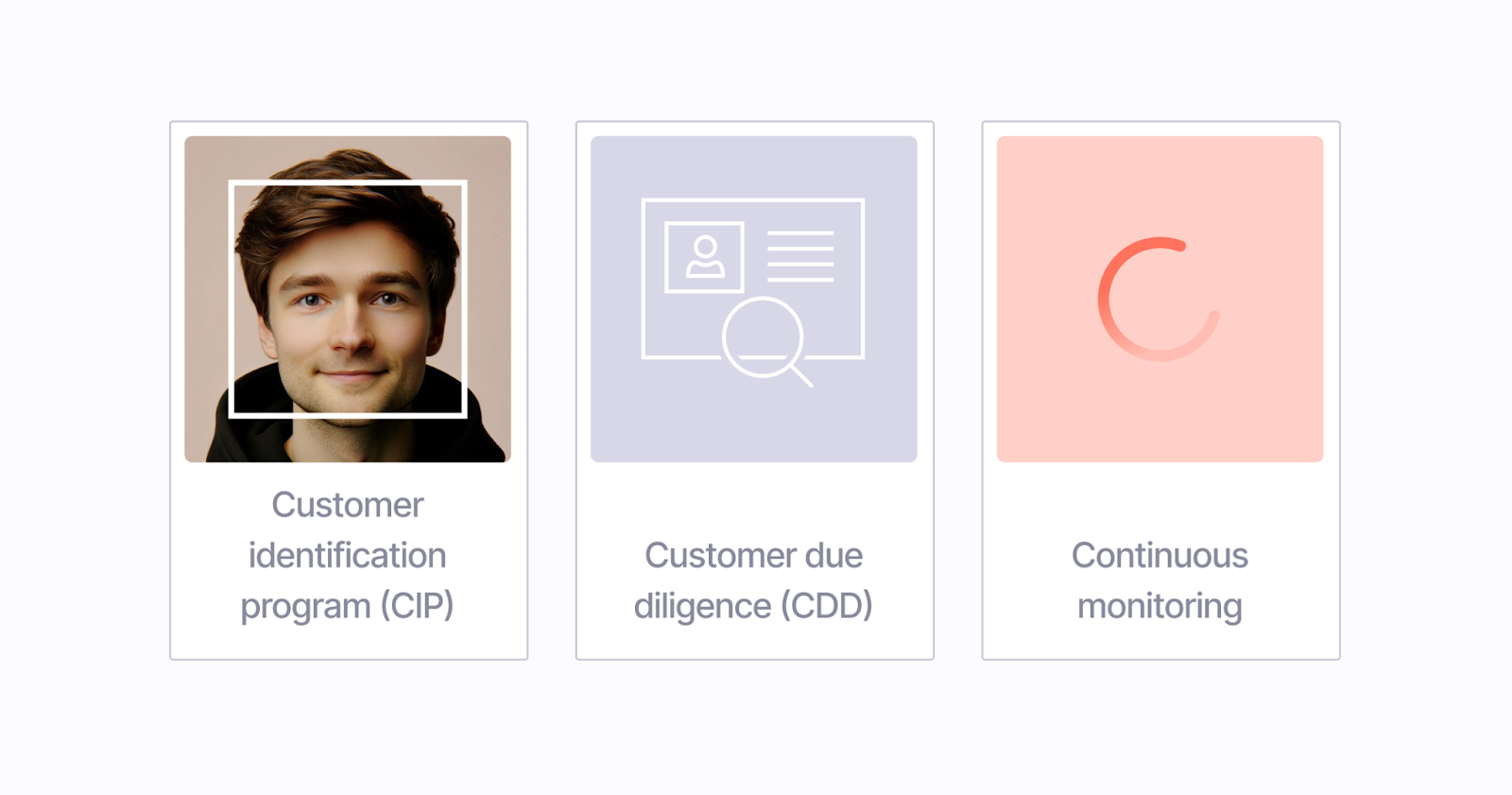
While the KYC and AML guidelines are not mandatory in every country or market, their international presence is growing every year.
For example, most financial institutions must verify customer data per the KYC guidelines of their relevant jurisdictions. Other industries are also joining the financial companies to increase their defence against malicious entities and money laundering threats.
Understanding the Know-Your-Customer Concept
Know-Your-Customer (KYC) actually is a mandatory legal requirement. It is the operational process of verifying that your customers are who they claim to be before they can access your financial services.
The goal is undestandable: to comply with global Anti-Money Laundering (AML) and counter-terrorism financing (CTF) laws. Regulators. and more importantly, your banking partners, demand that you prove you are not facilitating illicit activity. It's your primary defense against being used for financial crime.
In the crypto industry, this is especially critical. The inherent pseudonymity of wallet addresses is a direct challenge to these regulations. Therefore, any legitimate exchange or financial service must collect and validate real-world identity documents. A robust KYC process is not an optional extra for growth. It is the absolute, non-negotiable cost of entry for operating a legal and bankable financial service.
Identity Verification Process in KYC Solutions
KYC software consists of several important components. The most important are identity verification services that validate the customer profiles. The identity of customers can be verified in several ways, including simple ID document verification, address checks and even biometric authentication.
The extent of identity verification depends on the relevant regional laws and the company's decision. If there are no required KYC guidelines in your country, there are no objective answers to which verification checks you should implement. It all depends on the company structure, the number of customers, and other important factors.
Types of Identity Verification Services
There's no universal formula for verifying identity in crypto—and that's kind of the point. Depending on your product and your regulatory obligations, KYC can be as simple as uploading an ID or as layered as biometric scans, video calls, and geolocation checks.
Most crypto platforms start with the basics: government-issued ID plus a selfie or quick liveness check. It's fast, familiar, and meets the minimum standard in most jurisdictions. But when fraud risk is higher, or when local laws demand more, KYC can involve address verification, database lookups, phone validation, and face match technology.
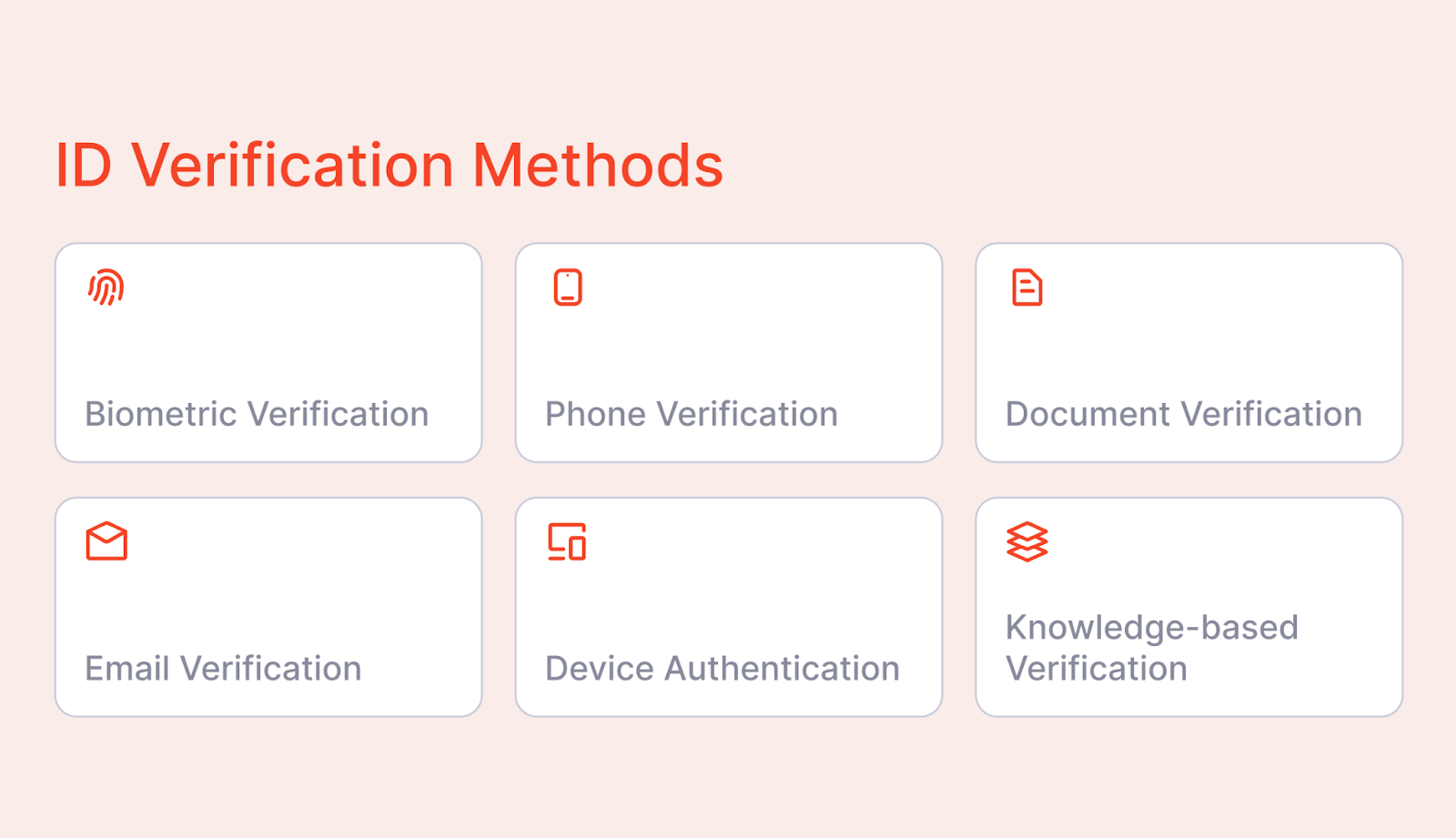
Some providers go beyond user-facing steps. They scan for duplicate accounts, compare document metadata, and flag unusual behavior in real time. Others layer in AML tools, cross-referencing users against global sanctions lists and politically exposed person (PEP) databases.
It's up to the business to decide how far to go. A high-volume exchange might want speed with automated checks, while a custody provider may opt for stricter validation. The best setups balance trust and conversion—tight where they need to be, but not so strict that they turn away real users.
AML Monitoring and Checklists
While not strictly a part of the KYC guideline steps, the anti-money laundering (AML) regulations are also critical for organisations that seek fraud prevention. AML practices go hand-in-hand with KYC, allowing companies to check the validity of financial transactions swiftly. In many cases, white-collar crime and money laundering are conducted by verified customers.
At first, they earn the trust of companies by submitting legitimate information and conducting lawful transactions. Once the KYC protocols are satisfied, the malicious parties execute fraudulent transactions.
AML practices prevent this from happening through extensive transaction checks. Each transaction deviation from the norm must go through AML evaluations. This way, malicious parties cannot sneak in money laundering attempts or other fraudulent activities.
Does KYC Affect Anonymity and Decentralization?
KYC and anonymity are fundamentally incompatible. One demands identity; the other rejects it. There is no philosophical middle ground where both coexist.
This isn't an internal debate the crypto industry is having for fun. It is a non-negotiable demand from global regulators and, more importantly, from the banking partners that provide access to the fiat world. Their anti-money laundering requirements are absolute. This external pressure is forcing decentralized platforms, once seen as permissionless, to face a hard choice: integrate kyc crypto compliance or be isolated.
The industry's response is to find a technical compromise. This is where privacy-preserving technologies like zero-knowledge proofs come in. The goal is to create a system that can prove a user has been verified by a trusted party, without revealing the user's actual personal data to the platform they're interacting with.
This is the likely future: a hybrid. The original, purist vision of total anonymity will be sacrificed in exchange for mainstream adoption and regulatory peace. Decentralization of the infrastructure may survive, but it will be accessed through a compliant identity layer.
What are KYC Rules for Crypto Wallets
Naturally, the KYC for crypto wallets is more relaxed and less intrusive to not limit the freedom of cryptocurrency transactions. However, after many cases of fraud, white-collar crime and other illegal activities, crypto wallet providers have started to partner with crypto KYC providers.
In most cases, crypto wallets require a simple identification check to match the provided ID with the wallet account information. This is a minimum requirement for the KYC guidelines, and most wallets have already implemented this basic verification.
Is KYC for Crypto Exchanges Any Different?
Crypto exchanges employ similar KYC procedures but are required to retrieve slightly more customer information. Typically, they must obtain a legal name, official address, birthdate and an ID verification number from each customer. After that, crypto exchanges must run several checks to verify the existence and legitimacy of each customer.
While this protocol goes against the complete anonymity and decentralisation of Blockchain methodology, it is a necessary precaution to prevent numerous money laundering attempts and other white-collar crimes.
Top KYC/AML Providers You Should Consider in 2026
Choosing a KYC/AML provider in 2026 is a foundational business decision. With regulatory enforcement intensifying worldwide, your compliance partner is now a critical point of operational success or failure.
The old model of simple document verification is obsolete. A professional-grade solution today is an integrated risk-management engine. It must, at a minimum, combine biometric liveness checks, real-time sanctions screening, and ongoing transaction monitoring into a single, coherent workflow.
What separates top-tier vendors is adaptability. Whether you're a DeFi protocol, a centralized exchange, or a Web3 wallet service, the leading providers have identity verification tools that can scale with your risk model and region-specific compliance needs.
Below, we break down three standout options in the current market—each offering a slightly different take on crypto compliance, but all built for serious growth.
SolidProof
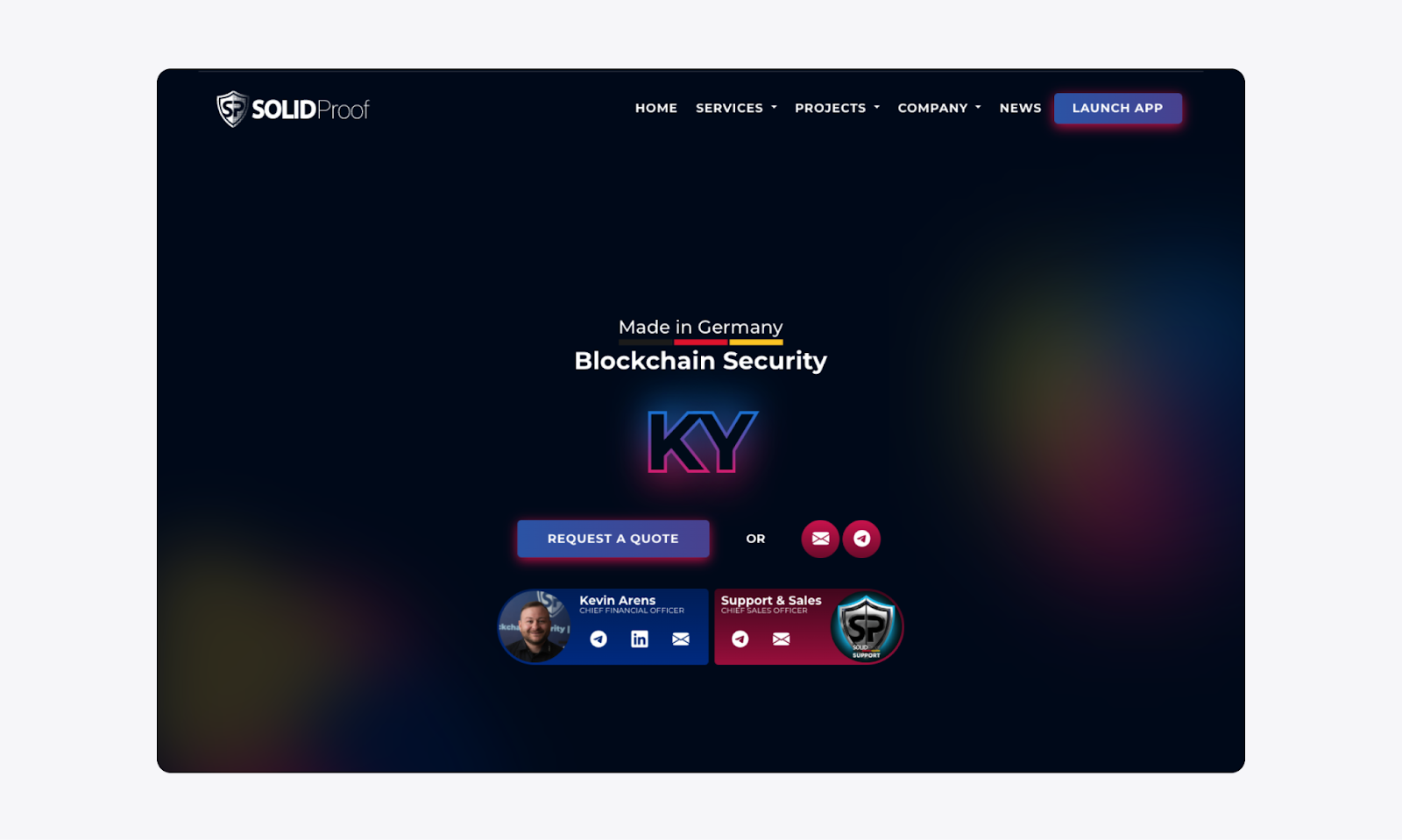
SolidProof is a go-to KYC provider for modern crypto projects and companies, delivering a seamless KYC service that doesn't disrupt the normal company workflow. SolidProof has a diverse selection of identity verification options, from simple ID checks to complex biometric scans.
However, SolidProof does not provide reactive services to clients. Instead, this company aims to identify vulnerabilities within your current client verification process and give you guidelines on how to fix them. SolidProof is developing a prototype software that automates the search for potential weaknesses in the client's business processes.
Identity.com
[[aa-note]]
KYT (Know Your Transaction) differs from KYC in that it evaluates the risk profile of the transaction itself — looking at source of funds, wallet history, and counterparty exposure — rather than just the user's identity.
[[/a]]
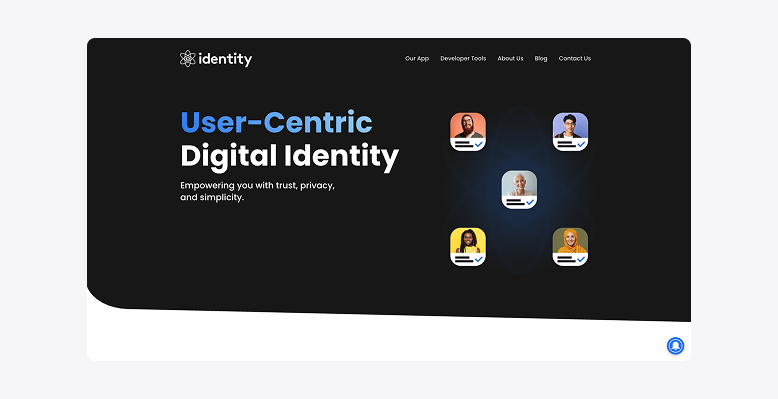
Coming in as a close second choice for an industry-leading KYC solution is identity.com. This project aims to combine the best of both worlds and merge the KYC protocols into a decentralised blockchain environment.
As a result, users can go through a verification process on-chain and without any centralised permissions. So, the entire authentication will be conducted swiftly and without endangering sensitive customer information. Identity.com is an open-source project that can be integrated into most existing blockchain networks.
Chainanalysis
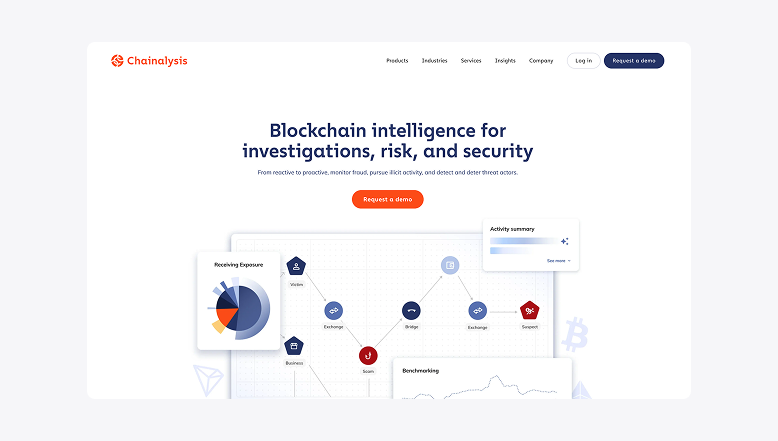
Chainanalysis is an established name in the blockchain industry, starting off as a blockchain data platform. Today, Chainanalysis offers a comprehensive package of cybersecurity, KYC and AML solutions for crypto projects. Their robust security solutions are great for just about any crypto company since they ensure full-stop protection against most crypto threats.
Chainanalysis helps clients investigate questionable transactions and users. They are also adept at incident response and recovery of lost crypto funds. Finally, Chainanalysis offers a comprehensive training course for all crypto professionals to deepen their knowledge about crypto security and crime prevention.
Chainanalysis is an excellent choice for emerging crypto startups to hit the ground running and implement the best-possible KYC/AML practices for their unique needs.
How to Choose a KYC Provider? Checklist of Critical Features
Not all KYC solutions are built the same—especially in crypto. The right kyc provider should do more than just verify identities; it should fit your business model, scale with your user base, and meet the compliance standards of every market you operate in. Below, we've outlined five critical areas to evaluate before making a decision.
Compliance Expertise
The global landscape in 2026 is a complex minefield of non-negotiable rules. A provider must demonstrate deep, practical knowledge of how to navigate this patchwork. This means understanding not just the EU's MiCA framework, but also the fragmented, enforcement-led environment in the U.S. under the Bank Secrecy Act. Furthermore, they must have a robust, working solution for the FATF Travel Rule. Ask them to show you, in detail, how their system handles the required data-sharing for transactions across different jurisdictions. A provider who gives a vague answer on this is not a serious player. This kind of multi-regional expertise is the absolute baseline; it is not a premium feature.
Flexibility and Customization
Rigid onboarding flows are obsolete. Modern identity verification is a flexible, risk-based system. The baseline is document validation and a liveness check. A professional platform must be modular, applying advanced layers like biometric scans only to high-risk users. This balances security with user experience.
Pay-as-you-go Pricing
KYC costs can scale quickly—especially if you're onboarding thousands of users a month. That's why pay-as-you-go pricing has become the preferred model for most crypto businesses. It lets you align costs with actual usage, avoiding bloated retainers or high upfront fees. The best providers offer transparent pricing tiers, clear per-check costs, and volume-based discounts. If your KYC vendor makes pricing hard to understand, that's a red flag.
Global Coverage
The real test is document recognition. Can their system instantly validate a national ID card from India, a driver's license from Brazil, and a passport from a European nation?
Many providers excel in Western markets but fail completely when processing document formats from Asia, Latin America, or Africa. This failure results in high drop-off rates from legitimate customers during onboarding. You must demand a specific list of supported countries and, more importantly, the types of documents they can process from each. This is a fundamental technical requirement, not a simple feature.
Technology Stack
Your KYC provider's tech stack is now your core infrastructure. The API must be stable and well-documented; a bad API will break your onboarding flow. The tech must include instant document validation, accurate biometrics, and 'passive liveness' detection. It also needs machine learning to reduce false positives, which otherwise bury you in manual review.
Final Takeaway
In 2026 KYC and AML are no longer up for debate. They are a core, non-negotiable component of any serious financial operation. Regulators demand it, and your banking partners will not do business with you without it.
The compliance technology ecosystem has matured to meet this demand. A professional-grade solution must combine biometric liveness, document validation, and real-time monitoring into a single, reliable workflow.
Choosing the right provider is a critical infrastructure decision. It will directly impact your operational viability, your user's onboarding experience, and the long-term survival of your business in a regulated environment.
FAQ
What is KYC for Crypto? (Know Your Customer)
KYC, or "Know Your Customer," is the mandatory process of verifying a user's real-world identity. It's the part of onboarding where a financial service collects and validates your government ID, proof of address, and often biometric data. Its entire purpose is to comply with Anti-Money Laundering (AML) regulations and stop fraud.
Is KYC mandatory for crypto businesses?
In any regulated jurisdiction, yes. The moment a crypto business touches the traditional financial system (like offering fiat conversions), it is legally required to perform KYC. It's a non-negotiable part of modern financial regulation.
What are key KYC compliance requirements?
It's a three-part process: 1) Verify a user's identity (ID, address, liveness). 2) Screen them against global sanctions and PEP (Politically Exposed Persons) lists. 3) Conduct ongoing transaction monitoring to detect and report suspicious activity. This isn't optional.
Is KYC safe in crypto?
This depends entirely on the provider. A professional KYC service uses strong encryption, secure APIs, and data minimization. However, the responsibility is on the business to vet its provider's security and data handling. Trust must be verified.
How does automated KYC improve onboarding?
It's about speed and scale. Automation replaces a slow, error-prone manual review process with near-instant verification. This reduces friction for good customers, allowing a platform to scale its user base without its compliance costs exploding.
What are the risks of not implementing KYC?
The risks are existential. You face massive regulatory fines, but the more immediate danger is the loss of your banking partners. Without a bank, your business is operationally dead. It's an unacceptable risk for any serious company.
Which certification is best for AML KYC?
There isn't one single certification. You're looking for a portfolio of proof. For technical security, demand a SOC 2 Type II audit and ISO/IEC 27001 certification. For data privacy, GDPR compliance is a must. For regulation, ensure they hold the required licenses, like a VASP registration.
[[aa-cta-grey]]
Merchant Wallet
Flat-Fee Crypto Payments That Scale
B2BINPAY charges a flat 0.25–0.40% per transaction regardless of volume. No percentage markups, no monthly fees, no withdrawal charges. The more you process, the more you save compared to card rails.
[[/a]]
Is KYC Sure legit?
KYC Sure is an active vendor in the market. As with any critical infrastructure provider, you must conduct your own due diligence. Verify their certifications, audit their data policies, and assess their technical capabilities before committing to an integration.

.svg)