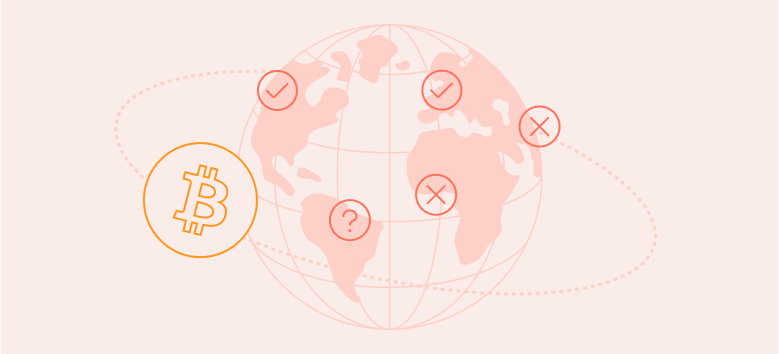


The legal status of Bitcoin depends on the country. In some states, it’s both legal to own and use as payment. In others, it’s legal to hold but restricted as payment. And in a few, it’s banned outright.
Below is a breakdown of where Bitcoin stands legally around the world, as of 2025.
[[aa-cta]]
Crypto Payments Gateway
Accept Bitcoin Where It’s Legal
B2BINPAY helps businesses accept Bitcoin and 350+ cryptocurrencies globally with full compliance and fiat settlement.
[[/a]]
Countries Where Bitcoin is Legal
Most of the major economies treat Bitcoin as legal property that can be bought, sold, held, and used for payments. These include the United States, Canada, the European Union member states, the United Kingdom, Australia, Japan, and South Korea. Switzerland and Singapore are known for crypto-friendly regulations.
In these jurisdictions, Bitcoin is treated as an asset or commodity for tax purposes. Capital gains taxes typically apply when you sell, trade, or use Bitcoin. Some countries also impose income tax on Bitcoin received as payment.
Bitcoin has legal tender status in El Salvador (since 2021), meaning merchants must accept it as payment. No other sovereign nation has done this as of early 2025.
Countries Where Bitcoin is Restricted
Some countries allow holding Bitcoin but restrict its use as payment or limit exchange activity:
- China banned cryptocurrency trading and mining in 2021 but hasn’t made holding Bitcoin explicitly illegal
- India taxes crypto at 30% with a 1% TDS (Tax Deducted at Source) on transactions; it’s legal but heavily taxed
- Indonesia permits trading on licensed exchanges but prohibits using Bitcoin as payment
- Russia restricts crypto as a payment method for goods and services, though holding it is permitted
- Turkey permits Bitcoin trading but restricts its use for payments
Countries Where Bitcoin is Banned
A small number of countries have banned cryptocurrency entirely or near-entirely:
[[aa-cta-blue]]
Enterprise Wallet
Manage Bitcoin Payments Across Borders
Handle Bitcoin payments and treasury across different regulatory environments with B2BINPAY’s Enterprise Wallet.
[[/a]]
- Algeria: illegal to buy, sell, use, or hold
- Bangladesh: illegal
- Bolivia: banned since 2014 (with some regulatory changes over time)
- Egypt: Islamic law-based rulings have led to restrictions
- Morocco: prohibited
- Nepal: banned cryptocurrency trading
These are minority cases globally. The majority of countries have moved toward regulation rather than prohibition.
Businesses Accepting Bitcoin
In jurisdictions where Bitcoin is legal, businesses that accept it must handle the tax and accounting implications of receiving cryptocurrency as payment. The value of Bitcoin at the time of the transaction typically counts as revenue. Capital gains treatment may apply when the business later sells the Bitcoin.
[[aa-note]]
For businesses looking to accept Bitcoin payments, B2BINPAY provides a payment gateway that handles address generation, transaction monitoring, and optional auto-conversion to stablecoins or fiat to manage price exposure. It supports Bitcoin alongside 350+ other cryptocurrencies.
[[/a]]
Summary
Bitcoin is legal to own and use in most major economies. El Salvador is the only country with Bitcoin as legal tender. Some countries permit holding while restricting payment use. A small number of countries have outright bans. The global trend is toward regulation and taxation rather than prohibition.

.svg)