


Crypto invoices need tracking, reconciliation, and settlement control, not just a wallet address pasted into an email. For finance teams running high-volume operations, the gap between a checkout button and a proper invoicing system is the difference between clean books and a treasury headache.
This guide is built for regulated, high-volume businesses comparing infrastructure: merchants, brokers, and platform operators that cannot tolerate manual treasury work or compliance gaps. We focus on invoicing workflows rather than generic gateway features, with a stablecoin-first, cross-border, B2B perspective throughout.
Key Takeaways
- The best crypto invoicing platforms create trackable on-chain payment requests that can simplify reconciliation and B2B settlement workflows.
- Stablecoin invoicing in USDT or USDC has become the practical default because it can reduce volatility during the payment window.
- Buyers should assess asset coverage, fiat settlement options, compliance controls, and API or white-label flexibility before committing.
- In regulated and high-volume sectors, a crypto invoicing platform is most valuable when it supports AML, KYT, and structured payment tracking.
- Comparing B2BINPAY, Gilded Finance, NOWPayments, CoinGate, and BitPay helps merchants match invoicing features to their settlement and operational needs.
What Makes a Crypto Invoicing Platform Different From a Payment Gateway
A crypto invoicing platform is structured payment-request software that issues invoices, tracks their status on-chain, and feeds confirmed payments into reconciliation and accounting systems. A payment gateway, by contrast, handles checkout flows, hosted buttons, and merchant acquiring at the point of sale. Both touch crypto, but they solve different finance problems.
Most SERP results conflate the two. That is a category mistake for mid-funnel buyers who already accept crypto and now need invoice creation, payment tracking, and reconciliation workflows tied to specific customers, amounts, and accounting records. A gateway routes a payment; an invoicing platform tells finance which client paid, when, on which network, and against which open invoice.
B2B settlement rarely begins with a shopping cart. It begins with a payment request sent to a counterparty, often with terms, an expiry window, and a settlement-asset choice. Finance teams need that request to map cleanly back into the ERP and the bank reconciliation file. For a side-by-side view of how invoicing diverges from broader processing rails, see this crypto payment gateway comparison.
[[aa-cta]]
Ready to issue trackable, reconciliation-ready crypto invoices?
Open an account and start sending USDT and USDC invoices with full audit trails.
[[/a]]
Key Criteria for Evaluating Crypto Invoicing Platforms
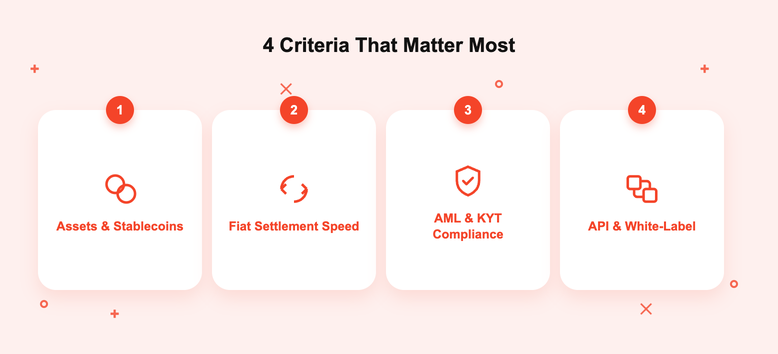
Platform choice affects treasury control, compliance exposure, and customer conversion in equal measure. A useful short framework groups criteria into four dimensions: assets, settlement, compliance, and integration. This mirrors how buyers in regulated verticals shortlist tools and fixes a recurring SERP gap where competitor lists drop into specs without explaining what those specs mean for treasury or audit work.
Supported Assets and Stablecoin Coverage
Native support for BTC, ETH, USDT, and USDC across efficient networks is the baseline. Examine network choice (Ethereum, Tron, BNB Chain, Polygon, Solana), token breadth, and whether the platform routes payments to network-specific addresses so customers cannot send USDT-TRC20 to a USDT-ERC20 address by accident.
Stablecoin invoicing typically drives B2B volume because counterparties want predictable settlement value during the payment window. Broader asset support matters more for customer acquisition across regions and verticals.
Fiat Settlement Speed and Auto-Conversion
CFOs care about when cash arrives, not which coins were accepted. Evaluate how quickly each platform converts received crypto into fiat or stablecoins, what conversion logic applies, and whether the platform locks an invoice amount in fiat so the counterparty bears the volatility risk.
Stablecoin-based invoicing can settle faster than traditional cross-border methods because the on-chain transfer clears within minutes rather than days. Auto-conversion lowers operational risk by removing the manual trading step finance teams would otherwise run on every inbound payment.
Compliance Infrastructure: AML, KYT, and MiCA
Regulated buyers need screening, audit trails, and escalation processes before they need another checkout widget. AML, KYT, KYC, and KYB controls determine whether the platform belongs in a forex broker's, iGaming operator's, or fintech's compliance program at all.
MiCA is now a live buying criterion for European merchants, brokers, and fintechs rather than a legal footnote. Platforms that publish their licensing entity, jurisdiction, and supervisor make compliance reviews materially shorter.
API Integration and White-Label Capability
API maturity, webhooks, sandbox access, and callback reliability decide whether invoicing fits existing ERPs, payment flows, and treasury systems. Look for documented sandbox environments, idempotent callbacks, and signature verification on every webhook.
White-label capability matters for brokers, wallets, and platforms that need branded invoicing without building on-chain infrastructure from scratch. A white-label layer lets the operator stay the customer-facing brand while the platform handles wallets, blockchain monitoring, and compliance plumbing underneath.
[[aa-cta]]
Need infrastructure that meets all four criteria in one stack?
B2BINPAY combines 350+ assets, T+1 fiat settlement, AML/KYT screening, and a documented API.
[[/a]]
Best Crypto Invoicing Platforms for Global Merchants
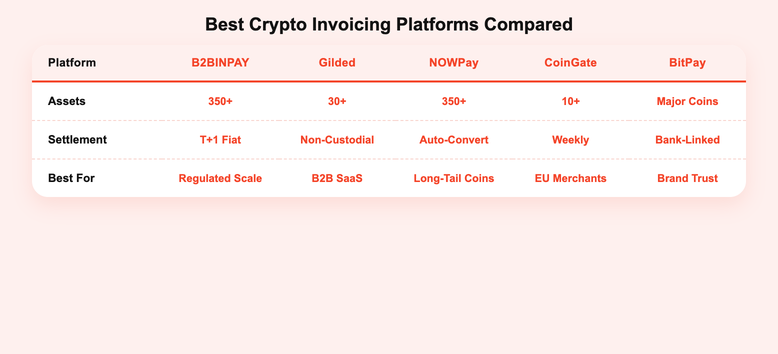
No single platform fits every merchant. Settlement and compliance needs vary widely across verticals, so a comparison of operating models is more useful than a flattened fee table. The five platforms below use the same review template: target user, invoicing strengths, settlement model, compliance posture, and notable tradeoffs.
B2BINPAY
B2BINPAY is regulated crypto payment infrastructure for merchants and operators that need on-chain invoicing, reconciliation, fiat settlement, and broader payment operations in one stack. It serves forex brokers, iGaming operators, prop firms, crypto exchanges, and high-volume cross-border merchants.
Operational differentiators include 350+ supported currencies, automatic conversion to stablecoins for volatility protection, AML and KYT screening on every transaction, and no rolling reserve. Fees scale with volume: incoming coins 0.25–0.40%, tokens 0.35–0.50%, outgoing 0%, with fiat withdrawals via SWIFT (0.50%, €20 minimum) and SEPA (0.50%, €10 minimum). Crypto settlement is immediate; fiat settles T+1.
Compliance is anchored in two licensed entities: B2BINPAY EL SALVADOR S.A. DE C.V. (CNAD PSAD plus Central Reserve Bank PSB, supervised by the SSF) and B2BINPAY MAURITIUS LTD (FSC VASP licence GB24203002). By 2025, B2BINPAY processed $5.1B in incoming volume across 6.7M transactions for 983 business customers. The tradeoff: B2BINPAY is built for infrastructure depth, so single-person shops and pure freelancers may find lighter tools easier to onboard.
Gilded Finance
Gilded Finance is invoicing-first software for B2B teams that need recurring invoices, accounting links, and stablecoin-friendly settlement. The product accepts payment in 30+ tokens including BTC, ETH, and stablecoins, with native sync to QuickBooks Online, NetSuite, and Xero.
Gilded is fully non-custodial, meaning the platform never holds customer funds, which suits agencies, SaaS vendors, and service firms. The tradeoff is scope: Gilded does not position itself as compliance infrastructure for regulated verticals, and the non-custodial model means finance teams handle their own treasury rather than receiving consolidated fiat settlement.
NOWPayments
NOWPayments is a broad merchant gateway with invoice features, useful for flexible coin acceptance across long-tail tokens. Public pricing lists 0.5% for mono-currency payments and 1% for conversions, with 350+ supported coins and 75+ fiat options.
The platform reports 30M+ monthly transactions and serves casinos, iGaming, e-commerce, SaaS, marketplaces, and payroll. Plugin breadth is an advantage for merchants wanting a single tool for checkout buttons, mass payouts, and basic invoicing. The tradeoff is feature sprawl: buyers focused on enterprise invoicing workflows with strict reconciliation and KYB controls may find a treasury-centered stack better aligned with their finance operating model.
CoinGate
CoinGate blends payment processing and invoicing for European merchants that value coin support and visible regulatory positioning. The billing product lets businesses send crypto bills via email or link, schedule recurring invoices, and settle in crypto, stablecoins, or EUR/GBP/USD with real-time FX conversion.
CoinGate operates under MiCA authorization in Lithuania (codes LB002323 and LB002324), simplifying compliance review for EU buyers. Standard plan fees are 1% per transaction, with weekly settlement, free SEPA withdrawals, and a 0.50% SWIFT fee (€50 minimum). The tradeoff: CoinGate supports 10+ crypto assets, narrower than some competitors, which may not fit high-volume operators with broader currency requirements.
BitPay
BitPay is an established processor with strong brand recognition, particularly for businesses prioritizing familiarity and bank-linked settlement. The Email Billing feature handles invoicing, and merchants can settle in local currency (USD, EUR, GBP, CAD, AUD, NZD, MXN), cryptocurrency, or a combination.
Fees follow a volume-tiered structure: 2% + $0.25 under $500K monthly, 1.5% + $0.25 from $500K to $1M, and 1% + $0.25 beyond $1M, with higher fees applied to high-risk industries that can affect iGaming. The tradeoff for this query is depth: BitPay supports a curated list of major assets (BTC, BCH, ETH, DOGE, LTC, XRP, plus several stablecoins) rather than long-tail coverage, and places less emphasis on white-label, on-chain, or infrastructure-grade invoicing customization than B2B-focused alternatives.
Stop forcing your finance team to reconcile crypto manually. Move trackable, compliance-ready invoices into B2BINPAY at app.b2binpay.com.
Why Stablecoin Invoicing Has Become the Default for B2B Settlement
Stablecoins have become the practical default for B2B crypto invoices because buyers want predictable settlement value, not speculative exposure. When an invoice carries a 24 to 72 hour payment window, even a 2% intraday move in BTC can wipe out the merchant's margin or trigger a dispute over the settled amount.
USDT and USDC fit cross-border treasury workflows for three reasons. They simplify pricing, since the invoice and the settlement value match. They shorten settlement windows compared with SWIFT, which can take three to five business days for the same route. And they reduce accounting noise for finance teams because the inbound amount equals the booked revenue without a conversion adjustment.
Platforms that auto-convert volatile assets into USDT or USDC at the moment of payment let merchants accept broad coin lists without taking the volatility risk back onto their own balance sheet.
Crypto Invoicing for High-Volume and Regulated Industries
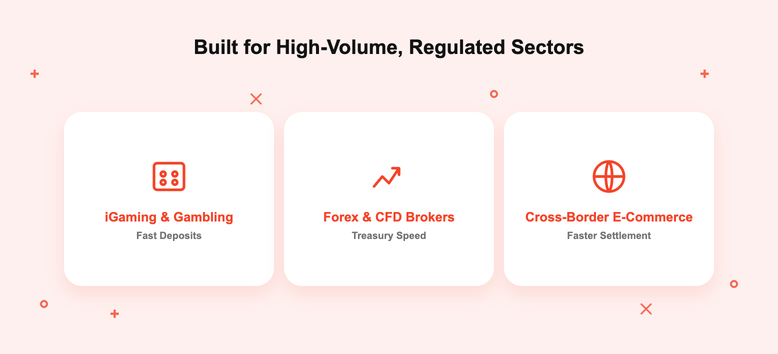
Industry context changes platform requirements. High-risk and regulated sectors need invoicing tied to compliance, settlement control, and operational resilience, not just a wallet integration. The verticals below share three traits: payout-heavy operations, cross-border client acquisition, and limited or expensive access to card rails.
iGaming and Gambling Operators
Operators need fast deposits, clear source-of-funds controls, and reliable settlement because card acquiring may be restricted, expensive, or subject to chargeback risk. White-label checkout, KYT screening on every transaction, and stablecoin settlement work as practical differentiators for this segment. A regulated platform with auto-conversion to USDT or USDC also removes the treasury risk of holding volatile assets between settlement runs.
Forex and CFD Brokers
Brokers need treasury speed, multi-asset support, and reconciliation that maps cleanly into trading back offices and reporting layers. Client funding via crypto invoice should land in the broker's wallet, get auto-converted if required, and trigger a callback that credits the trading account without manual intervention. API control, confirmation settings, and callback logic are high-value features for brokers automating deposits.
E-Commerce and Cross-Border Merchants
For merchants selling internationally, invoice links, auto-conversion, and faster settlement are central where bank transfers are slow or card fees are punitive. A clear payment-status view, customer-specific addresses, and consolidated reporting reduce the operational overhead of managing crypto inflows alongside card and bank channels. CFO-level cost and compliance considerations are covered in this look at the ecommerce crypto payment decision.
Choose the Right Crypto Invoicing Infrastructure Before Your Volume Scales
The decision underneath every shortlist is whether the infrastructure can reconcile, convert, and govern invoice flows before complexity compounds. Platforms chosen at $50K monthly volume often struggle at $5M monthly volume because their compliance, conversion, and reporting primitives were not built for that scale. Practical setup steps and processor selection considerations are covered in this guide to crypto payments for businesses.
[[aa-cta-blue]]
Need trackable on-chain invoicing with regulated settlement and finance-team-grade reporting?
Evaluate B2BINPAY against your current stack: become a client and run end-to-end test invoices in the fee-free sandbox before committing.
[[/a]]
Frequently Asked Questions about Crypto Invoicing Platforms
What makes a crypto invoicing platform different from a payment gateway?
A crypto invoicing platform creates structured payment requests, tracks status, and simplifies reconciliation, while a payment gateway is the broader rail for checkout and settlement. For B2B flows, invoicing platforms add invoice-level tracking, stablecoin support, and finance-friendly records instead of only showing wallet addresses.
Why are USDT and USDC the default choices for B2B crypto invoicing?
Stablecoin invoicing reduces exposure to price swings during the payment window, which matters when finance teams must forecast revenue, close books, and settle suppliers. It also supports faster cross-border settlement, and many platforms can auto-convert incoming funds to fiat or treasury assets without manual trading.
What features should you prioritize when comparing the best crypto invoicing platforms?
Start with supported assets, especially native USDT and USDC on efficient networks, then review fiat settlement speed, reconciliation tools, and recurring invoice support. Verify AML, KYT, and MiCA readiness, plus API quality if you need ERP sync, white-label delivery, or treasury automation.
How do you create a crypto invoice for B2B payments?
You define the amount due, choose the settlement asset, set an expiry window, and generate a payment link or dedicated address. Stronger platforms then monitor confirmations, update invoice status automatically, and push callbacks or exports into your accounting and back office systems. If you need non-custodial control, B2BINPAY DeFi App extends this flow with on-chain invoicing.
Which crypto invoicing platform is best for regulated or high-volume businesses?
The right choice is usually the platform that combines invoicing with compliance, fiat settlement, wallet infrastructure, and conversion tools in one stack. For teams that need KYT, API integration, white-label options, and treasury controls, B2BINPAY may fit better than invoicing-only tools, with the potential to reduce manual reconciliation as volume scales.
Disclaimer: The service has legal and jurisdiction limitations. Please check T&Cs on https://b2binpay.com/en/risk-disclaimer

.svg)


