



Every crypto payments decision reduces to one question: does your gateway only orchestrate payments, or does it also become your custodian? That distinction changes who carries fund-control risk, where compliance obligations land, and what happens if the provider has a bad week.
This comparison is for regulated businesses evaluating self-custody: forex brokers, prop firms, iGaming operators, crypto exchanges, and high-volume merchants — not hobbyist sellers seeking anonymous checkout tools. What follows is a practical breakdown across funds control, compliance, operations, multi-chain settlement, continuity, and integration.
Key Takeaways
- A non custodial payment gateway lets your business accept crypto while retaining control of private keys, so the provider monitors payments without taking possession of funds.
- Compared with custodial processors, the model can reduce counterparty exposure because settlements go directly to wallets your organisation controls.
- Most implementations rely on HD wallet derivation and unique deposit addresses to detect and reconcile payments without exposing signing keys.
- For regulated businesses, the architecture may narrow the custody-related regulatory perimeter, although AML, KYC, and transaction monitoring obligations remain.
- The main trade-off is operational. Fund control improves, but your team assumes more responsibility for key management and continuity.
What a Payment Gateway Actually Controls
A payment gateway is an orchestration layer: it creates invoices, assigns deposit addresses, watches the chain for confirmations, and fires callbacks into your finance stack. None of that requires owning private keys. Crypto rails settle directly on chain, so custody and orchestration can be cleanly separated.
The decision lens is three questions: who controls private keys, who receives funds first, and who carries freeze, insolvency, or licensing risk?
[[aa-cta]]
Ready to evaluate institutional-grade crypto payment infrastructure?
Talk to B2BINPAY about a managed integration
[[/a]]
How a Custodial Gateway Handles Your Funds
In a custodial setup, the provider receives customer funds into wallets it controls, then credits your merchant balance later. A third party sits between the customer payment and your account, holds the value, and releases it on a schedule.
Aggregated Balances and Periodic Settlement
Aggregated balances are omnibus custody. Customer payments land in shared provider infrastructure, while merchants see a dashboard balance reflecting an internal ledger entry, not a wallet they control. Settlement happens daily or weekly into a payout wallet.
This complicates treasury visibility, intraday liquidity planning, and invoice-level reconciliation. A broker matching client deposits to trade accounts in near real time gets less granular signal from a daily settlement file than from on-chain confirmations hitting addresses it already controls.
Counterparty Risk and What It Costs You
Counterparty risk is broader than hacks and insolvency. It includes account freezes during compliance reviews, reserve policies that lock part of your balance, payout windows that stretch during incidents, and exposure to the provider's regulatory standing. B2BINPAY's piece on what a custody service entails covers the dual-approval controls regulated custody adds on top of hot-wallet storage.
The hidden cost shows up as reserve drag, spread leakage on emergency conversions, manual support time, and the balance-sheet treatment of receivables you cannot move on demand.
How a Non-Custodial Gateway Handles Your Funds
A non-custodial gateway orchestrates payment flows, but funds move directly into merchant-controlled addresses. The provider never touches private keys or merchant balances, which materially changes counterparty and continuity risk.
There is no omnibus wallet and no payout schedule. For regulated operators, the architecture covers self-custody without forcing internal teams to build blockchain monitoring, callback infrastructure, and address management from scratch.
HD Wallet Derivation and Unique Address Generation
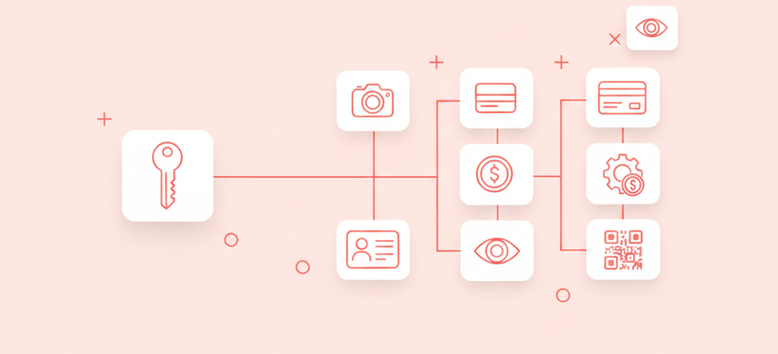
Hierarchical Deterministic wallets, defined in BIP-32, let one master seed generate a tree of keypairs. The extended public key (xpub) derives child public keys without exposing a private key. A gateway holding your xpub can create a fresh receiving address per invoice while signing authority stays with you.
Unique addresses simplify payment attribution to specific invoices, accurate callbacks into ERP or CRM systems, and clean support workflows when a customer claims to have paid the wrong address.
Payment Detection Without Key Exposure
Watch-only monitoring is the second half of the design. The gateway tracks mempool activity and confirmation depth for derived addresses, then sends status events to your callback URL when thresholds are crossed. It never signs a transaction because it never holds a private key.
Components worth evaluating include configurable confirmation thresholds per asset, tagged deposit events carrying invoice metadata, idempotent callbacks that survive retries, and a replayable event log for reconciliation.
The Compliance Difference: Regulatory Perimeter Reduction
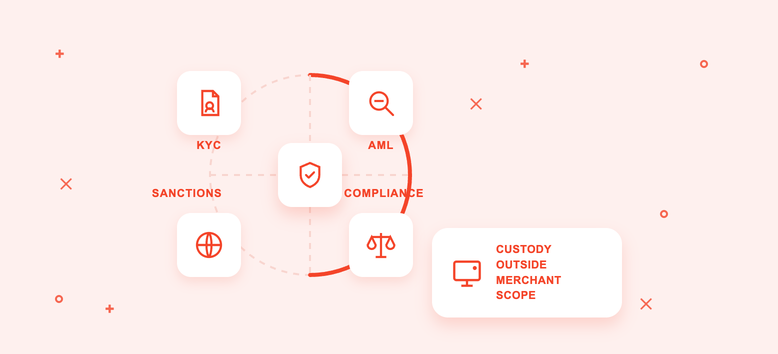
The real benefit of non-custodial design is regulatory perimeter reduction. Because the gateway does not hold client assets, its activity may sit outside licensing categories that apply to custodians. Under MiCA, Title V covers authorised crypto-asset service providers, and "custody and administration of crypto-assets on behalf of clients" triggers full CASP obligations.
Reduced perimeter is not zero perimeter. AML, KYC, KYT, sanctions screening, tax reporting, and recordkeeping still attach to the underlying business activity. FATF guidance on virtual assets treats anyone conducting covered activities as a VASP regardless of self-custody features. Classification is jurisdiction-specific, so validate with local counsel before launch.
The Operational Trade-Off: What Shifts to You
Non-custodial architecture removes provider custody risk but shifts operational responsibility inward: key governance, backup and recovery, withdrawal approval workflows, address whitelisting, key rotation policy, and an incident-response runbook.
The resolution most regulated businesses settle on is a managed model. Services such as B2BINPAY's Wallet as a Service abstract the blockchain plumbing while leaving control of withdrawal-signing keys with the merchant. You get the orchestration layer of a gateway and the control profile of self-custody.
[[aa-cta-grey]]
Want infrastructure that handles the chain plumbing without taking custody?
See how B2BINPAY's Wallet as a Service works
[[/a]]
Multi-Chain Settlement and Stablecoin Flows
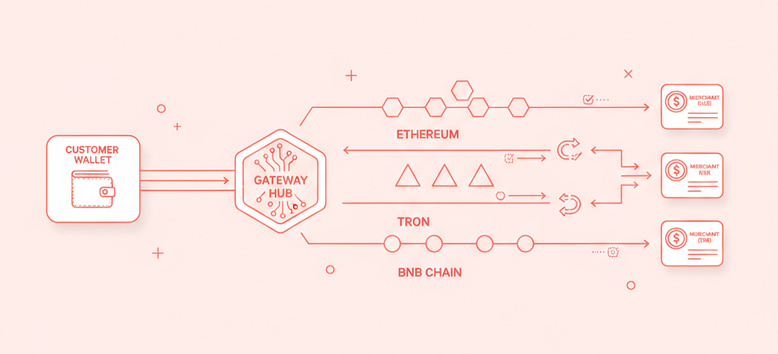
Real businesses rarely accept one asset on one chain. Institutional setups need USDT and USDC across Tron, Ethereum, BNB Chain, and increasingly Solana, plus BTC and ETH for higher-ticket flows. Chain choice is a finance decision: Tron fees are cents, Ethereum mainnet fees at peak load are dollars.
Three operational features matter: duplicate addresses across compatible EVM chains to reduce deposit user error, consolidated reporting joining on-chain events with invoice records, and immediate swap routing into USDT or USDC at settlement to contain volatility. B2BINPAY's payment processing layer supports 350+ currencies with auto-conversion to stablecoins at the moment of payment.
Business Continuity: What Happens If the Gateway Provider Shuts Down
If the provider disappears tomorrow, what happens to access, settlement, and historical payment data? With true non-custodial architecture, the answer is reassuring: merchants hold the keys, so provider failure does not equal fund loss. The wallet is yours; the chain still works.
What can still break are orchestration components: payment detection, invoice issuance, webhook delivery, dashboards, and the address index. Contingency planning should cover an export routine for invoice and address mappings, a documented fallback for payment detection, and an internal copy of the xpub-to-customer-ID map.
Self-Hosted vs. Managed Non-Custodial Gateways
Self-hosted versus managed is an operating-model decision. Self-hosted projects like BTCPay Server give maximum control and zero per-transaction fees, but your team runs the node, patches the stack, manages uptime, and handles incidents at 3 a.m. Managed gateways trade some autonomy for faster operations, support coverage, audit trails, and multi-chain orchestration.
Regulated businesses with uptime SLAs, compliance audits, and limited blockchain headcount usually land here. B2BINPAY's custody and orchestration products operate through regulated entities in El Salvador (CNAD PSAD, SSF supervised) and Mauritius (FSC VASP licence GB24203002), with KYT screening on every transaction.
Integration Architecture for Technical Decision-Makers
CTOs care about how cleanly a gateway plugs into checkout, treasury, ERP, CRM, and internal risk systems. The reference workflow runs invoice request, address derivation from your xpub, customer payment, confirmation watching, signed callback with invoice metadata, reconciliation matching, then conversion or payout routing.
Production-grade details include idempotent APIs, configurable confirmation thresholds per asset and amount tier, tagged callbacks that survive retries without double-crediting, sandbox access for end-to-end testing, and permissioned withdrawal controls. B2BINPAY's sandbox is fee-free.
[[aa-cta-blue]]
Building toward a regulated integration?
Open a B2BINPAY sandbox and review the API docs
[[/a]]
Choose the Model That Keeps You in Control and Keeps You Compliant
For regulated businesses, the verdict is usually a managed model with a non-custodial control profile: you keep key authority, narrow your custody-related regulatory perimeter, preserve continuity, and get the plumbing without a full self-hosted engineering bill.
B2BINPAY operates in that band, with $5.1B in processed incoming volume by 2025 across 6.7M transactions and 983 business customers, supporting both managed custody and merchant-controlled wallet flows. The next step for a forex brokerage, iGaming operator, or high-volume merchant is a working sandbox and a conversation with the integration team.
[[aa-cta]]
Start your B2BINPAY integration
[[/a]]
Frequently Asked Questions about Non-Custodial Payment Gateway
What is a non custodial payment gateway?
A non custodial payment gateway is software that creates invoices, assigns receiving addresses, and monitors confirmations without controlling your private keys or funds. Payments move directly from the customer wallet to addresses you control, so the provider orchestrates workflow rather than acting as a custodian. The model may reduce counterparty exposure and keep settlement logic inside existing treasury or ERP processes.
What is the difference between a custodial and non custodial payment gateway?
In a custodial model, the provider receives funds into wallets it controls and settles your balance later on a periodic schedule. In a non-custodial model, the gateway only detects and routes payments while keys and assets remain under your control. That difference affects counterparty risk, operational design, and how far your custody obligations extend under MiCA, FATF, and equivalent national rules.
Does a non custodial gateway ever hold my funds?
Properly designed non-custodial gateways should not hold funds at any point in the payment flow. They operate on your wallet infrastructure, often through HD wallet derivation or xpub-based address generation, to create unique payment addresses without signing authority. With a managed B2BINPAY integration such as Wallet as a Service, the orchestration layer never receives custody of merchant balances.
What are the compliance obligations when using a non custodial crypto gateway?
Non-custodial architecture may reduce your regulatory perimeter because you are not outsourcing control of client assets to the provider. It does not remove AML, KYC, KYT, sanctions-screening, tax, or recordkeeping duties for the underlying business activity. Clear wallet governance, transaction monitoring, and jurisdiction-specific legal review belong on your launch checklist regardless of gateway choice.
What happens if a non custodial gateway provider shuts down, do I lose my funds?
If the model is genuinely non-custodial, provider failure should not lock or confiscate assets because the private keys stay with you. What may break temporarily is payment detection, invoicing, callbacks, or reconciliation until you switch providers or activate a backup stack. When evaluating B2BINPAY or any managed solution, ask about data exportability, API fallback options, and your recovery plan before you sign.
Disclaimer: The service has legal and jurisdiction limitations. Please check T&Cs on https://b2binpay.com/en/risk-disclaimer

.svg)


