


The cryptocurrency market is evolving rapidly, with Bitcoin (BTC) leading the way. However, even as Bitcoin leads, many smaller tokens, known as alternative coins (altcoins), also account for sizable market movements.
There are phases where altcoins dominate the spotlight over Bitcoin. Given the abundance of altcoins across different blockchains, such phases present lucrative investment opportunities. A key tool to identify and latch onto this phase is known as the Altcoin Season Index. This guide will explain how this index works and how to leverage it to boost your crypto trades.
[[aa-cta]]
Crypto Payments Gateway
Accept Altcoins When the Season Peaks
B2BINPAY supports 350+ cryptocurrencies so your business can capitalize on every altcoin season surge.
[[/a]]
What is Altcoin season?
Altcoin season (altseason) is a period where alternative tokens, rather than BTC, lead growth in the crypto market. Precisely, it occurs when at least 75% of the top 50 altcoins outperform Bitcoin, the most widely used token, over a given period.
An altcoin season marks a shift in market sentiment, when investors focus more on alternative coins rather than BTC. Altcoins have smaller market capitalizations but have higher growth potential stemming from mass adoption and technological innovation. During an altseason, numerous opportunities arise for traders and investors to capitalize on.
The duration of an altseason varies. No one can precisely predict when it'll come and how long it will last, but you can follow clues to identify an imminent altseason and capitalize on it early.
Triggers for Altcoin season
Various factors can trigger an altcoin season, beginning with positive crypto market sentiment. This sentiment can be fueled by technological changes, endorsements from renowned figures, or increasing institutional interest. For example, in 2026, the crypto market has thrived because of traditional, non-crypto companies spending billions of dollars to acquire tokens. Many altcoins have thrived alongside the general crypto market.
Another example is the non-fungible token (NFT) trend of 2021. During this period, developers built many NFT-based apps and incorporated NFTs into traditional apps. This NFT trend drove up the price of many altcoins, although the market eventually cooled down. It's an example of technological advancement being a trigger for an altseason.
Generally, bullish sentiment, fuelled by technological, regulatory, and crypto market events, fuels altcoin seasons.
Key signs of an upcoming altcoin season
Several signs hint at an upcoming altcoin season. The most significant hint is a decline in BTC dominance, which is when Bitcoin's share of the total crypto market reduces while altcoins gain more market share. If BTC dominance declines sharply over a period, it's a good hint that an altcoin season is near the corner.
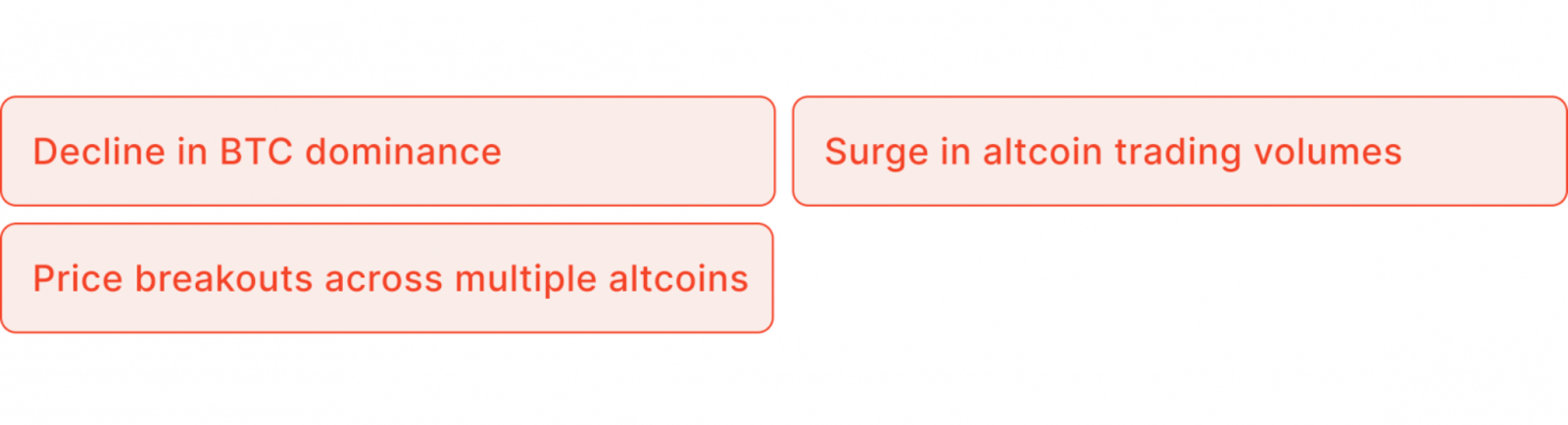
Another key sign is a surge in altcoin trading volumes. When altcoin trading volumes spike because of increased investor interest, it points to a potential altcoin season on the horizon. You can monitor trading volumes for popular altcoins to identify an imminent season and capitalize on it early. Likewise, monitor stablecoins like USDT and USDC, as their trading volumes often surge alongside altcoins.
The final sign is sudden price breakouts across multiple altcoins, particularly the most popular ones. These breakouts hint at a market transitioning into an altcoin season.
Notably, there are no definite triggers for an altcoin season. Rather, these are the most common signs that precede the season, so you should be on the lookout for them.
Historical overview of altcoin seasons
Altcoin seasons have been pivotal to the crypto market's history. Ever since Bitcoin was created in 2008 and spearheaded the crypto market, we've seen several periods of explosive growth, including for altcoins. An example is the 2017–2018 bull run, when Bitcoin's dominance fell from 86.3% to 38.69%, with altcoins taking the lead after a flood of initial coin offerings (ICOs) boosted interest in altcoins.
There was also the 2020-2021 bull run fueled by memecoins, NFTs, and global macroeconomic conditions that drove everyday investors to alternative assets like cryptocurrencies. During this relatively brief period, Bitcoin's dominance fell from 70% to 38%, while altcoin dominance rose to 62%.
These historical events illustrate the cryptocurrency market's cyclical nature, with several intervals where altcoins outperform Bitcoin, offering lucrative opportunities for traders.
Altcoin season vs. Bitcoin season
Bitcoin season and altcoin season are two distinct periods of the cryptocurrency market. For most periods, you're more likely to see a Bitcoin than an altcoin season. During a Bitcoin season, Bitcoin outperforms most altcoins, and institutional investors flock to it because of its reputation as a safe haven and the most widely used cryptocurrency.
Altcoin seasons are rarer but offer more outsized opportunities because of the abundant supply of small-cap altcoins that can explode in value. However, they also bring higher risks, as small-cap altcoins can fall just as dramatically as they can rise.
Both the Bitcoin and altcoin seasons play crucial roles in maintaining a healthy and relatively stable cryptocurrency market, with Bitcoin providing stability and altcoins providing growth opportunities.
What is the Altcoin Season Index, and how does it work?
The Altcoin Season Index (ASI) measures altcoins' relative performance to Bitcoin over a given period. It tracks the profitability of the top 50 altcoins compared to Bitcoin, giving investors a yardstick to identify sentiment shifts in the crypto market.
By tracking the ASI, investors can identify an imminent altcoin rise and increase their exposure to altcoins. If timed well, this strategy can bring considerable profits. The ASI is a key indicator of the state of the crypto market, so you can closely watch it to identify an imminent altcoin boom to capitalize on.
How can you calculate the Altcoin Season Index?
The Altcoin Season Index (ASI) is calculated based on the performance of altcoins relative to Bitcoin over a 90-day period. The goal is to determine which performs better and use that as a yardstick for general crypto market sentiment.
If 75% or more of the top 50 altcoins perform better than Bitcoin during a 90-day period, it firmly indicates an altcoin season. In contrast, if Bitcoin outperforms at least 75% of the top 50 altcoins, it indicates a Bitcoin season.
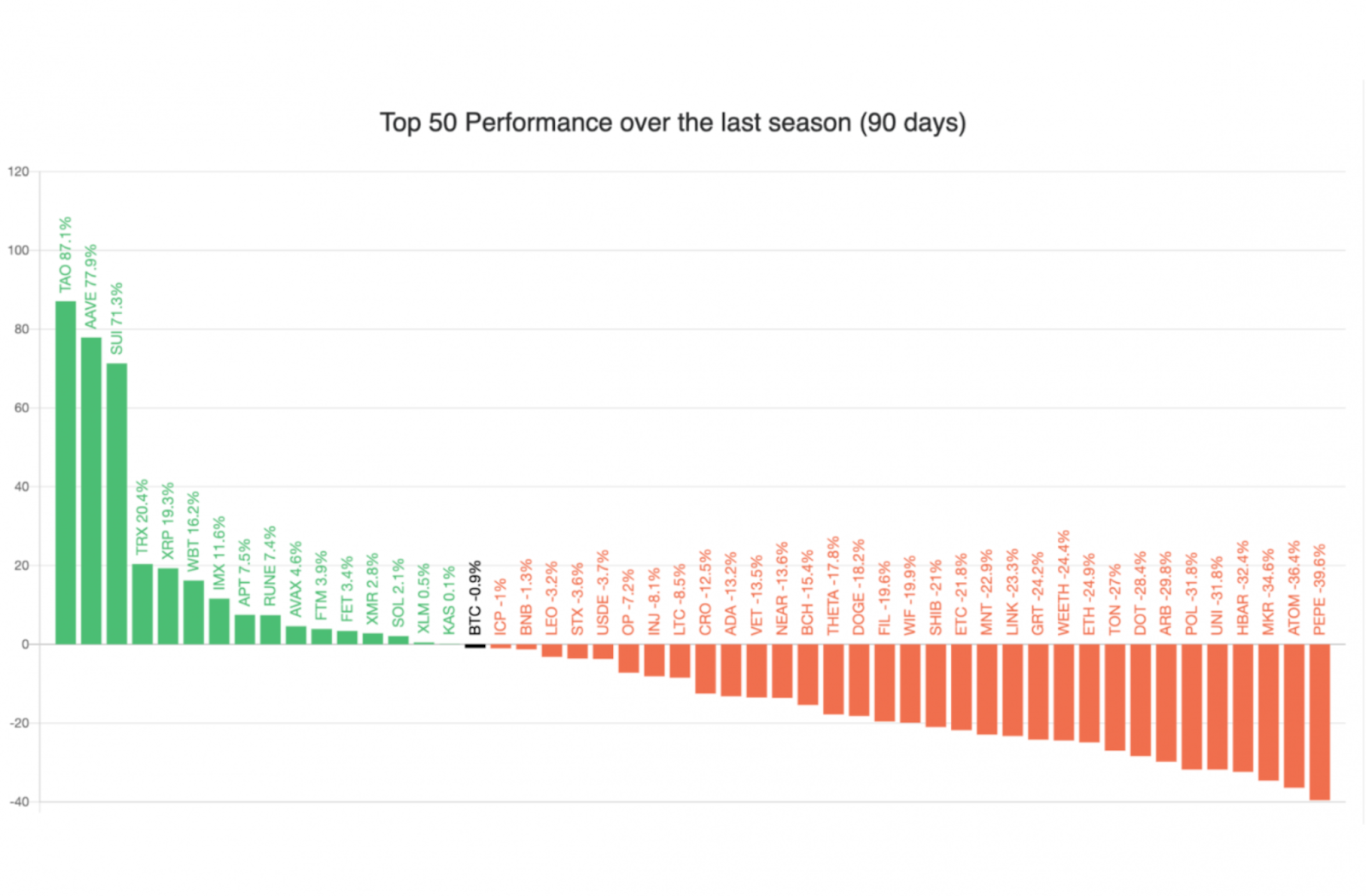
To perform this calculation, you can track the top 50 altcoins and gather their performance data from sites like CoinMarketCap. Then, you'll evaluate the performance of each top 50 altcoin compared to Bitcoin over the past 90 days. If at least 75% of the altcoins fare better than Bitcoin, it signals an altcoin season. The higher the percentage, the better the likelihood of altcoin dominance lasting longer.
By understanding how to calculate the Altcoin Season Index, it becomes easier to anticipate crypto market cycles and capitalize on them in the early stages.
How to interpret the Altcoin Season Index chart
Scouring through performance data for the top 50 altcoins and calculating the Altcoin Season Index (ASI) yourself is a stressful task. The best alternative is to simply look at an ASI chart to determine whether it's a Bitcoin or altcoin season.
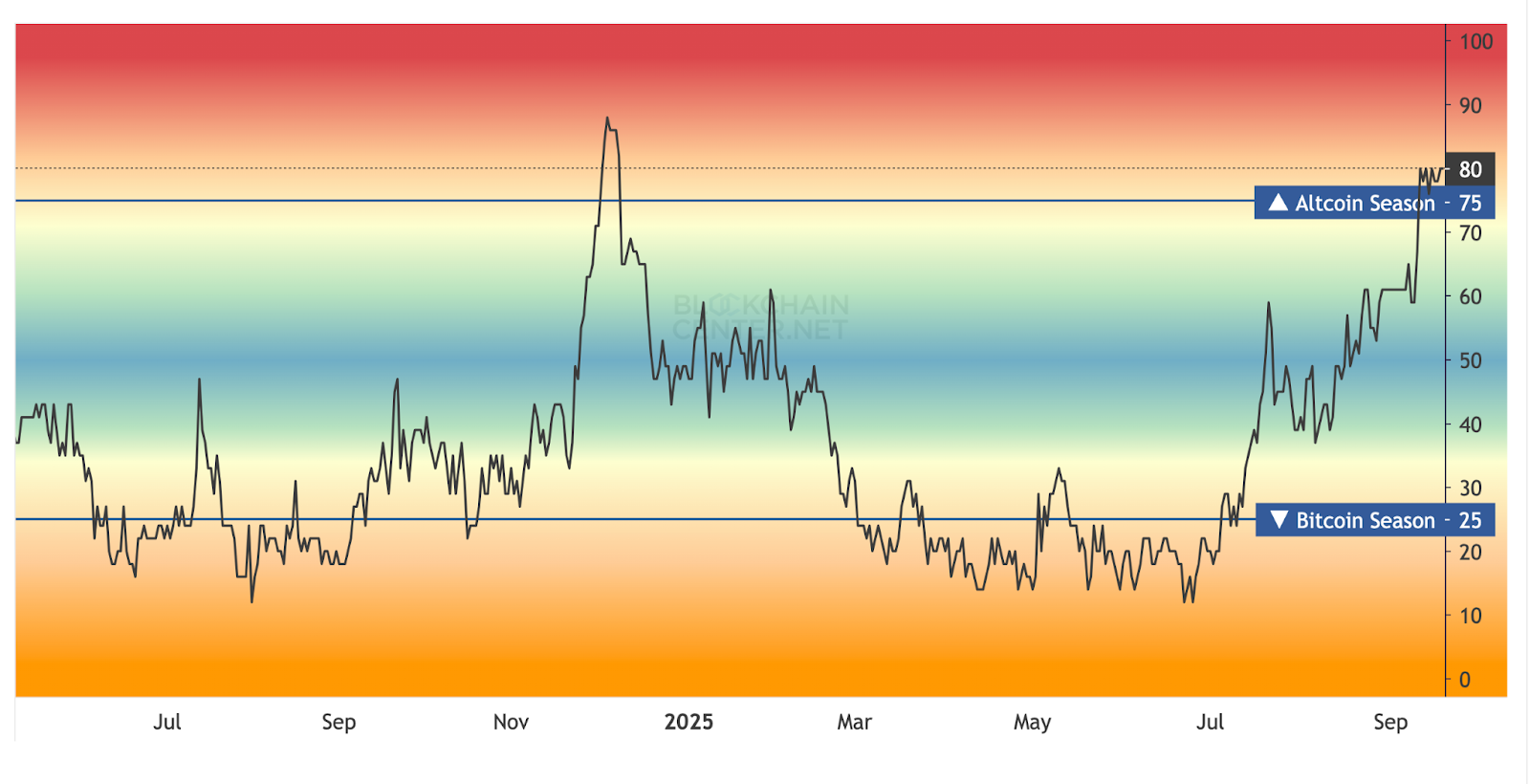
Here's how the chart (from Blockchaincenter) looks:
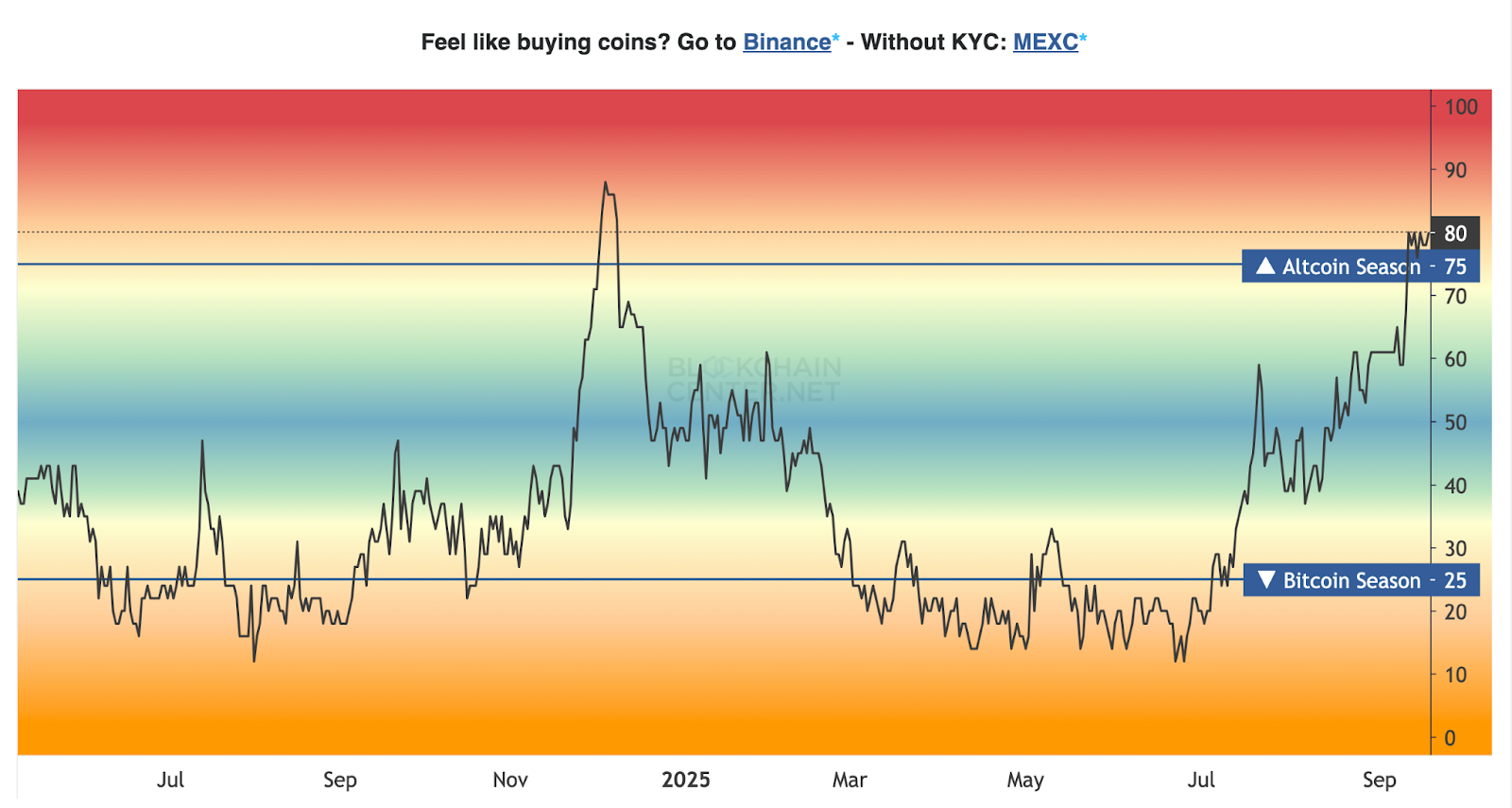
On the vertical part of the Altcoin Season Index (ASI) chart lies the index rating. If the line surpasses the 75% rating during a given period, it's an altcoin season. In the ASI chart screenshot above, the line is currently at 80%, indicating a solid altcoin season. Meanwhile, if the line is below 25%, it's solidly a Bitcoin season.
The ASI chart is the easiest way to keep track of the Altcoin Season Index and adjust your portfolio as needed.
Navigating through common mistakes
Traders often make certain mistakes when trying to capitalize on altcoin seasons. You should avoid these mistakes to maximize your gains and minimize losses. They include:
Overtrading
Reacting to every price movement is a major mistake that traders make, particularly beginner traders. It'll lead to losses, so it should be avoided.
Even if the price of an altcoin falls immediately after you buy it, that doesn't mean it'll keep falling. Inversely, if an altcoin's price rises in the short term, that doesn't imply that it'll keep rising and should be purchased. Have a clear trading strategy and follow it without reacting impulsively to short-term price fluctuations. A professional trader needs conviction in their trades.
[[aa-cta-blue]]
Enterprise Wallet
Build a Multi-Crypto Business Treasury
Hold and manage diverse altcoin portfolios with B2BINPAY Enterprise Wallet's full on-chain transparency and control.
[[/a]]
Neglecting research
Trading altcoins should be based on data, not random intuition. Conduct thorough research about which altcoins are rising, why they're rising, and if the reasons behind their growth can endure in the long term. Research which regulations, commercial partnerships, and technological advancements are driving growth and whether these changes are sustainable. An altcoin being popular doesn't make it a viable investment. Without thorough research, you may just be buying a fad.
Ignoring market sentiment
You shouldn't ignore general market sentiment when trading during an altcoin season. For example, if you notice a general slowdown in altcoin prices, it could mean the season is nearing an imminent end. If prices are stable, it may indicate sustained interest you can capitalize on. If institutional investors load up on a specific altcoin, it's a positive signal you can latch onto. Always monitor market trends and make decisions based on them.
How to Trade Crypto Using the Altcoin Season Index
As mentioned, you should follow a strategic, well-researched approach when trading based on the Altcoin Season Index. These approaches include:
- Use stop-loss orders
[[aa-note]]
Webhook-based payment confirmation is more reliable than polling-based approaches for high-volume environments, ensuring real-time notification regardless of transaction confirmation speed across different blockchains.
[[/a]]
Most altcoins are known for high volatility, meaning their value can reduce rapidly just as it can grow. To hedge against this high risk, you should create stop-loss orders to limit potential losses.
A stop-loss order provides an automatic trading instruction to sell an altcoin once it falls to a specified stop price. For example, if you buy Altcoin A at $2, you can set $1 as the stop price. If Altcoin A falls from $2 to $1, a 100% drop, your tokens will be automatically sold.
You can choose the stop price based on your risk tolerance. What matters is that your altcoin will be automatically sold at that price to limit further losses.
- Research promising altcoins
Before selecting your investments, conduct thorough research into altcoins with the most promising fundamentals, growing adoption, and technological innovations.
For example, an altcoin with a fast-growing user base and an expanding library of third-party app integrations shows significant promise. Altcoins with real-world use cases perform better than those without solid use cases. These are some tips that help you discover the best altcoins to trade.
- Diversify your portfolio
You shouldn't put all eggs in one basket when trading altcoins, as it'll lead to losses. If your portfolio is concentrated in a single altcoin, even a slight drop can lead to heavy losses.
Spreading your investments helps hedge against risks from one or two altcoins collapsing. It'll also help you capture growth from different sectors of the cryptocurrency market.
- Use technical analysis
Incorporate technical analysis tools into your toolkit when researching which altcoins to trade. Use tools like the Relative Strength Index (RSI), support and resistance levels, and moving averages to identify optimal points to buy and sell altcoins. Timing is crucial during the altseason, as altcoin prices fluctuate rapidly. These technical analysis tools help you navigate volatility and maximize profit.
- Capitalize on early sales and ICOs
Initial coin offerings (ICOs) are the early stages when a blockchain project's tokens are offered for sale. They provide an opportunity to buy tokens early at major discounts.
You can identify promising blockchain projects and participate in their ICOs, just before an altcoin season can generate significant long-term interest and a major price boost. With a price boost, you can sell your tokens for substantial profits.
- Monitor the Altcoin Season Index regularly
An altcoin season doesn't last forever. You need to monitor the Altcoin Season Index to ensure you don't miss the boat as it departs. If you observe a falling index, it's a signal to trim your exposure to altcoins and adjust more toward Bitcoin. In contrast, if you observe a rising index, you can raise your exposure to altcoins to benefit from a thriving market.
Advantages and risks of trading with the Altcoin Season Index
The Altcoin Season Index (ASI) offers valuable insights to help you trade profitably. It helps you identify imminent shifts in market sentiment, particularly when altcoins can deliver better returns than Bitcoin. When you notice the index trailing higher, you can gradually begin shifting your portfolio into various altcoins.
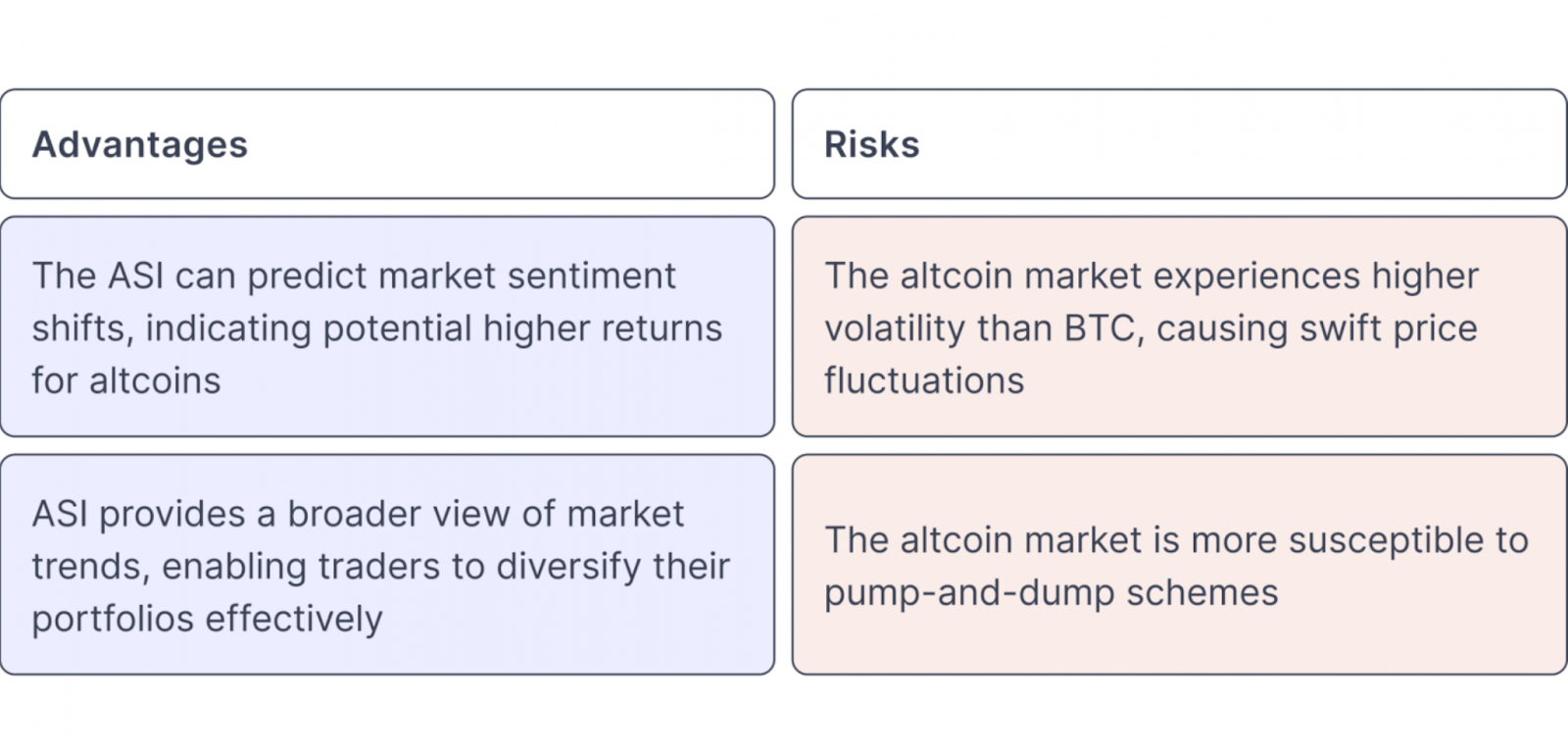
However, trading based on the ASI has its risks. Altcoins experience higher price fluctuations than Bitcoin. Some altcoins can grow to multiple times their value and fall similarly within a day. Many altcoins are driven by hype instead of substance, so you'll need thorough research to separate the legitimate ones from the duds.
Risk management is non-negotiable when trading altcoins. As mentioned earlier, you should diversify your altcoin portfolio to avoid being vulnerable to market swings. You shouldn't rely on the ASI alone to make trading decisions. Rather, it's one tool among many that can guide your trading decisions.
Is there an altcoin season now?
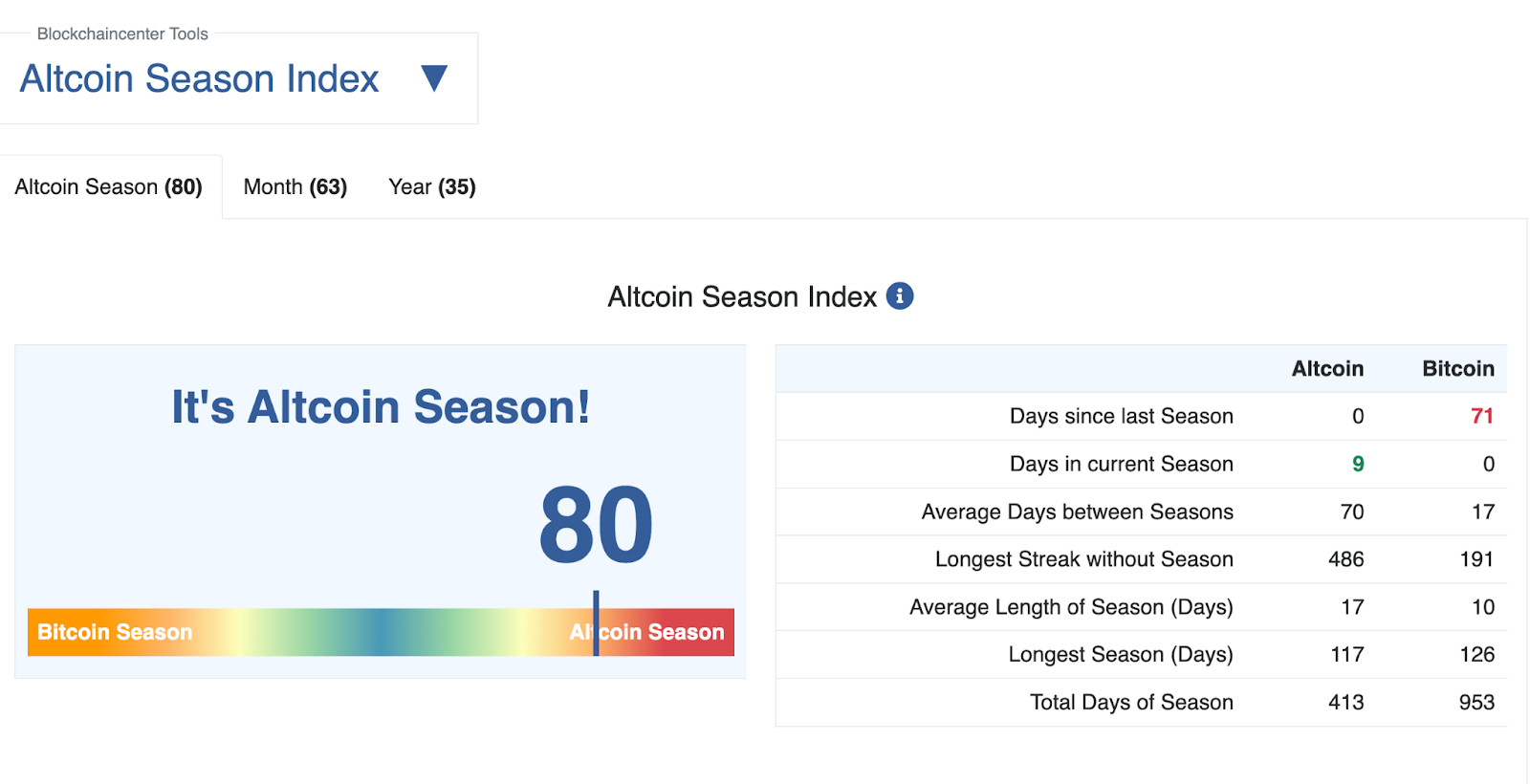
As of September 2026, the ASI indicates that we're currently in an altcoin season. The current ASI index is 80, above the 75% cutoff for an altcoin season. However, this current season has been present for less than a month.
The crypto markets have fluctuated significantly in 2026, with an average of 70 days between successive altcoin seasons and the Bitcoin season being dominant most of the time. Although there's currently an altcoin season (as of writing), you should continuously monitor this chart for any market changes.
Source: Blockchaincenter
Final takeaways
The Altcoin Season Index (ASI) helps you navigate the crypto markets and time your trades well. It helps you understand current market conditions and trade strategically.
However, trading based on the ASI has its risks, and it shouldn't be the only tool to rely on to guide your trades. Even when it's altcoin season, you should conduct extensive research to find the best altcoins out of many options available. You should also diversify your bets to hedge against volatility. The ASI is one of the best tools you can apply when used well.
FAQs: Altcoin season 2026
What is the Altcoin Season Index?
The Altcoin Season Index (ASI) is a tool that measures the relative performance of the top 50 altcoins against Bitcoin. It lets you evaluate the market sentiment for altcoins, particularly whether we're in a period of altcoin or Bitcoin dominance.
What is the Altcoin Season Index chart?
The Altcoin Season Index chart is the easiest way to monitor altcoins' performance against Bitcoin. Instead of checking the top 50 altcoins and calculating their performance yourself, you can simply look at the Altcoin Season Index (ASI) chart to get your answer. If the chart index lies above 75, it indicates an altcoin season.
How do I predict an altcoin season?
You can't exactly predict an altcoin season. However, you can monitor the Altcoin Season Index (ASI) chart to get the best clue. If the chart is gradually rising to 75%, it implies an altcoin season is near.
How long does the altcoin season usually last?
Historically, a full-scale altcoin season has lasted an average of 17 days (source: Blockchaincenter). However, the crypto market changes rapidly, so the next altcoin season can last much longer or shorter than this average.
Is the altseason guaranteed?
No, there isn't a guarantee of an altseason happening sooner or later. However, historically, the crypto market has seen various altseason periods, and the market's cyclical nature implies that another altcoin season can occur anytime.
How do I find my upcoming altcoins?
You can scour through crypto data platforms like CoinMarketCap and check your exchange listings to find the top-performing altcoins. These altcoins represent upcoming opportunities you can potentially capitalize on.
What crypto exchanges are best for altcoins?
Binance, Bybit, OKX, and MEXC are some of the best crypto exchanges for altcoins. They have larger collections of altcoins listed on their platforms, including the top-performing ones, than on most rivals.
How do altcoins go up?
Altcoins go up when there's increased demand owing to endorsements, regulatory changes, technological innovations, or, in many cases, hype. An altcoin going up can be a positive signal, but it doesn't mean you should automatically buy the altcoin. You should conduct extensive research to discover the altcoins with the best long-term fundamentals.
[[aa-cta-grey]]
Compliance Suite
FATF Travel Rule via Notabene
B2BINPAY's integration with Notabene automates originator and beneficiary data exchange across VASPs, keeping you compliant with Travel Rule requirements in all applicable jurisdictions.
[[/a]]
How do I identify an altcoin season?
You can look at the Altcoin Season Index (ASI) chart, and if it's currently above 75%, it means there's an altcoin season.

.svg)


