


The best non-custodial wallet for a broker is rarely a brand on a comparison listicle. It is an architecture decision that has to match how your treasury approves payments, how your compliance team monitors flows, and how your operations team reconciles client deposits. A broker handling client funding, prop firm payouts, or merchant settlement needs governance, audit trails, and shared signing, none of which a mobile wallet was designed to provide.
This guide reframes the "best non-custodial wallet" question around business infrastructure. It covers counterparty risk after FTX, the four wallet architectures that matter for institutional self-custody (EOA, multisig, MPC, and smart contract accounts), the controls that separate a governed business wallet from a consumer app, on-chain invoicing, embedded Wallet-as-a-Service (WaaS), and where B2BINPAY's regulated payment infrastructure fits.
Key Takeaways
- The best non-custodial wallet for a broker is rarely a consumer app, because funding flows usually require governance, auditability, and shared transaction control.
- Non-custodial custody may reduce exchange counterparty exposure, but it also shifts responsibility toward key management, internal approvals, and operational security.
- Multisig, MPC, and smart contract accounts solve different problems, so the right architecture depends on your authorization model, risk tolerance, and workflow complexity.
- Approval queues and on-chain invoicing can transform a non-custodial wallet from simple storage into a controlled payment workflow.
- An API-first Wallet-as-a-Service model may suit regulated brokers best when they need non-custodial, multi-chain wallet infrastructure without building blockchain operations internally.
Why Broker Funding Flows Demand More Than a Consumer Wallet
Broker funding flows involve client deposits, treasury rebalancing, payout batches, and exception handling, and every movement has to be approved, recorded, and reconciled. A consumer wallet was designed for one person controlling one balance, so it cannot enforce maker-checker workflows, surface withdrawal exceptions to compliance, or give an auditor a transaction trail that mirrors a corporate banking ledger. That gap is why "best non-custodial wallet" pulls a different answer for a CFO than for a retail user.

The institutional requirement is non-custodial control plus operational controls. MetaMask, Trust Wallet, Ledger, and Trezor all give one signer full authority over a wallet's outbound transactions. None of them natively enforce approval queues, segregate withdrawal permissions, or produce reconciliation-friendly callbacks.
The Custodial Risk That FTX Made Undeniable
FTX showed that legal entitlement to an asset means nothing if operational control sits with a collapsed intermediary. Customers held balances on paper, but the operational keys sat inside an exchange whose internal controls failed catastrophically. For brokers routing client deposits, any time a third party touches the keys, your funding flow inherits that third party's solvency, governance, and operational risk.
That history pushed institutional buyers toward non-custodial models for treasury layers. Self-custody removes the failure mode where an intermediary's collapse freezes your funds, but it does not remove every risk.
How Non-Custodial Models Shift Risk Rather Than Remove It
Non-custodial custody removes custodian failure exposure but introduces key management, signer coordination, policy, and human-error risks. A lost seed phrase, a phished signer, or an unauthorized outbound transaction can do as much damage as any exchange insolvency. The risk has not been eliminated; it has been moved into your organization.
The controls that compensate are concrete: multisig thresholds, MPC key share distribution, withdrawal approval queues, address whitelists, monitored callbacks, and time-locked transactions. Brokers should ask which of these a given architecture supports natively, which require manual process, and which a vendor can deliver as part of an integrated stack.
Four Non-Custodial Wallet Architectures and What They Mean for Brokers

Non-custodial is not one product category. The architecture you pick determines who can approve a transaction, how recovery works, what automation is possible, and whether the wallet fits broker operations at all.
Four models cover the field today: single-key externally owned accounts (EOAs), multisig wallets, multi-party computation (MPC) wallets, and smart contract accounts. The right question is not which is most secure in the abstract, but which gives you the right number of signers, approval logic, and recovery path for your funding flow.
1. Single-Key EOA Wallets: Simple but Ungovernable at Scale
A single-key externally owned account is the default MetaMask, Trust Wallet, or Ledger model. One private key signs every transaction, which makes EOAs easy to spin up and easy to compromise. A phished signer, a leaked seed phrase, or a malicious browser extension can drain the wallet in one block.
EOAs can work for prototypes or small test balances. They cannot deliver native approval queues, role separation, or policy logic, so they are a poor fit for any flow that needs more than one human in the loop. For a broker, an EOA is fine for paying a vendor invoice once a quarter and unfit for moving client funds.
2. Multisig Wallets: Shared Control and Dual Authorization
Multisig wallets require multiple signers to authorize a transaction, typically in 2-of-3 or 3-of-5 patterns. They are the clearest bridge from consumer self-custody to institutional governance because shared signing maps directly onto dual authorization, segregated duties, and board-level comfort.
Safe, the most widely used multisig stack, runs on Ethereum and most EVM chains and underpins a large share of corporate treasury today. For a broker, multisig means a treasury manager can propose a transfer, a CFO can approve it, and a compliance officer can sign off before anything broadcasts. The same threshold logic protects against single-signer compromise, since one stolen key cannot move funds alone.
3. MPC Wallets: Distributed Key Computation Without Assembly
Multi-party computation wallets split signing across multiple parties so the full private key is never assembled in one place. Each party holds a key share, and a signature is computed jointly without any party seeing the others' shares. From an attacker's perspective, there is no single key to steal.
MPC is often preferred for usability: transactions feel like a single signature on-chain, signing is faster than coordinating multisig approvals, and recovery flows can be smoother. The trade-off is governance. MPC handles distributed signing cryptography well, but the workflow logic around who proposes, who approves, and how exceptions escalate still has to be built on top.
4. Smart Contract Accounts: Programmable Policy Engines
Smart contract accounts are wallets governed by code rather than a single key. Through the ERC-4337 account abstraction standard, already used by more than 40 million deployed smart accounts, and the EIP-7702 upgrade that went live with Ethereum's Pectra release in May 2025, these accounts can enforce spending limits, batch transactions, sponsor gas, and require custom approval logic at the protocol level.
For brokers handling many users, assets, and workflows, programmable policy engines fit a wider set of use cases than any other architecture. Safe smart accounts, paymaster-enabled onboarding, and policy-driven session keys are all live in production today. The cost is engineering: the policies have to be designed, audited, and maintained.
[[aa-cta-blue]]
📢 Stop fitting a consumer wallet to an institutional problem.
B2BINPAY's WaaS gives you non-custodial wallet infrastructure with multisig accounts, manual outgoing approvals, and callback-driven reconciliation, built for broker funding flows from day one.
[[/a]]
The Business Evaluation Framework: What Actually Separates Institutional Wallets
Institutional wallets win on controls around people, process, and compliance, not on coin count. Asset coverage is a baseline filter. What separates a serious institutional option from a glossy consumer app is whether the wallet supports approval queues, role-based access, multi-chain error prevention, and compliance integration as native features.
The framework below maps to how a broker should evaluate any "best non-custodial wallet" shortlist before signing a vendor contract. For a parallel checklist, B2BINPAY's guide to choosing a crypto wallet for business walks through the same selection criteria from a practical operations angle.
Approval Queues and Transaction Authorization Controls
Approval queues stage transactions for review before they broadcast to the network. A treasury manager proposes the transfer, a second approver reviews it against policy, and only then does it sign and go on-chain. For brokers, that pattern is essential on withdrawals, treasury sweeps, and exception handling outside automated rules.
B2BINPAY DeFi supports approval workflows alongside multisig accounts and on-chain invoicing. That combination turns a self-custodial wallet into controlled payment infrastructure: every outbound transaction can be queued, reviewed, and signed by separate roles before it executes.
Role-Based Access and Separation of Duties
A business wallet should mirror how a finance team is structured: maker-checker models for transaction approval, view-only roles for analysts who need visibility without signing rights, and withdrawal permissions scoped per role. Sharing one seed phrase across a team is not a governance model.
Role-based access matters because brokers need people to reconcile, approve, monitor, and audit without any single role having the power to move funds alone. The same logic applies to disaster recovery: if a signer leaves, the remaining roles should still be able to authorize transactions through documented succession.
Multi-Chain Coverage and Cross-Chain Error Prevention
Multi-chain support is not just asset breadth. Brokers need safeguards against wrong-network deposits, since a client sending USDT on Tron to an Ethereum address loses the funds in most cases. The wallet stack has to flag chain mismatches before deposits land and reconcile balances cleanly across networks.
B2BINPAY WaaS addresses this through address duplication across compatible EVM chains, including ERC-20, BEP-20, Polygon, and Avalanche, so the same deposit address accepts a client's transfer regardless of which compatible network they pick. That cuts a major class of cross-chain error and the manual back-office work of chasing misrouted deposits.
Compliance Integration: Travel Rule, AML, and KYT Alignment
Non-custodial does not mean non-compliant. Brokers facing FATF Travel Rule, AML, and Know-Your-Transaction obligations cannot skip controls because they hold their own keys. The FATF June 2025 best practices on Travel Rule supervision make clear that VASPs sending to unhosted wallets must still collect originator data and may need to verify ownership of self-hosted addresses above defined thresholds, as the Travel Rule explainer from Elliptic summarizes.
Under MiCA, self-custody software remains outside the CASP authorization perimeter when a provider does not touch user funds, but any broker offering trading, exchange, or custodial services on top of wallet infrastructure still falls under MiCA's scope. A non-custodial wallet for business use therefore has to surround itself with screening, audit trails, originator data, and counterparty checks. B2BINPAY runs KYT screening on every transaction across the payment processing layer.
On-Chain Invoicing as a Broker Payment Workflow
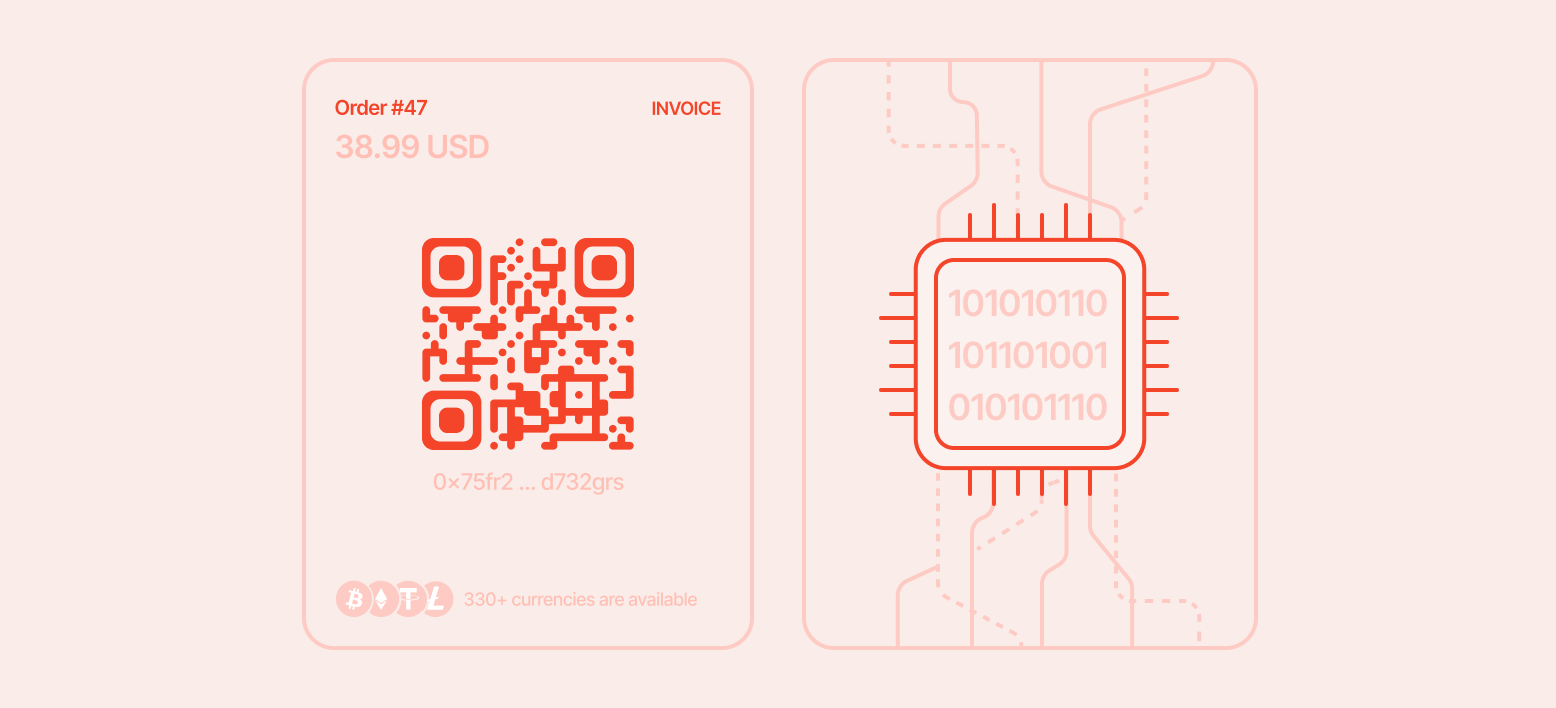
On-chain invoicing is a structured payment request that ties an asset, amount, address, and reference data together so deposits can be matched automatically. Instead of giving a client a bare wallet address, the broker issues an invoice with a one-time address (or a session-scoped reference) and a callback that fires when the deposit confirms.
For broker operations, the workflow benefits are measurable. Deposits reach operations faster because invoices, callbacks, and reference IDs strip out manual reconciliation. Client attribution is cleaner because each invoice ties to a known account from issuance. Back-office reporting becomes a structured pipeline rather than a spreadsheet of one-off transfers. Static wallet addresses cannot deliver any of that.
Embedded Non-Custodial Wallets via WaaS: The API-First Path for Brokers
Most brokers should not build wallet infrastructure from scratch. API-first Wallet-as-a-Service compresses what used to be a multi-quarter blockchain engineering project into an integration job, and it removes the overhead of running nodes, monitoring chains, and tracking new token standards. That means launching crypto funding in weeks instead of building a wallet team for years.
Embedded non-custodial wallets are user-controlled accounts delivered inside an existing product (a broker app, a prop firm portal, a merchant dashboard) via API. The user holds the keys, but the experience lives inside the broker's interface. That is what most institutional buyers mean today when they search for a non-custodial wallet API, embed non-custodial wallet API, or non-custodial wallet for brokers.
WaaS also handles the infrastructure work that breaks self-build projects: gas management, transaction batching, chain reorganizations, RPC redundancy, and maintaining support for new chains and tokens. Building those well is a full-time job. Buying them well takes one integration sprint.
[[aa-cta]]
📢 Skip the multi-year blockchain build.
B2BINPAY WaaS gives you a non-custodial wallet API with multi-chain coverage, KYT screening, and callback-driven reconciliation. Production-ready out of the box.
[[/a]]
How B2BINPAY WaaS Delivers Institutional Non-Custodial Infrastructure
B2BINPAY WaaS and the B2BINPAY DeFi App are institutional non-custodial infrastructure, not retail wallets. They were built for brokers, prop firms, iGaming operators, and high-volume merchants that need self-custody combined with the controls that make self-custody operationally viable. By 2025, B2BINPAY had processed $5.1B in incoming volume across 6.7M transactions for 983 business customers, with 350+ supported currencies.
The product capabilities map directly to broker outcomes. Multisig accounts and manual outgoing approvals replace the single-key risk that breaks consumer wallets in business contexts. Flexible confirmation thresholds let operations teams trade off settlement speed against fraud risk per asset class. Callback URLs feed deposits into back-office systems automatically. TRX staking offsets on-chain fees in high-frequency flows. APIs and mobile access mean the wallet works inside a broker's stack and on a CFO's phone.
Operationally, B2BINPAY runs on regulated infrastructure: B2BINPAY EL SALVADOR S.A. DE C.V. holds a CNAD PSAD licence and a Central Reserve Bank PSB authorization under SSF supervision, and B2BINPAY MAURITIUS LTD holds VASP licence GB24203002 from the Mauritius FSC. KYT screening runs on every transaction, and the sandbox is fee-free for testing before production volume moves. For brokers who need a separate custody layer, B2BINPAY's custody product sits alongside WaaS with multi-signature wallets, multi-factor authentication, and supervised transaction approval.
Choose the Non-Custodial Wallet Architecture Your Funding Flows Actually Require
Match the wallet architecture to your approval depth, compliance load, and transaction volume, not to marketing reputation. Single-key EOAs fit personal experimentation. Multisig fits shared treasury control. MPC fits distributed signing at speed. Smart contract accounts fit programmable policy at scale. Embedded WaaS fits brokers who want governed self-custody without becoming a blockchain engineering shop.
For most broker funding flows, the right answer combines multisig or policy-driven smart accounts with approval queues, on-chain invoicing, callback-driven reconciliation, KYT screening, and a regulated provider behind the stack. That is the gap consumer roundups never fill, and it is what B2BINPAY WaaS and B2BINPAY DeFi were built to deliver.
[[aa-cta-grey]]
📢 Ready to move from consumer wallet to institutional infrastructure?
Open a B2BINPAY account, run your first integration in the fee-free sandbox, and ship governed non-custodial funding flows to production.
[[/a]]
Frequently Asked Questions about Non-Custodial Wallets
What is the best non-custodial wallet for a business?
For a business, the best non-custodial wallet is usually not a consumer app but a governed wallet architecture with shared controls and auditability. You should prioritize multisig or policy-based smart accounts, because single-key wallets rarely provide the approval queues, role separation, and recovery options operations teams need. In practice, B2BINPAY DeFi fits this category by combining self-custody with multisig accounts, on-chain invoicing, and transaction approval workflows.
Is a non-custodial wallet safe for broker funding flows?
A non-custodial wallet may reduce exchange counterparty risk, but it shifts responsibility toward key management, transaction governance, and internal security controls. Safety depends less on the wallet label and more on whether you enforce multisig thresholds, approval queues, access policies, and secure backups. For funding operations, the safest setup usually mirrors corporate banking, with dual authorization, limited permissions, and clear audit trails for every outbound transfer.
What features separate a business non-custodial wallet from a consumer wallet?
The biggest difference is governance. Consumer wallets focus on personal key control, while business wallets need approval queues, role-based access, segregated duties, and reconciliation-friendly payment workflows. Useful business features also include multi-chain support, cross-chain error prevention, on-chain invoicing, and API connectivity for treasury, settlement, and back-office automation.
Which non-custodial wallet architecture is best: multisig, MPC, or smart contract accounts?
Multisig is often the clearest fit for shared treasury control, because it enforces defined signer thresholds like 2-of-3 or 3-of-5. MPC may help when you need distributed key computation with less signer friction, especially across devices, teams, or embedded wallet environments. Smart contract accounts are strongest when programmable policy matters most, such as spending limits, gas sponsorship, batched actions, or custom approval logic.
Can a non-custodial wallet support compliance and payment workflows?
Yes, but non-custodial status does not remove AML, KYT, Travel Rule, or recordkeeping obligations for regulated businesses. The better approach is to choose infrastructure that combines self-custody with screening, approval controls, and on-chain invoicing for cleaner payment matching. If you want an API-first path, B2BINPAY WaaS and B2BINPAY DeFi may help you embed governed wallets without building the blockchain stack alone.
Disclaimer: The service has legal and jurisdiction limitations. Please check T&Cs on https://b2binpay.com/en/risk-disclaimer

.svg)



.png)


