



Blockchain offers users and companies a new way to deal with data and payments. However, as the technology expands to more and more use cases, it becomes clear that the traditional chains, known as monolithic, struggle to keep up with the enterprise demands of scalability. The modular blockchain is an approach that aims to address these issues.
In this article, well explore what a modular blockchain is, how it differs from the traditional monolithic one, and how its shaping the future of digital assets and decentralized systems.
[[aa-cta]]
Crypto Payments Gateway
Accept Payments Across Any Blockchain
B2BINPAY supports 350+ cryptocurrencies across multiple networks, ready for any blockchain architecture you build on.
[[/a]]
What is a Modular Blockchain?
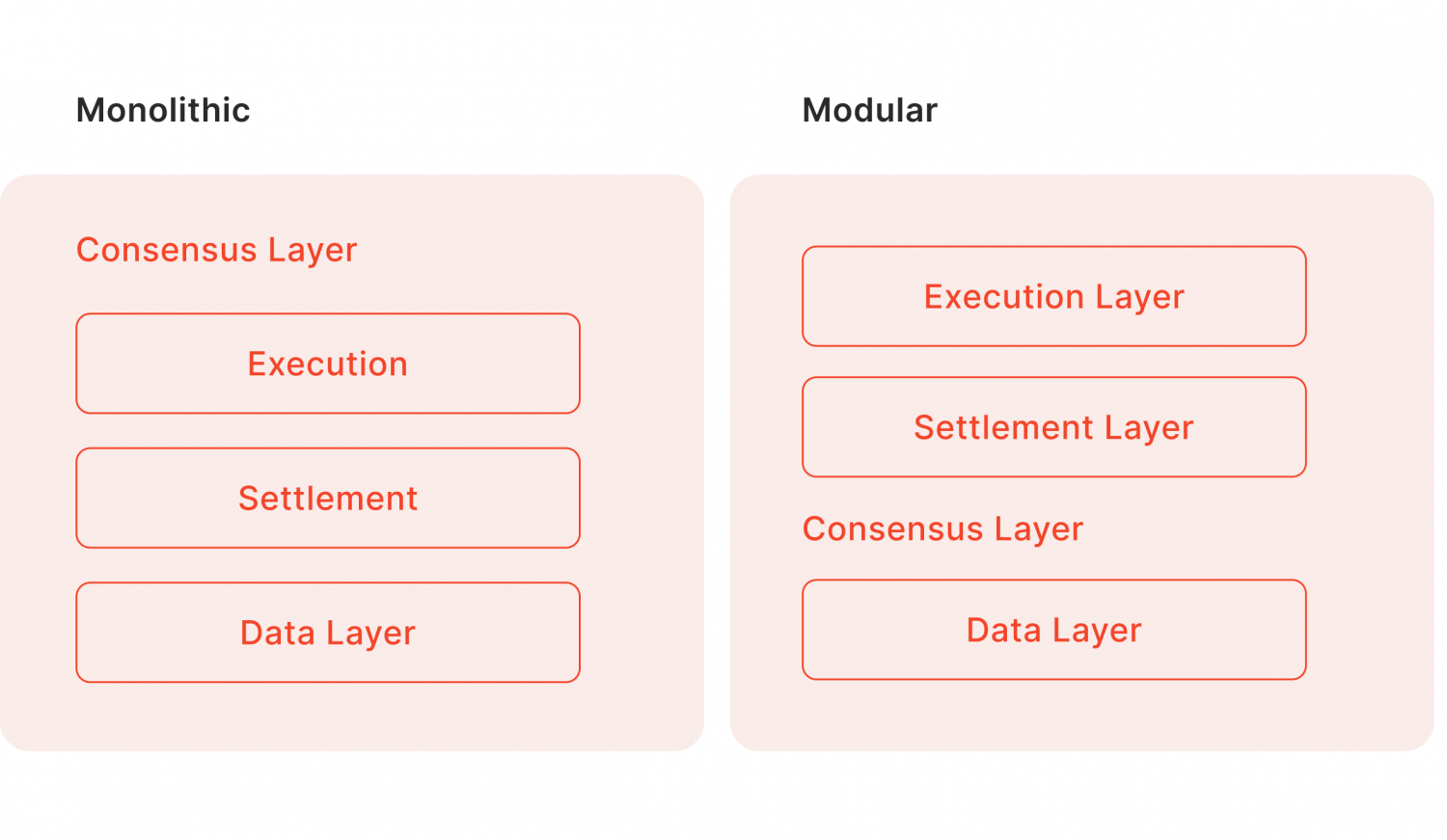
A modular blockchain is an approach to blockchain architecture that separates the main functions of a network into different layers or modules.
Such chains divide these processes into distinct layers.
- Consensus: Manages the process of agreeing on the validity of transactions.
- Data Availability: Ensures the data for transactions is accessible and can be verified.
- Execution: Handles the execution of smart contracts and transactions.
- Settlement: Finalizes the transactions and records them on the blockchain.
Separating functions enables each layer to focus on a specific task, increasing the performance of the network. At the same time, modular blockchains are more scalable than traditional systems, as each layer can scale independently.
With this architecture, developers can select the layers that best suit their needs, allowing for tailored solutions for various use cases.
Modular vs Monolithic Blockchain
Traditional (monolithic) blockchains, on the other hand, handle every aspect of the process within the same network. Bitcoin and early versions of Ethereum are prime examples of this architecture.
While this design offers simplicity, it also creates a number of serious challenges. As more users connect to the network, the blockchain can become congested, leading to slower transactions and higher fees.
Practical Example
Picture a decentralized app (dApp) that needs quick transactions but doesnt rely on heavy data storage. With a modular blockchain, developers can pick a speed-focused execution layer and pair it with a lightweight data availability layer, crafting a solution that perfectly fits their needs. This kind of flexibility is tough to achieve with a monolithic system, where everything is already bundled together.
Implementation of Modular Networks
There are several different approaches to implementing modular blockchains:
- Rollups: Rollups function primarily as an execution layer. They process transactions off-chain and then bundle and submit transaction data to a layer-1 (L1) blockchain like Ethereum. This method reduces congestion on the main network and lowers transaction fees while still leveraging the security of the L1 blockchain.
- Sovereign Rollups: Sovereign rollups act as both an execution and settlement layer. They publish data blocks directly onto their own rollup chain without relying on L1 smart contracts for validation. This grants them greater autonomy and can improve performance by reducing dependency on the L1 blockchain. Sovereign rollups are ideal for projects that require more control over their execution environment.
- Validium: Validium is similar to rollups in that it processes transactions off-chain. However, unlike rollups, Validium does not publish transaction data to the L1 blockchain. Instead, it relies on a network of Proof of Stake validators to ensure data integrity and availability. This approach offers enhanced scalability and privacy, as sensitive transaction data doesn't need to be posted publicly.
Real-Life Case Study
One of the most notable modular blockchain projects is Casper. Designed for enterprise use cases, Casper offers a clear example of how modular blockchain architecture can benefit businesses and developers.
What Makes Casper a Modular Blockchain?
Casper separates its blockchain into multiple layers. Execution and consensus layers are optimized for scalability, enabling the chain to handle high transaction volumes. Here are the benefits of such architecture:
Scalability
Caspers modular approach allows it to support high transaction throughput, making it ideal for businesses with large data and transaction requirements.
Security
By separating critical functions like consensus and execution, Casper enhances the security of its network, ensuring that each layer is optimized for its role.
Enterprise Adoption
The modular architecture blockchain of Casper makes it perfect for enterprise usage. According to the Casper Association's Board Member Ralf Kubli, the Casper Network, along with its native CSPR token, is designed to cater to the specific needs of enterprises. The network is built to support business-critical applications, offering features that align with enterprise requirements.
Casper's strength in the enterprise space is evident from its partnerships with giants such as IBM. Together, they are working to help clients employ blockchain technology to gain transparency and auditability in AI systems.
[[aa-cta-blue]]
Enterprise Wallet
Multi-Chain Business Wallet for Enterprises
Manage digital assets across multiple blockchain layers with B2BINPAY's real on-chain wallet infrastructure.
[[/a]]
Other Modular Blockchain Projects
There are many modular chain projects that are reshaping the decentralized networks landscape. Here are some several of them:
Celestia
[[aa-note]]
API-first payment infrastructure allows businesses to embed crypto acceptance directly into existing checkout flows, back-office systems, or custom trading platforms without redirecting users to third-party pages.
[[/a]]
Celestia is an example of a modular layer-1 blockchain that focuses on separating the consensus and data availability. It allows developers to build their own execution environments on top of it, providing an incredibly flexible platform for various use cases.
Polygon
Polygon is moving toward a modular blockchain approach. With its new zk-rollups and other scaling solutions, Polygon is positioning itself as a modular chain capable of scaling and customizing for a wide range of use cases.
Ethereum 2.0

Ethereums transition from a Proof-of-Work (PoW) system to a Proof-of-Stake (PoS) model includes introducing sharding, a modular system that splits the blockchain into multiple shards, each responsible for a portion of the overall data processing. This design significantly enhances Ethereums scalability, making it more modular than the original version.
Fuel Network
Fuel Labs focuses on building highly optimized execution layers for Ethereum rollups. By decoupling the execution from other modules, it aims to provide faster, more efficient blockchain solutions.
Benefits of Modular Blockchains for Businesses
For businesses, modular blockchains offer a range of advantages that make them an attractive option for implementing decentralized solutions.
Efficiency in Business Processes
Modular blockchains allow businesses to choose only the modules they need, which boosts efficiency and cuts down on unnecessary expenses. For instance, a supply chain management system can prioritize the data availability layer to keep transaction records secure and easily accessible without bogging it down with extra functions.
Versatile Applications
The modular design makes it easy to create flexible applications, improving the user experience in the blockchain world. This flexibility opens the door to a variety of efficient DApps, encouraging innovation across a wider range of use cases.
Great Scalability
As businesses expand, their blockchain needs to evolve. Modular blockchains can grow right along with them by adding or adjusting layers as necessary, whether that means processing more transactions or managing advanced smart contracts.
Security and Customization
Companies can achieve higher security by selecting specialized modules for different tasks. Plus, the modular setup allows for deep customization, making these solutions ideal for different industries where meeting specific compliance standards is essential:
- Finance: Financial institutions can use modular blockchains to enhance transaction speeds while maintaining robust security.
- Supply Chain Management: Modular blockchains can provide transparency and traceability in supply chains.
- Healthcare: Healthcare providers can ensure patient data is securely stored and accessed only by authorized parties by implementing modular chains.
Challenges for Modular Blockchains
There are also challenges that developers and businesses must consider:
Complexity of Implementation
Implementing a modular blockchain can be more complex than using a monolithic system. Developers need to manage the interaction between different layers, which requires a deep understanding of the architecture.
Security Concerns
If not properly integrated, the layers of a modular blockchain could introduce vulnerabilities. Recently, as more traffic flows through these systems, bridges have become prime targets for hackers. According to DeFiLlama data, over $2.8 billion has been stolen from cross-chain bridgesmaking up more than 40% of all DeFi hacks to date.
Interoperability Between Layers
Seamless interaction between layers is essential for a modular blockchains success. The system could become inefficient or vulnerable if the layers dont work well together.
[[aa-cta-grey]]
Compliance Suite
FATF Travel Rule via Notabene
B2BINPAY's integration with Notabene automates originator and beneficiary data exchange across VASPs, keeping you compliant with Travel Rule requirements in all applicable jurisdictions.
[[/a]]
Conclusion
The modular blockchain represents a significant shift in how we think about blockchain technology. By segmenting the chain into several modules, these blockchains offer enhanced scalability and efficiencyqualities that make them increasingly attractive to businesses, developers, and investors.

.svg)


