


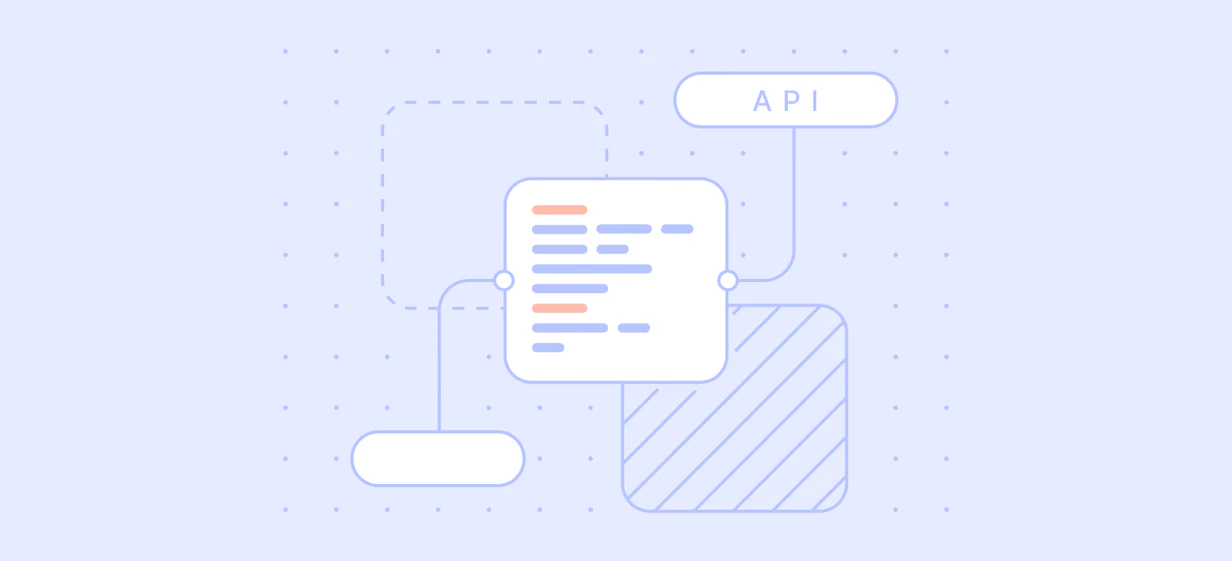
Payment Gateway API: How It Works & Integration Guide

Do you ever wonder how payment gateways work on every website you’ve paid for something on? How does the payment get processed instantly despite passing through several channels? The answer is APIs.
Modern gateways have Application Programming Interfaces (APIs) that enable uninterrupted information flow between the gateway and an external platform. Businesses integrate APIs into their websites or apps, enabling them to accept payments without requiring customers to leave the site. This guide explains how a payment gateway API works and what to consider before choosing one for your business.
What is a Payment Gateway API?
A payment gateway API is a set of software protocols that connects your website to a payment gateway, enabling customers to pay you via credit/debit cards, digital wallets, and other methods.
Think of an API as a bridge through which payments flow to your website. This bridge collects a customer’s card information, encrypts it, and sends it to a payment processor to authorize the payment with the customer’s bank. If the payment is authorized, it’ll be routed to your merchant bank account, and the customer will receive their product or service.
A payment gateway API enables businesses to accept payments from customers worldwide without building a complex payment system from scratch.
Core Components of Payment Gateway APIs
Every payment gateway application programming interface (API) consists of several core components. These components work hand-in-hand to enable seamless information flow between merchants, customers, and financial institutions. The main components include:
- API endpoints: These are specific URLs your system sends requests to. For instance, a payment gateway endpoint like api.gateway.com/payments handles payment transactions. Different endpoints handle different tasks, like creating a payment, checking its status, or canceling a transaction.
- Authentication keys: These are special codes (API keys or tokens) that you include in each request to prove you’re an authorized user. They protect against unauthorized access.
- Request and response format: This defines how data is packaged when sent to the API and how results are returned. Most modern payment APIs use JavaScript Object Notation (JSON), which is a standardized text format for sending data between systems. When you submit a payment request, you structure your data in JSON format, and the gateway responds in JSON as well.
- Webhooks: These are URLs on your server that the payment gateway calls when events occur, such as when payments are completed, failed, or disputed. They allow real-time updates to your system without constantly checking the API.
- SDKs (Software Development Kits): Many payment gateways provide libraries for popular programming languages (Python, Java, PHP, etc.) that simplify API integration by handling the complex code.
How Payment Gateway API Works
Payment gateway APIs work by facilitating a series of secure data exchanges between your system and the payment network. Every time a customer completes a payment, several steps happen in the background, including:
- Customer initiates payment: A customer enters their payment details, like credit card number and CVV, on your checkout page.
- Data encryption: Before your system sends the customer's information to the payment gateway API, it encrypts the data to prevent theft during transmission.
- Payment request: Your server sends this encrypted payment data to the payment gateway’s API endpoint, along with your authentication credentials (API key).
- Authentication and validation: The payment gateway verifies your API key, then validates the payment data to ensure it’s complete and in the correct format.
- Transaction processing: The gateway forwards the payment to the relevant card network (Visa, Mastercard) or bank, which checks if the customer has sufficient funds or credit and approves or declines the transaction.
- Response returned: The payment gateway sends a JSON response back to your server via the API, indicating whether the payment was approved or declined.
- Confirmation displayed: Your system processes the response and displays the appropriate message to the customer (payment successful or failed).
- Funds transfer: If approved, the funds are deducted from the customer’s account and eventually deposited in your merchant account.
Types of Payment Gateway API Integrations
When integrating a payment gateway API, you have several integration options to choose from, depending on your technical capabilities and business needs:
- Hosted payment pages: The simplest option. You redirect customers to the payment gateway’s own webpage to complete payment. It requires minimal coding, but you have limited control over the customer experience.
- Direct API integration: The most flexible option. Your website collects payment details and sends them directly to the payment gateway API. It requires more technical expertise but gives you full control over the checkout experience.
- JavaScript libraries: A middle-ground approach where payment gateways provide JavaScript code that you add to your checkout page. The library handles secure data collection while keeping the customer on your site.
- Mobile SDKs: Similar to JavaScript libraries but designed for mobile apps (iOS and Android). They provide pre-built UI components and handle secure payment data collection within your app.
- Server-to-server: Your server communicates directly with the payment gateway’s API for recurring billing or subscription scenarios. It’s used when you’ve already collected and tokenized payment data.
Key Security Features in Payment APIs
Security is a critical component of any payment gateway API. Without robust security measures, sensitive payment data could be intercepted, stolen, or misused. The key security features to look for include:
- PCI DSS compliance: Ensures the gateway follows the Payment Card Industry Data Security Standard (PCI DSS), a set of security standards designed to protect card information during and after financial transactions.
- TLS/SSL encryption: All data transmitted between your system and the payment gateway is encrypted using Transport Layer Security (TLS) or Secure Sockets Layer (SSL), preventing eavesdropping.
- Tokenization: Sensitive payment data (like card numbers) is replaced with unique tokens. Tokens can’t be used outside the system that created them, so if intercepted, they’re useless.
- 3D Secure authentication: An additional verification step that redirects customers to their bank for authentication, reducing fraud and chargebacks.
- Fraud detection tools: Machine learning algorithms and rule-based systems analyze transactions in real time to detect fraudulent patterns.
What to Consider When Choosing Payment API
Choosing the right payment gateway API is one of the most critical decisions you’ll make as a business owner. Here are some key factors to consider:
- Transaction fees and pricing: Different providers charge different fees, including per-transaction fees, monthly fees, and currency conversion fees. Calculate the total cost based on your expected transaction volume.
- Supported currencies and payment methods: Ensure the gateway supports the currencies your customers use and the payment methods they prefer, such as credit cards, digital wallets, or Buy Now, Pay Later options.
- API documentation quality: Well-written, comprehensive documentation is essential for smooth integration. Look for clear guides, code examples, and an active developer community.
- Developer tools and testing: Good gateways provide sandbox environments for testing without real transactions, plus debugging tools and sample code.
- Security and compliance: Verify the gateway is PCI DSS compliant and offers features like tokenization, encryption, and fraud detection.
- Integration complexity: Consider your team’s technical capabilities. Some APIs are simpler to integrate than others.
- Reliability and uptime: Payment processing downtime means lost revenue. Look for providers with high uptime guarantees (99.9% or above).
- Customer support: When something goes wrong with payment processing, you need immediate help. Evaluate the quality and availability of customer support.
Payment Gateway APIs for Crypto Payments
Traditional payment gateway APIs are designed primarily for fiat currency transactions. However, with the rise of cryptocurrency, new types of payment gateway APIs have emerged to facilitate crypto transactions for businesses.
A crypto payment gateway API allows businesses to accept cryptocurrency payments by connecting their platform to a crypto payment processing network. Similar to a traditional gateway, it handles the transaction flow, but instead of routing payments through banks and card networks, it processes transactions on blockchain networks.
How it works: When a customer pays with crypto, they send funds to a blockchain address generated by the gateway API. The gateway monitors the blockchain for the transaction, confirms it after the required block confirmations, and notifies your system via a webhook. The gateway may then automatically convert the crypto to fiat currency or hold it as crypto, depending on your settings.
Summary
Payment gateway APIs are the backbone of modern online payments. They enable secure, real-time data exchange between merchants, customers, and financial institutions. When choosing a payment gateway API, consider factors like fees, supported currencies, security, and documentation quality. For businesses looking to accept cryptocurrency, dedicated crypto payment gateway APIs offer blockchain-based transaction processing with features comparable to traditional payment gateways.
Subscribe to our channel so as not to miss new publications
SubscribeWallet as a Service — Enterprise
Merchant Wallet
Accept Crypto. Settle Fiat.
Seamless checkout for Forex, iGaming & e-commerce. Auto-convert 70+ tokens to USD/EUR — zero volatility risk.
70+
Currencies
0.25%
Min Fee
0%
Reserve
Enterprise Wallet
Automate Treasury. Cut Manual Work.
Real on-chain wallets with auto-sweeping, auto-payouts, and AML built in. Built for institutional scale.
350+
Currencies
20+
Blockchains
24/7
Support
DeFi App
Non-Custodial On-Chain Payments.
Audited multisig invoicing for DeFi teams. You own your keys, you control your funds. Free UI tier.
8+
Chains
Free
UI Tier
Multisig
Security
Crypto Payment Gateway
Ready to Protect Your Margin?
Join 983+ businesses that use B2BinPay to eliminate payment friction, stop account freezes, and settle in fiat — instantly.
Create an account- Onboarding in <24 hours
- 0% Rolling Reserve
- Regulated VASP · El Salvador

Subscribe
Join our community and stay tuned for the latest news. No spam, unsubscribe anytime
Thank you! Your submission has been received!