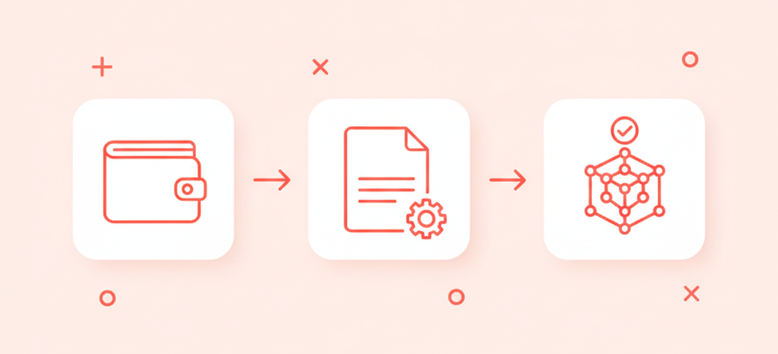



A decentralized payment gateway settles transactions directly on a blockchain, where wallet transfers and smart contracts replace the batch clearing and authorization steps used by card networks.
For institutional buyers, the real question is no longer whether the gateway accepts crypto, but how settlement finality, key custody, compliance controls, and gas costs combine into something a treasury team can operate.
Brokers, prop firms, iGaming operators, and high-volume merchants face a clear tension: they want on-chain finality and DeFi cost efficiency without giving up reporting, sanctions screening, or treasury visibility.
This guide walks through wallet flows, smart contracts, stablecoins, gas economics, and operating models, and connects each design choice to business risk.
Key Takeaways
- A decentralized payment gateway settles transactions on-chain, where wallet transfers and smart contracts replace the clearing and batch processing of traditional rails.
- Custodial, non-custodial, and hybrid models differ on who controls keys and where settlement executes, which drives compliance design and operational liability.
- Audited smart contracts help institutional buyers verify settlement logic and reduce counterparty dependence.
- Stablecoins act as the practical settlement layer because they combine blockchain programmability with lower treasury volatility.
- A decentralized payment gateway can still meet compliance obligations when on-chain settlement is paired with off-chain KYC, KYT, sanctions screening, and reporting.
What a Decentralized Payment Gateway Actually Is
A decentralized payment gateway is a payment system where the settlement step happens on public blockchain rails, while gateway services add APIs, invoicing, routing, reporting, conversion, and compliance layers around that core. The crypto rail handles value transfer; the gateway handles everything an operator needs to run that rail inside a business.
Competitors often blur two ideas. Decentralized settlement means the final transfer of value is recorded by a public ledger and confirmed by network consensus. Decentralized custody means the merchant or payer holds private keys directly, with no third-party signer.
A gateway can be one without being the other, so institutional teams evaluate key control independently from finality. For the gateway-versus-processor framing, see B2BINPAY's overview. Most flows route through Bitcoin, Ethereum, TRON, and stablecoins such as USDT, USDC, and DAI.
[[aa-cta]]
📢 Move from theory to working infrastructure
Talk to a B2BINPAY architect about on-chain settlement that fits your compliance stack.
[[/a]]
How Settlement Works on a Decentralized Gateway
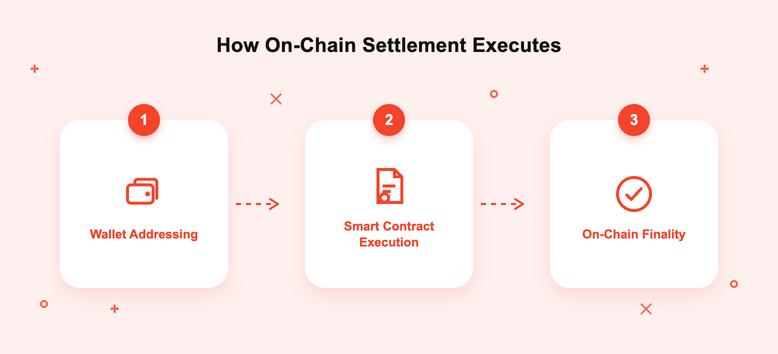
Settlement on a decentralized payment gateway follows five mechanical steps: invoice creation, wallet routing, smart contract execution, network confirmation, and final movement into a controlled treasury destination.
Each step replaces a function card networks handle through authorization, clearing, and batch settlement, which is why the operating model looks different from traditional rails.
The shift matters for any business managing chargeback-sensitive flows. On-chain settlement replaces batch clearing with consensus-defined finality, so once the confirmation policy is met, the transfer is economically irreversible. Brokers, iGaming operators, and merchants gain certainty but lose issuer-side reversals, which changes how risk, refunds, and dispute policies are written.
Step 1: Payment Initiation and Wallet Addressing
The gateway generates a unique payment request, quote window, and destination address (or smart contract call) for each payer session. The address is bound to that order, so reconciliation can match the on-chain transaction back to the merchant's accounting record without manual lookup.
Address handling is where most errors begin. A payer sending USDT on the wrong chain can lose funds permanently. B2BINPAY's Wallet as a Service issues addresses that resolve across Ethereum, Polygon, Avalanche, and similar EVM chains, lowering the chance of a cross-chain send error during checkout.
Step 2: Smart Contract Execution and Conditional Logic
Smart contracts encode the settlement logic that would otherwise live inside a processor's batch engine. Typical examples include escrow release on delivery confirmation, fee splitting between marketplaces and sellers, refund triggers based on time or oracle data, and automated payouts to merchant treasuries once confirmation thresholds are met.
Audit quality becomes counterparty risk here. Guidance from Ethereum.org on smart contract security lists what mature audits cover: reentrancy, access control, upgradeability via proxy patterns, input validation, and emergency pause mechanisms.
Step 3: On-Chain Confirmation and Settlement Finality
The gateway waits for the network confirmation count defined by the merchant's policy, then marks the payment final. Finality is the moment funds become economically irreversible and can move into treasury, swaps, or fiat off-ramp workflows. The threshold is a tunable risk parameter, set per chain and asset.
Card payments separate authorization from settlement, and chargebacks can land months later. On-chain finality removes that tail, which is why high-risk merchants in gaming, forex, and prop trading often prefer the model. The trade-off is operational: refunds become an explicit business workflow.
Custodial, Non-Custodial, and Hybrid Models Compared
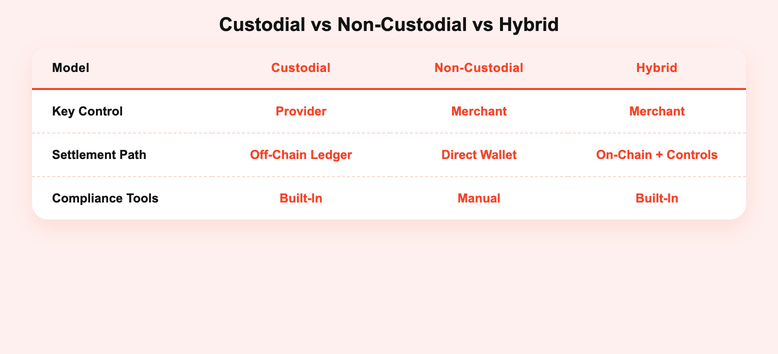
Decentralized payment gateways split into three operating models defined by two questions: who holds private keys, and where settlement executes. Custodial gateways hold keys on the merchant's behalf. Non-custodial gateways settle directly to addresses the merchant controls. Hybrid models combine on-chain settlement with operationally managed controls.
Each model carries a different liability profile. BTCPay Server places key management entirely on the merchant. Coinbase Commerce reduces that burden but introduces third-party risk. Embedded WaaS stacks like B2BINPAY's non-custodial DeFi infrastructure sit in the hybrid zone: settlement remains verifiable on-chain through CertiK-audited multisig contracts, while the platform layer supplies orchestration, reporting, and compliance plumbing.
For most institutional teams, the question is how much custody, screening, and tooling the business can absorb internally, and which functions belong with an infrastructure partner.
Why Audited Smart Contracts Matter for Institutional Buyers
Audited smart contracts turn decentralization from an unquantified technology risk into a due diligence asset. The audit converts the contract into a verifiable artifact that compliance, security, and finance teams can review before procurement sign-off, and it gives those teams a concrete answer when regulators ask how settlement executes.
Buyers should focus on six categories: access controls, upgradeability, reentrancy resistance, input validation, emergency pause mechanisms, and treasury movement logic. Each maps to a business question.
Access control governs internal segregation of duties. Upgradeability governs whether a vendor can change settlement rules without consent. Pause mechanisms govern incident response. A gateway that publishes audit reports, scope letters, and remediation logs publicly accelerates the buying cycle.
[[aa-cta-blue]]
📢 Need on-chain rails your compliance team can sign off on?
B2BINPAY pairs audited contracts with regulated VASP licensing in El Salvador and Mauritius.
[[/a]]
Stablecoins as the Practical Settlement Layer
Stablecoins are the working settlement asset in most decentralized payment gateway flows because they preserve blockchain speed and programmability while removing the treasury volatility that makes BTC or ETH unworkable for invoicing.
A merchant quoting in USDT or USDC receives almost the same dollar value at finality that the payer agreed to at checkout, which simplifies reconciliation.
Common options behave differently. USDT carries the deepest liquidity across exchanges and chains. USDC offers stronger reserve disclosures and faster bank-rail off-ramps where Circle operates.
Tokenized deposits issued by regulated banks are emerging as a third category. Chain choice changes fees, liquidity depth, and redemption risk. For the underlying mechanics, see how stablecoins maintain their peg.
Stablecoin settlement is not risk-free. The Bank for International Settlements has flagged data gaps in stablecoin reserve composition, and depegging events do occur. Treasury policy should set reserve diversification rules and a maximum exposure window per issuer.
How Compliance Layers Onto Decentralized Settlement
Compliance does not sit inside the blockchain transaction. It sits above the on-chain settlement event through KYB onboarding, KYC and KYT screening, sanctions checks, transaction reporting, and approval workflows.
The gateway's job is to wire those controls into the same pipeline that settles funds, so a regulated business can use blockchain rails without breaking licensing obligations.
B2BINPAY screens every transaction with KYT controls and operates under licences from the Comisión Nacional de Activos Digitales in El Salvador (PSAD designation, with Central Reserve Bank PSB supervised by SSF) and an FSC VASP licence in Mauritius (GB24203002). The European Securities and Markets Authority's MiCA framework imposes white-paper disclosure, authorisation, and supervision requirements on EU-facing crypto-asset service providers and stablecoin issuers. FATF Travel Rule expectations apply to VASPs globally.
Gas Cost Architecture and What It Means at Scale
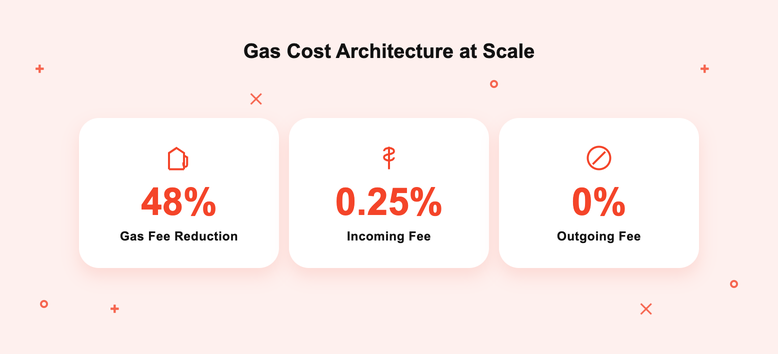
Gas is an operating expense, not a developer footnote. For a high-volume merchant or broker processing thousands of transactions per day, network fees and contract execution costs land directly on margin, so architecture decisions show up on the income statement every month.
Several choices materially change cost. Transaction batching consolidates multiple settlement events into one on-chain write. Network selection routes payments across TRON, Polygon, or Layer 2 rollups. Smart contract efficiency reduces gas units per call. One-commission models charge a single gateway fee per transaction rather than passing every gas spike to the merchant.
B2BINPAY's WaaS applies several of these. The platform reports an approximately 48% reduction in gas fees through its single-commission structure, and merchants can use TRX staking to acquire bandwidth and energy resources on TRON. Published fee schedules start at 0.25% for coin incoming volume above $5M and 0.35% for tokens, with outgoing transfers at 0%.
Choose a Decentralized Gateway Built for Regulated Business
The decision criteria for a regulated buyer are concrete: audited execution paths, stablecoin settlement options, integrated compliance tooling, treasury controls, scalable wallet infrastructure, and transparent fee architecture. Generic decentralization claims do not survive a CFO's diligence checklist; specific artifacts and licences do.
B2BINPAY combines audited on-chain execution, KYT-screened settlement, regulated VASP licensing in El Salvador and Mauritius, 350+ supported assets, and a published fee schedule of 0.25–0.50% incoming with 0% outgoing.
The platform processed $5.1B in incoming volume and 6.7M transactions for 983 business customers as of 2025, which is the scale a treasury team can underwrite. If your roadmap includes accepting crypto settlement without rebuilding your compliance stack, the next step is a structured conversation with our infrastructure team.
[[aa-cta-grey]]
📢 Ready to operate decentralized settlement on regulated rails?
Spin up a B2BINPAY sandbox today — fee-free testing, full API access, KYT-screened from day one.
[[/a]]
Frequently Asked Questions about Decentralized Payment Gateway
What is the difference between a custodial and non-custodial decentralized payment gateway?
A custodial decentralized payment gateway holds private keys on the merchant's behalf, while a non-custodial model settles directly to wallets the merchant controls. For most institutional teams, the deciding factor is not decentralization alone but how key control, reconciliation responsibility, and liability fit the existing operating model.
How does settlement work in a decentralized payment gateway?
Settlement begins when the payer sends funds to a generated address or smart contract that encodes the invoice terms. After network confirmations meet the merchant's policy, the transaction reaches on-chain finality, and the gateway can trigger callbacks, post reconciliation events, or initiate fiat off-ramp workflows.
Why do audited smart contracts matter in a decentralized payment gateway?
Audited smart contracts reduce hidden logic risk because routing, fee rules, and release conditions become visible and testable on-chain. For institutional buyers, that auditability is trust infrastructure: finance, compliance, and engineering teams can verify how settlement executes, which shortens procurement review.
Why are stablecoins the main settlement asset in a decentralized payment gateway?
Stablecoins combine blockchain programmability with lower price volatility, which makes them practical for invoicing, treasury transfers, and cross-border merchant settlement. They also simplify reconciliation, because the accounts receivable value does not move materially between payment initiation and final on-chain settlement.
Can a decentralized payment gateway work for regulated businesses?
Yes, provided the architecture separates on-chain settlement from off-chain controls such as KYT, KYC, sanctions screening, and reporting. That hybrid model lets brokers, merchants, and iGaming operators access decentralized rails without giving up compliance workflows. For teams evaluating B2BINPAY, the question is whether audited execution and operational controls match their licensing, custody, and settlement requirements.
Disclaimer: The service has legal and jurisdiction limitations. Please check T&Cs on https://b2binpay.com/en/risk-disclaimer

.svg)


