


Cross-border payment rails still produce disputed settlements, reconciliation lags, and audit gaps that cost finance teams time and capital. On-chain transactions answer those problems with transparent settlement, predictable audit trails, and verifiable proof that funds moved. For regulated operators evaluating crypto payment infrastructure, that visibility is the practical reason to consider blockchain rails alongside traditional banking.
An on-chain transaction is any transfer or smart contract action recorded directly on a blockchain network, where it becomes publicly verifiable after enough confirmations. This guide explains the lifecycle from broadcast to finality, the trade-offs against off-chain alternatives, how transparency supports compliance, and which enterprise controls keep irreversibility from becoming operational risk.
Key Takeaways
- An on-chain transaction is a transfer or smart contract call recorded directly on a blockchain, verifiable through its transaction hash after network confirmation.
- The path from mempool to finality explains why confirmation times, gas fees, and TxIDs shape daily payment workflows.
- On-chain transactions offer stronger transparency and audit trails than off-chain transfers, but often involve higher fees and slower execution during congestion.
- For regulated businesses, the immutable record supports KYT monitoring, reconciliation, and external audits across payment and treasury workflows.
- Because on-chain transactions are largely irreversible and fees vary by chain, enterprises need controls that reduce errors and prevent routing mistakes.
What Is an On-Chain Transaction?
An on-chain transaction is a state change recorded directly on a blockchain: a coin transfer, a token movement, or a smart contract execution that validators add to a confirmed block.
The record is timestamped, signed, and publicly retrievable through its transaction hash. That makes it materially different from an internal balance update sitting inside a single operator's database.
For payment and treasury teams, every confirmed action creates a tamper-resistant audit trail. Reconciliation can reference a TxID instead of a counterparty's word, and compliance officers can demonstrate to auditors exactly when funds moved and which addresses were involved.
When a customer pays a merchant in USDT on Ethereum, the transaction broadcasts to the network, waits in the mempool, gets included in a block, and accumulates confirmations until both sides treat it as settled.
How a Transaction Moves From Broadcast to Confirmed Block
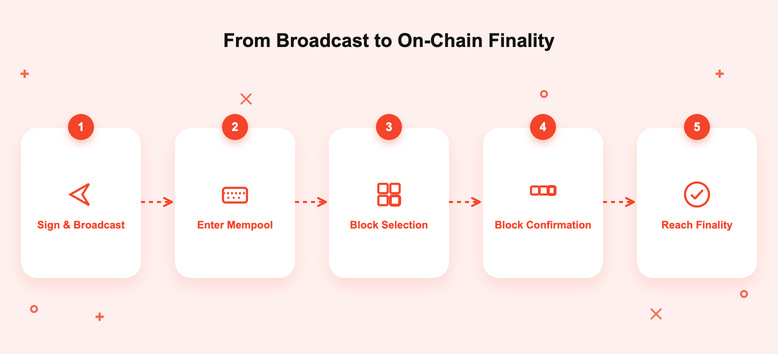
The lifecycle has five stages. The sender signs the transaction and broadcasts it to the network. Nodes propagate it into the mempool, a queue of unconfirmed transactions. A validator (or miner) selects transactions, usually prioritizing higher-fee ones, and packs them into a candidate block. Once the block is added to the chain, the transaction has one confirmation. Each subsequent block adds another, increasing the cost of any attempted reversal.
Finality models differ by chain. On Bitcoin, finality is probabilistic: most exchanges treat six confirmations (roughly an hour) as settled for high-value transfers. On Ethereum post-Merge, blocks are bundled into 32-slot epochs of about 6.4 minutes, and a block typically reaches finalization after two epochs, around 12.8 minutes (ethereum.org). On many proof-of-stake chains, deterministic finality arrives in seconds.
Key Terms: Mempool, Gas Fees, Finality, and TxID
Mempool. The pool of pending, unconfirmed transactions held by each node. When congested, fees rise and confirmations slow.
Gas fees. The cost of computation paid to validators. On Ethereum, fees split into a base fee that is burned and a priority fee paid to the validator; a standard transfer requires 21,000 gas units (ethereum.org). On Bitcoin, fees buy block space in satoshis per virtual byte.
Finality. The point at which reversing a transaction becomes economically or cryptographically impractical. Probabilistic on Bitcoin, deterministic on most proof-of-stake networks.
TxID (transaction hash). A unique identifier produced when the transaction is signed. Operations teams use it to look up settlement status in a block explorer and attach evidence to support tickets, refunds, or audits.
[[aa-cta]]
Stop Running Your Own Reconciliation
B2BINPAY's crypto payment processing handles broadcast, confirmation, and settlement across 350+ currencies, with full TxID-level transparency from a single dashboard.
[[/a]]
On-Chain vs. Off-Chain Transactions: Core Trade-Offs
On-chain and off-chain are architectural choices, not ideological camps. The trade-off: stronger trust guarantees and public verifiability on-chain, against lower cost and higher throughput off-chain. Most production payment stacks use both, depending on transaction value, frequency, and audit posture.
A high-value treasury transfer benefits from on-chain settlement because both sides want immutable proof. Micropayments inside a wallet app benefit from off-chain handling because the per-transaction cost would otherwise exceed the payment amount.
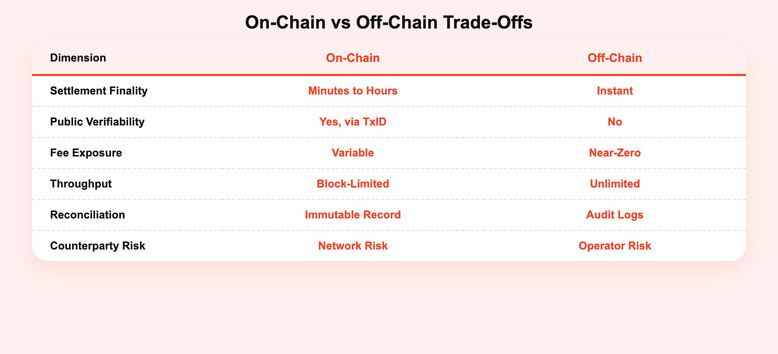
Speed, Cost, and Settlement Finality Compared
Bitcoin produces a block roughly every ten minutes, with six confirmations (about one hour) as the conventional threshold for high-value finality (bitcoin.org). Ethereum produces a block every 12 seconds and reaches formal finalization in roughly 12.8 minutes.
An internal exchange ledger settles instantly because no consensus is required. Layer 2 rollups like Arbitrum batch many transactions off the main chain and post a compressed proof back to Ethereum, where settlement finality is inherited from L1 (Arbitrum docs).
When Off-Chain Settlement Makes Sense for Businesses
Off-chain settlement fits internal transfers between accounts under one operator's control, high-frequency microtransactions where fees would dominate, and merchant batching where end-of-day netting is acceptable. In these cases, immediate public settlement adds cost without adding meaningful audit value.
Hybrid payment gateways combine both. Customer deposits and merchant withdrawals settle on-chain, giving auditors a verifiable trail, while internal ledger movements run off-chain for speed.
For background, B2BINPAY's on-chain vs. off-chain transactions beginner's guide walks through the implications for payment teams.
Why On-Chain Transparency Matters for Compliance and Auditability
Transparency is the operational reason regulated firms use on-chain settlement. Every confirmed transaction is timestamped, signed, and addressable by hash, giving compliance teams a verifiable record that does not depend on the counterparty's cooperation.
Immutable records support KYT screening, exception reviews, and external audits. When a payment processor screens an inbound transaction against sanctions lists or known illicit addresses, the chain itself is the source of truth. Reconciliation stops being a multi-system join and becomes a single explorer query.
Institutional compliance teams increasingly expect on-chain analytics as a baseline control (Chainalysis 2026 benchmark). B2BINPAY runs KYT screening on every transaction, backed by regulated entities in El Salvador (CNAD PSAD authorisation, SSF supervised) and Mauritius (FSC VASP licence GB24203002).
[[aa-cta-blue]]
Don't Bolt Compliance on Later
Open a B2BINPAY merchant account and inherit KYT screening, audit-ready transaction history, and regulated settlement from day one.
[[/a]]
On-Chain Transactions Across Multiple Networks
Most operators do not run a single-chain business. BTC, Ethereum, TRON, BNB Chain, and Solana expose different fee structures, confirmation rules, and token standards. Treating them uniformly is how routing mistakes happen, and on-chain routing mistakes are usually unrecoverable.
The same USDT moves on ERC20 (Ethereum), TRC20 (TRON), and BEP20 (BNB Chain), each with its own fee logic, address format, and confirmation expectation; sending USDT-TRC20 to a USDT-ERC20 address typically destroys the funds.
Across 2025, B2BINPAY processed 6.7 million transactions for 983 business customers, with $5.1 billion in incoming volume routed across 350+ currencies, each with chain-specific validation, confirmation logic, and KYT screening applied automatically.
How Fee Structures and Finality Differ by Chain
Fee logic differs by what each network prices. Bitcoin sells block space, so fees scale with transaction byte size and mempool congestion. Ethereum prices computation, charging base + priority fees per gas unit. Faster proof-of-stake networks like Solana typically offer fractions of a cent per transfer, with different validator trust assumptions in exchange.
Confirmation thresholds should vary with asset value, fraud risk, and refund policy. A $25 retail payment can clear in one or two confirmations; a $250,000 treasury transfer should wait for full finality. B2BINPAY's processing fees reflect this multi-chain reality: 0.25–0.40% on coin payments, 0.35–0.50% on tokens, and 0% on outgoing transactions, with crypto settlement immediate and fiat settled T+1.
TRON Bandwidth and Energy as a Cost Optimization Model
TRON does not charge gas the way Ethereum does. It allocates two resources, bandwidth and energy, that users can earn by staking TRX or pay for by burning it. Each user gets 600 bandwidth units free per day; beyond that, the network burns 0.001 TRX per byte for bandwidth and 0.0001 TRX per energy unit for smart contract execution (TRON docs).
Staking TRX through the FreezeBalanceV2 mechanism allocates a share of the daily network resource pool proportional to the staked amount, which can cut TRC20 transfer costs for high-volume merchants.
B2BINPAY's Staking and Wallet as a Service implement this directly, lowering TRC20 payment costs while keeping reporting centralised.
Managing the Irreversibility Risk in High-Volume Operations
Irreversibility is both the benefit and the risk of on-chain settlement. No chargebacks protect merchants from fraud; no recovery path means a wrong-address transfer is permanent. The controls around the send are as important as the rail itself.
Regulated operators converge on a standard control set: address whitelists, multi-signer approval workflows for large transfers, manual review above defined thresholds, callback validation tied to TxID, role-based permissions across treasury and ops, and staged release policies.
Each control reduces a different failure mode: input error, internal fraud, address poisoning, or compromised credentials. B2BINPAY's Wallet as a Service layers these into infrastructure: configurable confirmation thresholds trade speed for safety per asset, duplicated addresses across chains catch wrong-network sends before broadcast, and the fee-free sandbox lets new integrations verify callback handling before any mainnet funds move.
[[aa-cta-grey]]
Test Before You Ship
Spin up a B2BINPAY sandbox account to validate confirmation thresholds, callbacks, and address handling at zero cost.
[[/a]]
On-Chain Settlement in Enterprise and Institutional Contexts
On-chain settlement now serves real payment, treasury, and wholesale use cases, not only retail transfers or DeFi experiments. JPMorgan's Kinexys platform settles on-chain FX trades for institutional counterparties, showing that programmable, auditable settlement has crossed from pilot into production at major financial institutions (Kinexys on-chain FX).
For merchants, brokers, exchanges, and funds, the practical use cases are already operational: high-value treasury movements between custodians, auditable payouts to suppliers or affiliates, programmable settlement logic for revenue-share arrangements, and cross-border B2B transfers where SWIFT timing or cost is prohibitive.
Build Your Crypto Payment Infrastructure on a Compliant On-Chain Foundation
The case for on-chain transactions in business payments comes down to three operational gains: verifiable settlement evidence, automated compliance signals from immutable records, and multi-chain cost flexibility. None of those benefits arrive automatically. They require infrastructure that handles broadcast, confirmation thresholds, KYT screening, and irreversibility controls on the operator's behalf.
B2BINPAY provides that infrastructure as a regulated service, with licensed entities in El Salvador and Mauritius, KYT screening on every transaction, 350+ supported currencies, and processing fees that scale with real volume.
[[aa-cta]]
Start accepting crypto payments on a regulated, compliance-ready foundation.
Open a B2BINPAY merchant account
[[/a]]
Frequently Asked Questions About On-Chain Transactions
What does an on chain transaction mean?
An on-chain transaction is a transfer, smart contract call, or other state change recorded directly on a blockchain ledger. After validators include it in a block and finality is reached, the record becomes publicly verifiable through its TxID. That public record is what separates on-chain settlement from internal ledger updates inside a single operator.
How does an on chain transaction differ from an off chain transaction?
An on-chain transaction settles on the blockchain itself and is verifiable by anyone with the TxID, while an off-chain transfer stays inside a separate ledger, payment channel, or Layer 2. The trade-off usually means stronger transparency and finality on-chain, but lower speed and higher network fees during congestion.
How do you check or track an on chain transaction?
Use the transaction hash (TxID) in a block explorer to view the sending address, receiving address, fee, status, and number of confirmations. For operations teams, that record helps reconcile deposits, investigate delays, attach evidence to support tickets, and prove settlement without depending on an internal ledger alone.
Are on chain transactions reversible?
In most cases, no. Once an on-chain transaction reaches sufficient finality, reversing it requires a new transaction in the opposite direction, not a cancellation. That is why businesses use whitelists, multi-signer approval flows, confirmation thresholds, address validation, and staged release policies to reduce costly sending errors before they happen.
Why do on chain transactions matter for compliance and crypto payments?
Because every confirmed movement leaves a tamper-resistant audit trail, on-chain settlement supports KYT screening, reconciliation, and regulator-facing reporting. For merchants, brokers, and fintechs, infrastructure such as B2BINPAY combines that visibility with automated callbacks, wallet controls, and multi-chain cost optimization.
Disclaimer: The service has legal and jurisdiction limitations. Please check T&Cs on https://b2binpay.com/en/risk-disclaimer

.svg)


