

A payment gateway and a payment processor are often mistaken for each other, but they aren’t the same thing. A payment gateway is the front-end-facing platform that collects a customer’s payment information, while the processor is the backend program that validates the payment information and routes funds from the customer’s bank account to the business being paid. They both play key roles in online payments, and this article dives deeper into their respective roles.
[[aa-cta]]
Global Crypto Processing for E-commerce
Join 500+ global enterprises scaling with blockchain payments.
Go beyond traditional banking boundaries. Accept 350+ digital assets, settle in your preferred fiat currency, and eliminate chargeback risks with our industry-leading Merchant solution.
Onboarding in <24h
[[/a]]
The payment ecosystem
The online payments ecosystem comprises several key parties:
- The merchant getting paid for their product or service.
- The customer sending the payment to the merchant.
- The customer’s bank and the merchant’s bank.
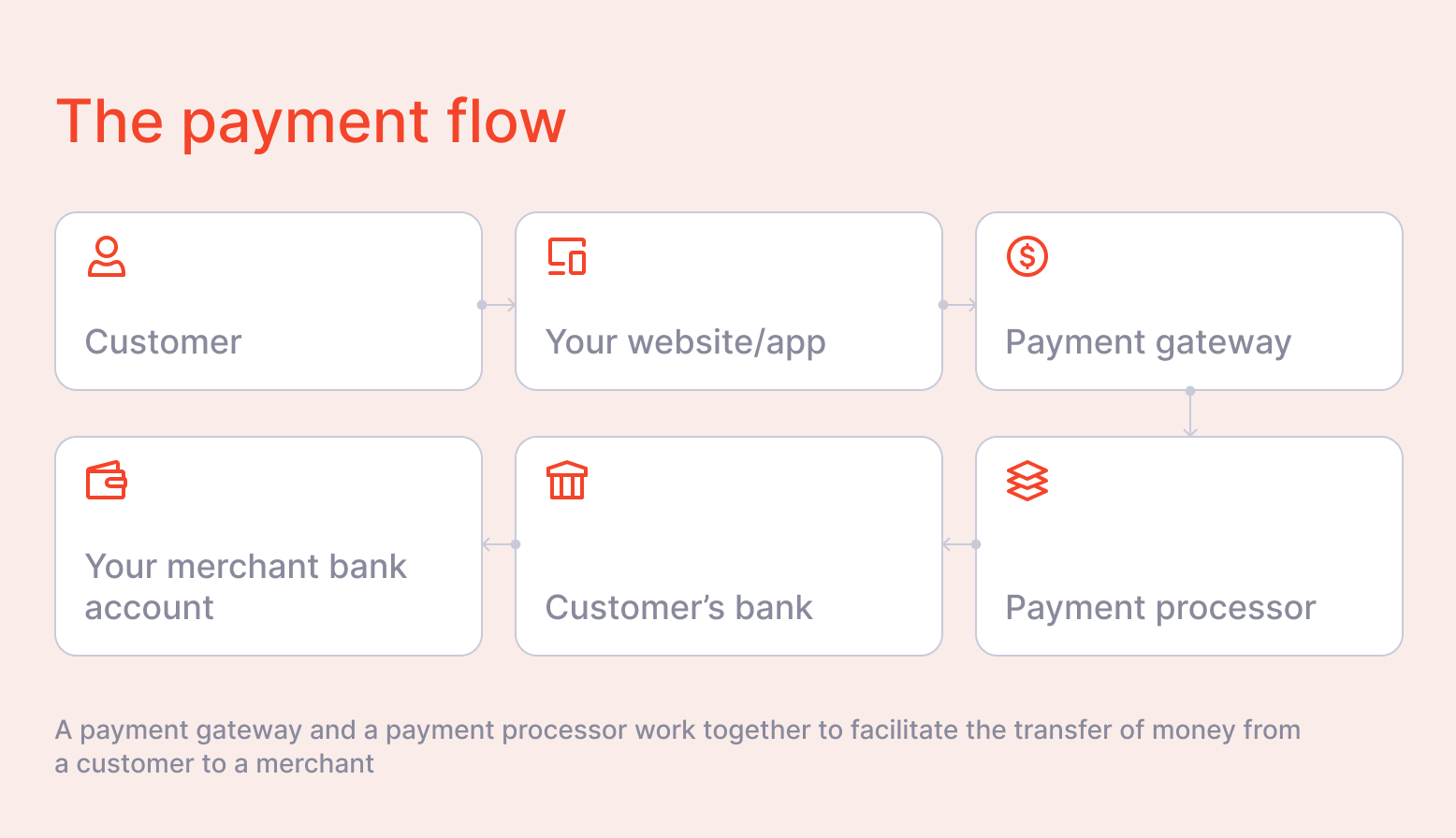
A payment gateway and a payment processor serve as the glue that binds these parties. They work together to ensure payments get swiftly routed from the customer’s bank account to the merchant’s bank account.
What is a payment gateway?
A payment gateway provider is the platform where a customer enters their credit/debit card information to initiate a transaction. The gateway securely transmits this information to the payment processor to execute the transaction.
What is a payment processor?
A payment processor is the backend platform that receives a customer’s credit/debit card information, then routes this information to the customer’s bank account to authorize a payment. If the payment is authorized, the gateway receives the customer’s money and sends it to the merchant’s bank account.
Payment processors ensure funds are safely moved from the customer’s bank account to the merchant’s. They also provide complementary services like fraud detection and chargeback management.
Gateway vs. Processor: Key differences
Let’s explore the difference between a payment gateway and a payment processor in different scenarios:
Service scope
A payment gateway is primarily concerned with securely transmitting payment information. It receives the customer’s credit/debit card details or other payment information, encrypts it, and transmits it to the payment processor.
The payment processor handles the backend logistics of validating the payment information and routing funds from the customer to the merchant. It also offers broader services like fraud detection, compliance, and chargeback processing.
Integration options
Payment gateways are generally easier to integrate into your website through APIs or ready-made plugins. On the other hand, payment processors require first setting up a merchant account, then submitting various documents to verify your personal and corporate information.
Data flow and security
Both a payment gateway and a processor heavily use encryption protocols to safeguard payment information. However, a processor deals with more data flow, from the customer’s card network to their bank, then receives a response before transmitting it back to the merchant.
Merchant accounts & acquirers
As mentioned above, a payment processor requires businesses to create a merchant account. Money collected from customers will be deposited into this merchant account, which temporarily holds the money before transferring it to the business’s main bank account.
Every processor works with an acquiring bank that authorizes a payment from a customer’s bank account. The money is then transferred from the customer’s bank account to the acquiring bank. Funds in your merchant account are held by the acquiring bank before being transferred to your main business bank account.
Payment methods & supported channels
Although credit/debit cards are the most widely used, payment processors support various other payment methods. For example, users can pay through a digital wallet app like Google Pay, Apple Pay, and PayPal. Some payment processors also support cryptocurrencies, particularly stablecoins like USDT and USDC. Merchants can choose to receive cryptocurrency directly or convert it into fiat before withdrawal.
Likewise, some processors support bank transfer payments. Supported channels vary across locations, and customers can pick which channel is most convenient. When selecting a payment processor, you’re better off with an omnichannel processor that supports multiple payment methods.
Fraud management, security, & compliance
Payment processors face a lot of hacking attempts and can’t afford to be complacent about security. They use sophisticated encryption algorithms to safeguard payment information in transit and ensure that malicious actors don’t gain access to customers’ card details. They also use AI and ML algorithms to analyze transactions for fraud patterns, then block suspicious transactions in real-time.
Because they move funds through the banking system, payment processors must comply with regulations in various jurisdictions. For example, in the U.S., they must comply with anti-money-laundering and know-your-customer (KYC) laws. When selecting a payment processor, choose only a licensed provider that complies with regulations in your customers’ jurisdictions.
Fees and pricing models
Payment gateways and processors charge several fees for their services. You can expect these fees when using a payment gateway and processing platform:
Setup fee
Processors can require a one-time payment to set up and integrate their platform into your website.
Monthly/Annual fees
Some gateways require a monthly or annual subscription to maintain access to their services.
Transaction fee
Virtually all gateways charge a fee per transaction, typically a small fixed fee plus a percentage of 1.5% to 3.5%.
Other
You may incur extra fees for currency conversion, withdrawals from your merchant account to a corporate bank account, chargeback processing, etc.
Card network
The customer’s card network charges a small assessment fee of 0.13% to 0.15% per transaction.
Between all these fees, expect to incur a total charge of 1% to 5% to process a fiat transaction. However, if your payment processor supports cryptocurrency, fees can be considerably lower.
Integration, APIs, and platform features
To integrate a payment gateway or processor, you’ll use APIs issued by your respective platform. APIs enable instant communication between your website and the gateway or processor’s platform, so customers can enter their payment details and receive a response within seconds.
For example, B2BinPay provides a crypto payment gateway API you can use to accept cryptocurrency payments from customers. After integrating this API into your website or app, you can accept Bitcoin, USDT, USDC, Litecoin, and dozens of other digital tokens from customers.
You can also use APIs to build custom payment features for your website, like automatically selecting a specific currency based on the customer’s location.
Choosing the right payment solution
To choose the best payment gateway and payment processor for your business, consider these criteria:
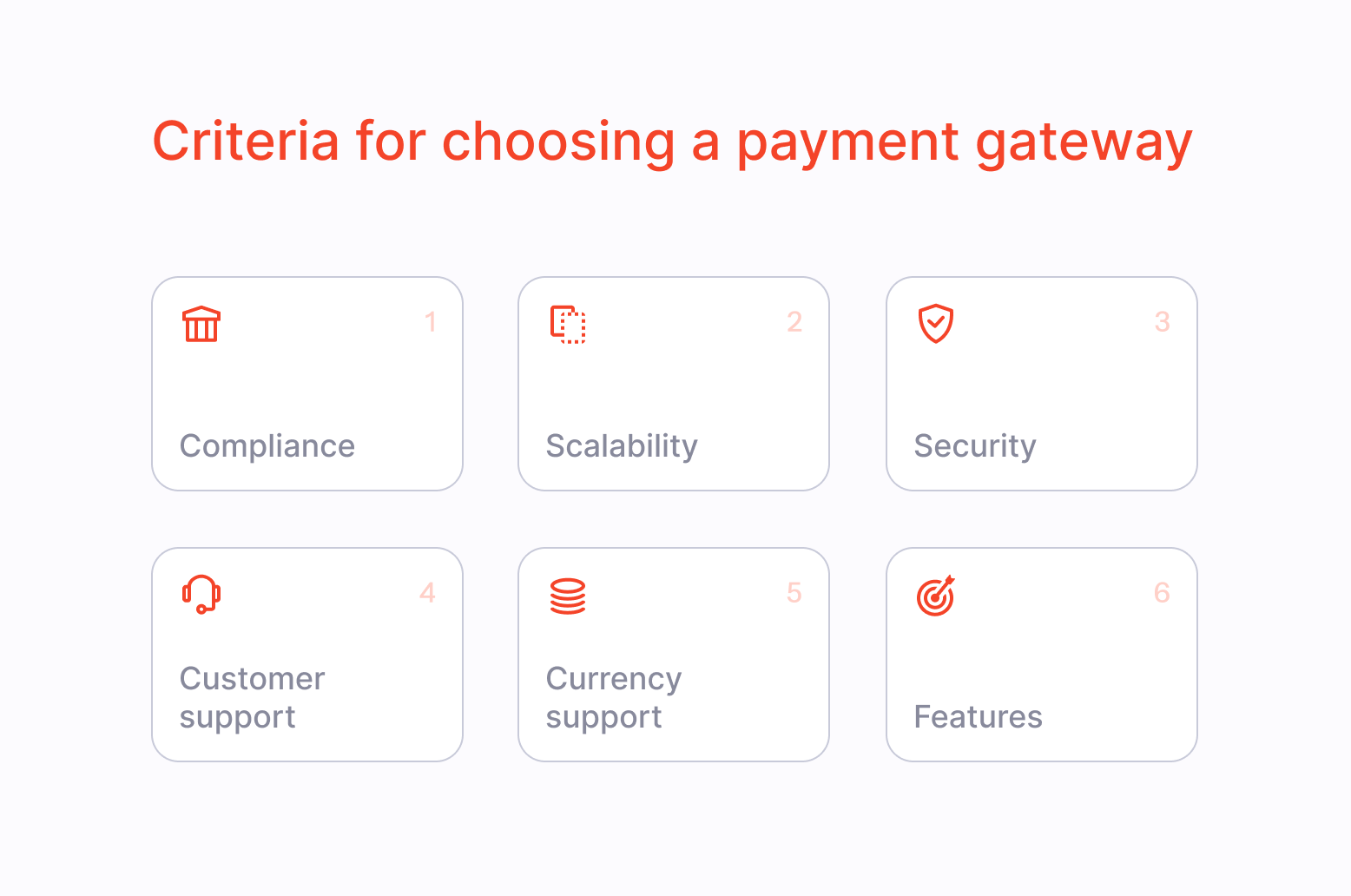
- Compliance. Ensure the platform complies with regulatory requirements in your jurisdiction, including KYC, anti-money laundering, and reporting. Otherwise, your payments could get entangled in legal disputes.
- Scalability. Seek a platform that can process increasing amounts of money without sacrificing performance. You may be asked to provide extra documentation to process large payments, but the infrastructure should remain intact.
- Security. Your online payment gateway or processor should have enhanced fraud detection algorithms and encryption protocols to safeguard customers’ funds.
- Support. The best payment gateway providers offer excellent support services, with detailed API documentation and guides to help with the initial setup. Their support teams can be quickly reached via email, live chat, or telephone.
- Currency support. Choose a platform that allows customers to pay in your preferred currencies. If you need a payment processor that accepts cryptocurrencies, B2BinPay is an ideal choice.
- Features. Consider your desired features, from fees to batch processing, onboarding, fraud prevention, and third-party integrations. Compare features from different platforms before making your final decision.
Crypto payment gateway special features
These are the main features to expect if you’re seeking a crypto payment gateway:
- Multi-currency wallets. Crypto payment gateways let you accept payments in many cryptocurrencies, from mainstream tokens like Bitcoin and Ethereum to stablecoins like USDT and USDC. You can seamlessly convert earnings from one token to another.
- Speed. Cryptocurrency transactions can be settled within seconds or minutes, unlike fiat transactions that can take several days to settle in your bank account.
- Unlimited. Many crypto payment gateway services don’t impose limits on the volume of crypto you can receive. You can receive as much as your business permits.
Trends & industry statistics
Digital payments is on a massive growth spree globally, more so in emerging markets. According to Statista, annual digital payments are expected to grow from $24 trillion in 2025 to $36 trillion in 2030. This figure includes card payments, wallet apps, cryptocurrencies, and in-person point-of-sale systems.
China and the U.S. lead the global digital payments market, followed by India, Japan, and the U.K. Massive growth opens more opportunities to build successful e-commerce businesses, and the journey begins with choosing the right payment gateway.
Use cases & industry scenarios
Payment gateways and processors are used across many industries. From accepting payments for your e-commerce business to companies paying for software subscriptions, cryptocurrencies used for remittances, and micro-payments for media content, there are endless examples of digital payments making the global economy run smoothly.
In particular, cryptocurrencies have made it easier to conduct business globally, with transactions settled within minutes. If you need a reliable payment gateway, look no further than B2BinPay and enjoy instant processing, low fees, smooth integration, and unlimited transaction volumes.
FAQs
Do I need both a payment gateway and a payment processor?
Yes, you need both a payment gateway and a payment processor to receive money from customers. The payment gateway collects the customer’s information, and the processor uses this information to send funds from the customer’s bank to your merchant bank account. Both work hand-in-hand to enable smooth e-commerce transactions.
Can a payment gateway be a payment processor?
Yes, some platforms combine both a payment gateway and a payment processor. They both collect a customer’s payment information and use this information to execute a financial transaction. They are more convenient compared to using separate gateways and processors.
What is the difference between a payment gateway and a point-of-sale (POS) system?
A payment gateway handles online transactions, while a point-of-sale (POS) system handles in-person transactions where the customer swipes, inserts, or taps their card. A POS system can also allow customers to pay by entering their card details, similar to using a payment gateway. Both have overlapping features, but a gateway is for online transactions, and a POS system is for processing in-person transactions.
How do chargebacks work with gateways and processors?
If a customer requests a chargeback, citing issues like unmet service, the payment processor conducts a thorough investigation to decide who’s at fault. If there’s no fault from your end, the chargeback will be declined. Otherwise, the processor will refund the customer, and you may incur a chargeback fee.
However, chargebacks aren’t available on a crypto payment gateway. Blockchain transactions are irreversible, so the customer needs an alternative way to seek a refund, e.g., contacting your support team.
Can I switch payment processors without changing my gateway?
Yes, you can switch a payment processor without changing your payment gateway. However, it introduces more complexity to the setup and ongoing maintenance. Integrating the new payment processor may require some downtime during which you can’t accept payments. It’s advisable to use the same payment gateway and processor for added convenience.

.svg)