


Finance teams running hundreds or thousands of payouts a cycle know the pattern: a junior ops person copy-pasting wallet addresses into a spreadsheet at 11pm, a duplicate payment spotted the next morning, and a reconciliation session that eats half of a Monday. Crypto payout automation fixes that. It uses APIs, stablecoin rails, and compliance automation to execute mass transfers of digital assets to many recipients with minimal human touch.
The speed advantage is real. A SWIFT cross-border transfer takes two to five business days and stops at bank cutoffs. Stablecoin settlements finalize in seconds to a few minutes and run 24/7, a reality confirmed by Stripe’s research on stablecoin cross-border payments. The business case is showing up in the numbers too: B2B stablecoin payments grew over 730% year-over-year in 2025, according to The Defiant, driven largely by payroll, affiliate, and supplier payout flows.
This article is a practical walkthrough, not a feature tour. It covers why manual payouts break, what automation actually means in practice, the three layers of a production payout stack, and a five-step roadmap for launching automated payouts fast, without rebuilding treasury infrastructure from scratch.
Key Takeaways
- Crypto payout automation eliminates manual bottlenecks by using APIs and stablecoin rails to process mass transfers in minutes rather than days, making it essential for businesses scaling past a few dozen recipients per cycle.
- A reliable automated payout stack requires three core layers: a liquidity wallet for treasury management, a compliance engine with KYT screening, and an execution rail with built-in reconciliation.
- Stablecoins like USDT and USDC remove volatility risk while enabling 24/7 settlement, letting finance teams disburse funds without holding speculative crypto assets on the balance sheet.
- Implementation can move in weeks, not months, when you start with sandbox API testing, define clear trigger logic, and deploy monitoring before going live with production batches.
- Post-launch success depends on tracking metrics like settlement time, failure rate, and reconciliation accuracy. Small operational wins compound across hundreds of payout cycles.
Why Manual Payouts Break at Scale
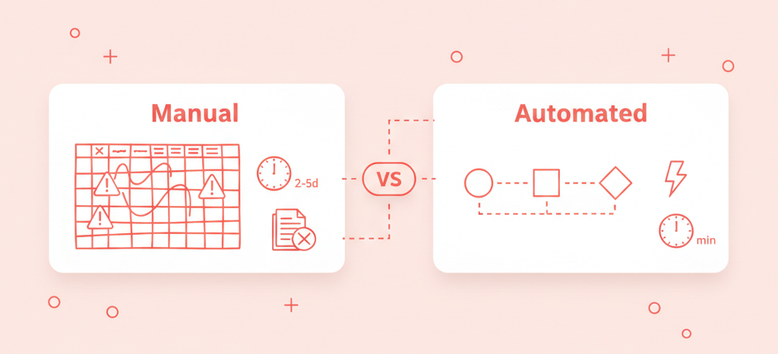
Manual payout runs work for small, one-time batches. They stop working the moment your recipient list grows from 30 names to 300. Inconsistent data entry causes wrong-address sends. Duplicate processing creates double payments that you may never recover. Missed payments show up as support tickets two weeks later. Reconciliation mismatches turn every month-end close into a fire drill.
The operational cost is hidden but enormous. A gaming platform paying 500 affiliates weekly spends eight or more hours on verification, approvals, and execution, and still ships errors. A creator marketplace running monthly payouts to 200 accounts typically loses a full ops day per cycle. That time is before anything goes wrong.
Fiat rails add their own drag. SWIFT transfers take two to five business days, die at bank cutoffs, and charge aggressive FX spreads on top of wire fees. For businesses paying across 20+ countries, cross-border banking fees commonly run 3–6% of payout value, a margin tax that scales with volume. Crypto rails replace that with near-instant settlement, 24/7 availability, and transaction costs that can drop 60–80% compared to correspondent banking.
Manual workflows cannot absorb that kind of load. Automation is the only honest answer once you cross a few hundred payouts per cycle.
[[aa-cta-blue]]
Build your payout automation on regulated infrastructure
See how B2BINPAY's developer-first API helps you launch automated stablecoin payouts with built-in KYT screening in under 24 hours.
[[/a]]
What Crypto Payout Automation Really Means
Crypto payout automation uses software to calculate, validate, and execute cryptocurrency transfers to multiple recipients based on predefined rules and triggers. In practice, it is three things working in sequence: a trigger layer that decides when to pay, a validation layer that checks each payout, and an execution layer that settles on-chain.
Triggers come in three flavors. Scheduled triggers fire on a calendar cadence: daily payroll, weekly affiliate cycles, monthly contractor runs. Event-driven triggers fire on condition, such as a player hitting a withdrawal threshold, a contractor marking a milestone complete, or a creator's earnings crossing a payout floor. Batch-based triggers aggregate instructions throughout the day and release them at a cutoff.
The architecture is hybrid by design. Off-chain logic handles the business rules, the compliance checks, and the approval queues. On-chain execution processes the transfers on the blockchain, typically combining off-chain logic with on-chain execution. This split matters because it lets you catch a bad payout before the money moves, not after.
Automation does not mean no humans. Approval workflows, exception queues, and manual overrides stay in the loop. What changes is that repetitive work runs by itself: address validation, amount calculation, batch assembly, webhook tracking.
Stablecoins are the preferred payout asset for a reason. USDT and USDC preserve the speed of crypto settlement without exposing your treasury or your recipients to price volatility. Most mature payout stacks default to stablecoin rails and treat native-crypto payouts as a special case.
High-Impact Use Cases: From Gaming Rewards to Global Payroll
Crypto payout automation shows up well beyond crypto-native businesses. Any operator moving a large volume of small-to-medium payments across borders is a strong candidate. The patterns below repeat across industries: the pain is manual processing, the unlock is API-driven stablecoin rails, the measurable outcome is settlement time collapsing from days to minutes.
Automate Gaming Reward Payouts
Gaming and iGaming platforms distribute tournament winnings, loyalty rewards, and affiliate commissions to thousands of players across dozens of jurisdictions. Manual processing here is brutal: a frustrated player files support tickets within hours of expected payout, and cross-border compliance adds friction that banking rails cannot handle at scale.
The automated flow looks like this: event-driven triggers release funds once a player clears a withdrawal threshold, automated KYT screening runs against sanctions and risk lists, and stablecoin rails settle the payout in minutes regardless of where the player lives. B2BINPAY supports this model by enabling gaming operators to automate payouts directly from a single liquidity wallet without regional bank integrations.
Affiliate and Creator Payouts
Marketplaces, SaaS platforms, and media companies run performance-based payouts to affiliates, influencers, and creators on monthly or bi-weekly cycles. Each payment is different: variable amounts, multiple target currencies, recipients spread across 30+ countries. Manual processing makes this error-prone and slow.
The automated flow aggregates earnings at the cycle close, validates each recipient against the compliance layer, and executes payouts in a single stablecoin batch. A creator platform paying 200 accounts monthly typically compresses a two-day manual process into under an hour. International recipients off-ramp to local fiat through their own exchange when they want, freeing the platform from managing currency conversion at the payout layer.
Contractor Payroll at Scale
Distributed teams paying international contractors hit the same banking wall every pay cycle: FX fees on every transfer, cutoffs that stall payroll Friday afternoon, 2–5 business day delays for recipients who need the money that week. Stablecoin payroll solves all three at once.
Scheduled triggers fire payroll on the cadence you already use. Stablecoin payouts settle within minutes, not days. Recipients convert to local currency through their preferred off-ramp. For businesses already paying employees in cryptocurrency, automation removes the spreadsheet entirely.
Core Building Blocks of an Automated Payout Stack
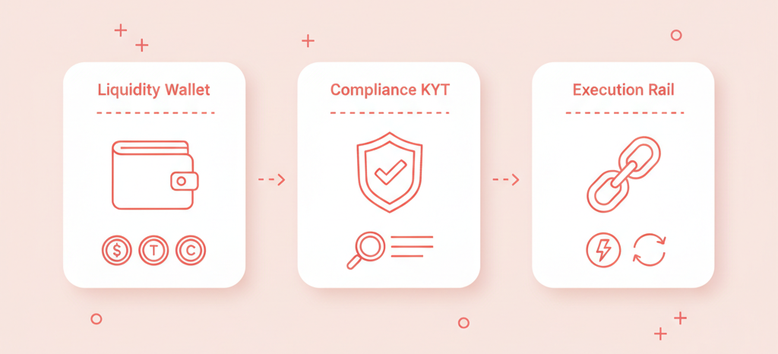
A reliable payout system is not one service. It is three layers working together.
Liquidity Wallets and Off-Chain Queues
A liquidity wallet is a treasury-controlled wallet holding the stablecoins or crypto you pay out from. The off-chain queue is the staging layer where payout instructions get validated, prioritized, and assembled into batches before execution.
B2BINPAY consolidates incoming funds automatically into a single crypto wallet per currency, simplifying treasury tracking and enabling efficient batch planning.
Compliance Engine With KYT
KYT (Know Your Transaction) screens every payout against sanctions lists, risk-scored wallet clusters, and fraud patterns before execution.
Regulatory pressure is increasing globally. According to Sumsub’s overview of the FATF Travel Rule, 73% of jurisdictions are implementing Travel Rule legislation, with the EU and UK requiring data sharing on all transfers. B2BINPAY integrates compliance through risk scoring, sanctions screening, and AML monitoring on every payout.
Execution Rail and Reconciliation Layer
The execution rail processes transactions on-chain, while the reconciliation layer ensures internal records match blockchain results.
Robust systems include idempotent webhooks, retries, and real-time dashboards. B2BINPAY provides monitoring tools that track payout status in real time for accurate reconciliation.
How to Launch Crypto Payout Automation: A Step-by-Step Guide
Step 1: Plan Your Triggers and Data Schema
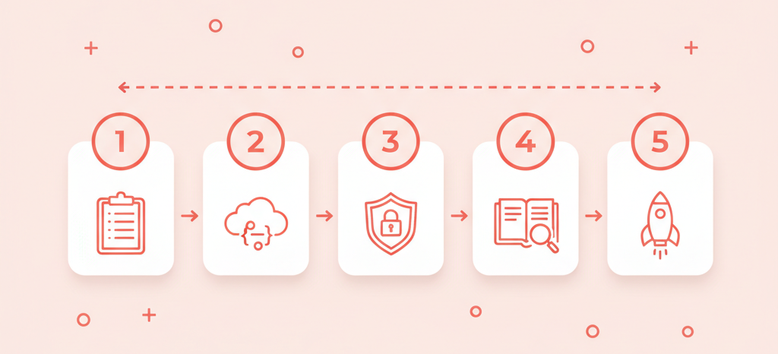
Define payout triggers and required data fields such as wallet address, amount, asset type, and reference ID.
Step 2: Integrate Sandbox API and Webhooks
Test integration with sandbox APIs and simulate edge cases like invalid addresses or duplicate submissions.
Step 3: Define Risk Controls and Compliance Checks
Implement idempotency keys, KYT checks, and balance alerts before production.
Step 4: Audit Ledger and Webhook Reliability
Ensure internal records match on-chain transactions and test failure scenarios.
Step 5: Go Live With Monitoring in Place
Start with small batches, verify results, and scale gradually with monitoring tools active.
Post-Launch Metrics and Continuous Improvement
Track key metrics: settlement time, failure rate, reconciliation accuracy, transaction cost, and exception resolution time. Review performance regularly and refine operations continuously.
Move Faster With Developer-First Payout API
B2BINPAY offers REST APIs, sandbox testing, and infrastructure designed for fast integration. Key features include automated wallet consolidation, zero outgoing payout fees, and built-in crypto payment processing.
The platform supports 350+ cryptocurrencies across 20+ blockchains and enables fiat conversion via SEPA and SWIFT, making it suitable for global payout operations.
[[aa-cta]]
Ship automated crypto payouts in weeks, not months
Get API keys and sandbox access today.
[[/a]]
Frequently Asked Questions About Crypto Payment Automation
What if a recipient never claims the payout?
Crypto payouts settle directly to wallet addresses. If a payout fails before execution, apply reissue policies.
Can I automate payouts without holding volatile assets?
Yes. Stablecoins like USDT and USDC allow automation without price volatility exposure.
How do I combine fiat and crypto in one payout run?
Use hybrid routing. Platforms like B2BINPAY support both crypto payouts and crypto-to-fiat conversion within a unified system.

.svg)


