


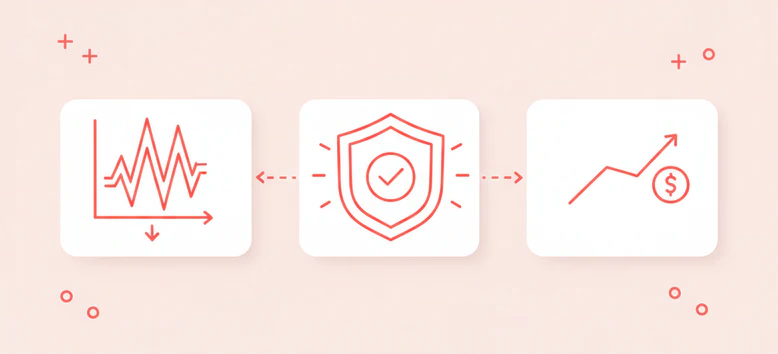
Navigating Crypto Price Shocks: How Businesses Protect Against Volatility

You can manage crypto volatility risk for your business without turning treasury into a trading desk. The tools that actually work, instant auto-conversion, stablecoin buffers, hedging for intentional holdings, and automated operational guardrails, don't require market expertise. They require configuration.
That's the difference between how investors experience crypto volatility and how payment-accepting businesses should approach it. An investor riding a 30% price swing has a thesis. A CFO whose accounts receivable just fell 8% overnight has a problem. The same asset class, completely different exposure profile.
Bitcoin's daily price standard deviation averages around 3.5%, according to Bitbo's Bitcoin Volatility Index . That sounds manageable until you apply it to a monthly payment volume of $500,000, where a 3.5% daily swing represents $17,500 in potential variance, every single day. Some altcoins can move 20–30% in 24 hours. Finance teams that accept crypto without controls are running treasury operations on an unpredictable asset.
B2BINPAY is built around eliminating that exposure. This article covers what causes crypto price shocks, which four controls actually reduce volatility risk for businesses, and how to implement them systematically.
Key Takeaways
- Instant auto-conversion to fiat or stablecoins at the moment of transaction eliminates price exposure entirely, protecting your margins from crypto swings between payment receipt and settlement.
- Stablecoin buffers give treasury teams a volatility-neutral holding option while maintaining crypto liquidity for future conversions or payments.
- Position sizing and wallet thresholds limit how much crypto exposure your business carries at any time, preventing a single price shock from threatening cash flow.
- Integrating KYT-driven transaction filters with your payment gateway ensures compliance checks run alongside volatility controls without creating operational friction.
- Choosing a crypto risk management service with transparent fees, no rolling reserve, and multi-asset coverage reduces hidden costs that compound during volatile periods.
What Are Crypto Price Shocks and Why Do They Threaten Business Cash Flow?
A crypto price shock is a sudden, significant price move, not the gradual drift of a slow market, but a fast, high-magnitude move that can happen within minutes. For businesses holding cryptocurrency between receipt and conversion, these shocks translate directly into margin erosion, unpredictable treasury balances, and reconciliation headaches.
The core business risk isn't volatility itself; it's "time-in-crypto." The longer a received payment sits unexchanged, the more exposure accumulates. A payment received Friday afternoon that isn't converted until Monday morning has experienced three days of 24/7 market exposure. That's the window where price shocks happen.
How Crypto Markets Differ From Traditional Financial Markets
Traditional financial markets come with built-in shock absorbers. Equity markets have circuit breakers that halt trading when indices drop sharply. Central banks have intervention tools that can dampen currency volatility. Most traditional markets close overnight and on weekends, limiting the hours during which shocks can compound.
Crypto has none of those stabilizing mechanisms. Trading runs 24/7, 365 days a year — including holidays, overnight, and weekends when your finance team isn't monitoring balances. There are no circuit breakers. There's no central bank standing ready to intervene. Bitcoin's annual volatility (~54%) is roughly four times that of the S&P 500 (~13%). That ratio has narrowed over time, but it remains the defining characteristic of the asset class for treasury operations.
Common Triggers: Liquidity Gaps, Whale Trades, and News Events
Three recurring triggers account for most significant price shock events.
Liquidity gaps occur when buy-side or sell-side order book depth thins out. When few counterparties are willing to trade at current prices, even a moderate-sized order can move the market significantly. The October 2025 crypto crash illustrated this dramatically — as Solidus Labs documented , BTC order-book depth shrank by more than 90% on key venues, turning a manageable macro shock into a $20 billion liquidation event.
Whale trades are large holder moves that trigger cascading reactions. In August 2025, a single $2.7 billion sell-off of 24,000 BTC wiped $200 billion from total crypto market cap and liquidated over $550 million in leveraged positions within hours. Your business wasn't involved in that trade, but your unhedged BTC balance felt it.
News and regulatory events create instant, unpredictable price moves. A regulatory announcement, an exchange outage, or a high-profile security incident can move prices before any treasury team can respond.
How Price Swings Affect Forecasting, Margins, and Reconciliation
The operational consequences of uncontrolled crypto exposure compound across three finance functions.
Revenue forecasting becomes unreliable. A $10,000 sale denominated in BTC could settle as $9,200 or $10,800 depending on when conversion happens. At scale, this creates variance that makes quarterly forecasting nearly impossible.
Margin erosion occurs silently. The gap between the price when a customer paid and the price when you converted is pure margin loss. A business with 15% gross margins absorbing a 5% adverse move on crypto revenue isn't just experiencing volatility — it's experiencing a margin compression event.
Reconciliation and audit friction increase with conversion timing inconsistency. When conversion rates differ across similar transactions because some were converted quickly and others after a delay, auditors require detailed explanations for the variance. Consistent, automated conversion eliminates this burden.
Reducing time-in-crypto is the simplest way to cut volatility risk without speculating or hedging. The four controls below show how.
Four Controls That Reduce Crypto Volatility Exposure
1. Instant Auto-Conversion to Fiat or Stablecoins
Instant conversion at the moment a blockchain payment is confirmed removes the "time-in-crypto" entirely. Instead of holding a volatile digital asset while it drifts, you receive a fiat-denominated or stablecoin balance the moment the transaction settles.
The mechanism: your payment gateway receives the cryptocurrency, triggers a conversion immediately at market rate, and credits your account in the target currency according to your configured rules. B2BINPAY supports auto-conversion across 70+ tokens to USD or EUR, executing in under 20 seconds. Once configured, this runs without daily manual intervention — no monitoring, no timing decisions, no manual swap orders.
This is the default control for most payment-accepting businesses. It eliminates volatility exposure at the source and makes revenue entirely predictable from the moment a payment is confirmed.
2. Stablecoin Buffers for Treasury Planning
Stablecoins — USDT, USDC, and similar fiat-pegged digital assets — offer a middle path between full fiat conversion and holding volatile cryptocurrency. They're priced in dollars, so they don't expose you to BTC or ETH price movements, but they remain on crypto rails — available for quick conversion, vendor payments in crypto, or liquidity management within your payment stack.
Instead of converting all incoming cryptocurrency directly to fiat, you can convert volatile assets (BTC, ETH, altcoins) to a stablecoin buffer immediately, then convert to fiat on a schedule or when needed for payouts. According to Stripe's guide to crypto treasury management , stablecoin buffers are increasingly standard practice for businesses that want crypto liquidity without the price risk of major coin swings. USDC merchant payment volume jumped 337% between 2024 and H1 2025, reflecting this shift at scale.
3. Hedging With Futures or Options (and When It Makes Sense)
Hedging — taking an offsetting position to neutralize price movements — is the right tool when a business intentionally holds a meaningful cryptocurrency balance for strategic reasons (treasury diversification, cross-border settlement efficiency, or crypto-denominated payouts).
Futures contracts let you lock in a future price today, protecting the value of your holding regardless of market movement. Options cap downside while preserving upside. Both instruments add operational complexity: you need policies, position limits, counterparties, and ongoing management.
For most businesses that accept crypto as a payment method, hedging is overkill. Auto-conversion solves the problem more simply. Hedging fits when you're running an intentional crypto treasury position. Our guide to crypto derivatives covers the mechanics in detail.
4. Operational Guardrails: Wallet Thresholds, Access Rights, and KYT Filters
Guardrails limit how much volatility exposure can accumulate even when auto-conversion isn't immediate.
Wallet thresholds cap the balance held in any crypto wallet before triggering automatic conversion or transfer. If your threshold is $5,000 in BTC, the system automatically converts or transfers any amount above that limit — so you never accumulate large unhedged positions through payment flow alone.
Access rights and permissions ensure only authorized team members can modify conversion rules, access wallets, or initiate large transfers. During fast-moving markets, unauthorized or mistaken transactions can magnify losses. Role-based permissions prevent that.
KYT (Know Your Transaction) filters screen incoming payments for risk signals — links to sanctioned addresses, mixing services, or illicit fund sources — before conversion proceeds. This compliance layer runs automatically as part of the payment flow, so your volatility controls and AML obligations run in parallel without creating separate manual review queues. B2BINPAY's treasury management infrastructure integrates wallet thresholds, user rights, and KYT screening in a single platform.
How to Implement Automated Crypto Risk Management: A Step-by-Step Workflow
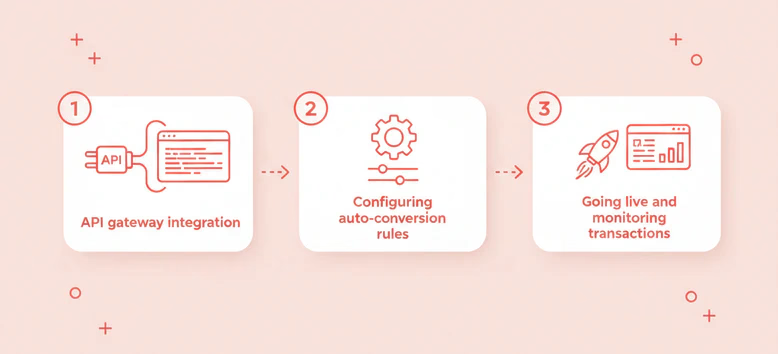
Step 1: Integrate Your Payment Gateway With Your Existing Stack
Connect your payment gateway API to your checkout flow, invoicing system, or treasury stack. B2BINPAY uses a REST API that integrates with standard e-commerce and ERP environments. Keep API key handling secure and role-limited — production keys should only be accessible to authorized integration owners, not shared or stored in unencrypted configurations.
Step 2: Configure Conversion Rules, Thresholds, and Alerts
Set your auto-conversion rules: which incoming assets convert automatically, what target currency (USD, EUR, or stablecoin), and what minimum amount triggers a conversion. Configure wallet thresholds that trigger alerts or automatic transfer when balances exceed your exposure limit.
Per-asset configuration matters here. Auto-convert BTC and ETH to USD immediately; hold USDT as-is since it's already a stablecoin; flag altcoins for manual review or auto-convert based on your accepted asset list. For more on the benefits and trade-offs of cryptocurrency payments , see our related guide.
Step 3: Test in a Sandbox Before Going Live
Test edge cases in the sandbox: a large single payment that triggers your threshold, multiple simultaneous payments in different assets, and a stablecoin conversion scenario. Confirm callbacks process correctly and that conversion records appear with the right timestamps and exchange rates before going live.
What to Look for in a Crypto Risk Management Service
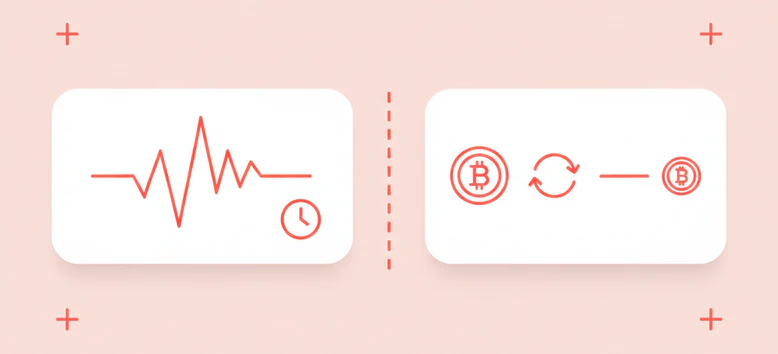
Security and Compliance Capabilities
Essential security controls: two-factor authentication, address whitelisting, role-based user permissions, and full operational audit logs. Compliance capabilities — integrated KYT/KYC and AML screening that runs automatically — matter more during volatile markets, not less. B2BINPAY operates as a regulated VASP with authorization in El Salvador. For context on crypto vs. fiat in business operations , including compliance trade-offs, see our related article.
Fee Structures, Rolling Reserves, and Asset Coverage
Rolling reserves: Some processors withhold 5–10% of monthly volume as fraud protection — funds you own but can't access. During volatile markets, that locked-up cash is exactly what you need. Choose a provider with 0% rolling reserve.
Fee transparency: Hidden spreads add up quickly at high volume. B2BINPAY charges a flat 0.25–0.40% processing fee with no hidden spreads and zero fees on outgoing merchant payouts.
Asset coverage: B2BINPAY supports 350+ digital currencies with auto-conversion across 70+ tokens — broad enough to handle most payment scenarios without manual exceptions.
Near-Zero Volatility Settlement With B2BINPAY
You can accept cryptocurrency at scale and still achieve the predictable fiat settlement your treasury, accounting, and audit functions require. The gap between those two things isn't a fundamental conflict — it's a configuration problem.
B2BINPAY eliminates the volatility window through instant auto-conversion, built-in KYT screening, configurable wallet thresholds, and transparent fee structures with no rolling reserve. Near-zero effective volatility exposure: you accept crypto, your customers pay with what they prefer, and your treasury receives a predictable fiat balance.
For a deeper look at how B2BINPAY addresses this in payment contexts specifically, see our article on how to solve the volatility problem in crypto payments .
Frequently Asked Questions about Crypto Volatility Risk Business
What settlement window is safest for eliminating price risk?
Instant conversion at the moment the payment is received eliminates exposure entirely. Any delay introduces volatility risk proportional to how much the market can move in that window.
Can I limit which coins customers use at checkout?
Yes. Most payment gateways let you configure exactly which digital assets you accept. Many businesses prioritize stablecoins and major coins like BTC and ETH while restricting highly volatile altcoins.
Do volatility controls interfere with AML or KYT checks?
They shouldn't. B2BINPAY integrates KYT screening into the payment flow automatically — flagged transactions pause for review while clean transactions process at full speed.
How do I prove to auditors that controls are effective?
Maintain transaction logs with timestamps, exchange rates, and conversion moments. Exportable reports that show consistent control operation give auditors traceable evidence.
Subscribe to our channel so as not to miss new publications
SubscribeWallet as a Service — Enterprise
Merchant Wallet
Accept Crypto. Settle Fiat.
Seamless checkout for Forex, iGaming & e-commerce. Auto-convert 70+ tokens to USD/EUR — zero volatility risk.
70+
Currencies
0.25%
Min Fee
0%
Reserve
Enterprise Wallet
Automate Treasury. Cut Manual Work.
Real on-chain wallets with auto-sweeping, auto-payouts, and AML built in. Built for institutional scale.
350+
Currencies
20+
Blockchains
24/7
Support
DeFi App
Non-Custodial On-Chain Payments.
Audited multisig invoicing for DeFi teams. You own your keys, you control your funds. Free UI tier.
8+
Chains
Free
UI Tier
Multisig
Security
Crypto Payment Gateway
Ready to Protect Your Margin?
Join 983+ businesses that use B2BinPay to eliminate payment friction, stop account freezes, and settle in fiat — instantly.
Create an account- Onboarding in <24 hours
- 0% Rolling Reserve
- Regulated VASP · El Salvador


Subscribe
Join our community and stay tuned for the latest news. No spam, unsubscribe anytime
Thank you! Your submission has been received!