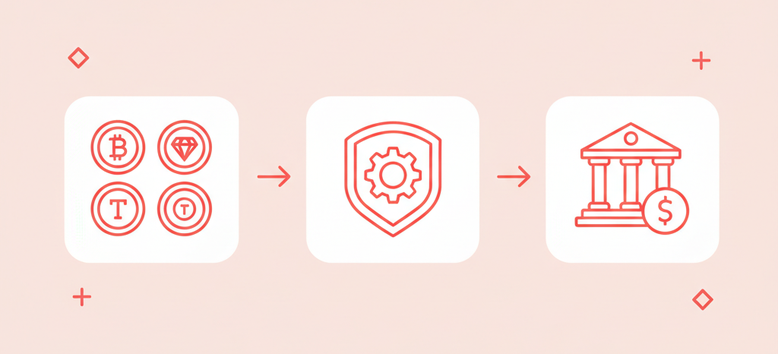


Card processing costs are eating into margins across every industry. The average merchant pays 3.4% or more per transaction, on top of rolling reserves, dispute fees, and the constant threat of chargebacks. For cross-border businesses, high-risk merchants, and anyone dealing with international clients, the math gets worse fast.
Crypto payments for businesses offer a concrete alternative: lower fees, faster settlement, no chargebacks, and no correspondent bank delays. The volatility exposure most finance teams expect is largely solved. A modern payment gateway converts crypto to fiat at the moment of purchase, so you receive stable currency regardless of what Bitcoin does overnight.
With 741 million crypto users worldwide as of 2026, the customer segment is real and growing. This guide covers what enabling crypto payments actually means, the two fastest integration paths, a four-step launch you can validate before going live, and what to look for in a processor so you don't get burned on hidden costs.
Key Takeaways
- Crypto payment gateways let businesses accept cryptocurrency and settle in fiat instantly, eliminating volatility risk and reducing transaction fees to around 1% compared to 3.4%+ for traditional card processors.
- Integration can happen in minutes using API keys or one-click plugins for platforms like Shopify, WooCommerce, and Magento — no blockchain expertise required.
- Blockchain's irreversible ledger removes chargeback fraud entirely, while licensed gateways handle AML, KYT, and regional compliance on your behalf.
- A four-step process, account creation, sandbox testing, coin configuration, and go-live, enables businesses to accept crypto payments in under an hour.
- Choosing the right crypto payment processor depends on fee transparency, supported assets, settlement speed, compliance coverage, and integration simplicity.
What Crypto Payments Mean for Businesses
When a customer pays in crypto, the gateway does the conversion and credits your bank account in fiat — USD or EUR, not BTC or ETH. Your business never holds volatile assets or manages a wallet. The whole point is that you get the payment, the customer pays the way they want, and the gateway handles everything in between.
That distinction matters. There's a difference between holding crypto (treasury exposure to price swings) and accepting crypto with instant conversion (you receive fiat, full stop). Most businesses considering cryptocurrency merchant services want the second option. The gateway takes on the exchange risk; you get stable receipts.
A practical example: a SaaS company invoices a client in USDT. The gateway confirms the payment on-chain, converts to USD at the current exchange rate, and credits the business account the next business day. The client paid in crypto. The business received dollars. Nobody managed a wallet.
Why Companies Replace Card Rails With Crypto Payment Systems
Businesses replace card rails with crypto payment systems primarily to cut fees, eliminate chargebacks, and reach customers card networks can't serve. According to a Deloitte survey, 85% of merchants identify crypto payments as a strategic way to access new customer segments — particularly younger, tech-forward buyers and international clients outside conventional banking systems.
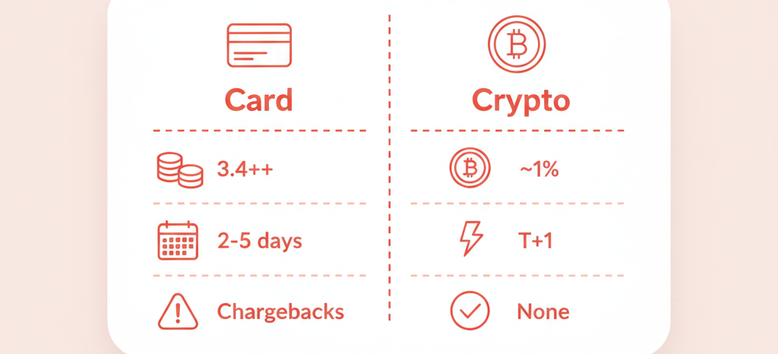
The fee comparison alone drives most conversations. Card processors charge 2–3.4%+ per transaction, before you factor in rolling reserves (some processors hold 5–10% of revenue for 90–180 days), chargeback dispute fees, and currency conversion costs for international payments.
Crypto payment systems typically charge 0.25%–1% per transaction with no rolling reserve requirements. The settlement math is straightforward.
That $41.69 billion chargeback loss figure projected by 2028 isn't abstract — it's operations teams fighting disputes, finance teams adjusting cash flow forecasts, and legal teams handling representment. Blockchain payments bypass all of it. Once a transaction's confirmed on-chain, it's final. No reversal window, no dispute process, no 120-day exposure.
For cross-border payments, crypto removes the correspondent banking layer entirely. Funds move from customer wallet to gateway to your account without currency conversion friction or the risk of payment rails freezing funds in jurisdictions with banking restrictions.
Licensed gateways shoulder AML and KYT compliance obligations too. You're not running transaction screening in-house — the gateway handles it. That's real operational overhead your compliance team doesn't have to absorb.
[[aa-cta-blue]]
Cut Card Processing Costs Starting Today
B2BINPAY's flat 0.25%–0.40% fee and 0% rolling reserve mean you keep more of every transaction — no hidden spreads, no reserve holds.
Start your free sandbox account
[[/a]]
Integration Paths You Can Launch Today
Accepting crypto doesn't require blockchain expertise. The gateway abstracts wallet management, confirmation monitoring, and settlement entirely. Your team interacts with an API or a plugin, nothing more.
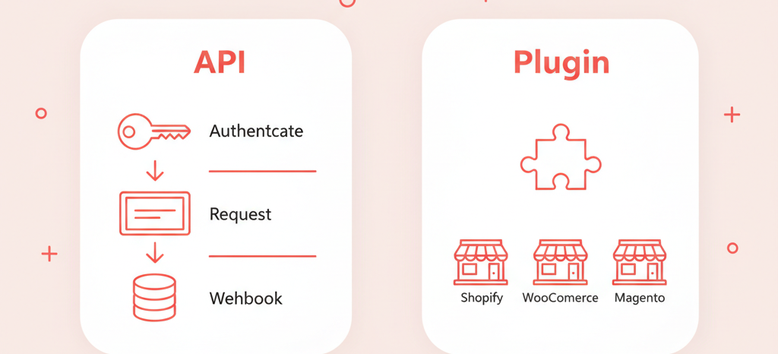
Two paths cover almost every business type:
API Keys and Three-Call Setup
Three calls — that's the full integration. Authenticate with your API keys, fire off a payment request (you get a deposit address and QR code back), and set up a webhook endpoint to catch the on-chain confirmation. Most developers have a working prototype in an afternoon. For the full technical walkthrough, how to connect a crypto payment API covers the integration sequence in detail.
Run the full flow through a sandbox before you touch production. It sounds obvious, but skipping this step is where integration problems sneak in — webhook delivery failures, order ID mismatches, settlement preview discrepancies all need a real test before your first live customer.
One-Click Plugins for E-Commerce Platforms
Shopify, WooCommerce, Magento — if you're running any major e-commerce platform, there's already a plugin for this. Install it, configure your API credentials, and crypto shows up as a checkout option next to cards. No redirects, no third-party branding eating your conversion rate.
White-label checkout options keep your branding front and centre. Customers stay in your checkout environment, not handed off to a payment page that looks like it belongs to someone else. That matters — redirect fatigue is real.
Plugin users get the same compliance coverage, fee structure, and fiat conversion behaviour as API integrations. The difference is implementation complexity, not capability.
Four Steps to Accept Payments in Under an Hour

Most businesses complete the technical setup well within an hour once KYC clears. The bottleneck is documentation review, not integration work.
1. Create Merchant Account and Complete KYC
Sign up, submit your business details, and clear KYC/KYB. Licensed gateways require this to meet AML obligations — it's the regulatory cost of using a compliant payment rail. Worth it.
Many providers complete verification within 24 hours. Once you're approved, your API credentials or plugin access come through.
2. Test a Sandbox Transaction
Run the full loop in sandbox before going live: payment initiation, webhook arrival, settlement preview, and any reconciliation logic your system relies on. You're looking for mismatches between your internal order IDs and the gateway's payment identifiers. Find them here, not in production.
3. Configure Supported Coins and Stablecoins
Start with BTC, ETH, USDT, and USDC — those four cover most customer demand. Stablecoins now account for roughly 70% of crypto payment volume, so USDT and USDC are the practical priority for most merchants. Add more assets later from the dashboard once you've validated the core setup.
4. Go Live and Monitor Payouts
Switch from sandbox credentials to production, publish your payment link or enable the checkout integration, and watch the dashboard. You can see incoming payments, live conversion rates, and payout status in real time as transactions arrive.
Automatic consolidation moves funds from multiple deposit addresses into your main account. Payout frequency and destination bank details are configured in your account settings.
[aa-cta]]
Accept 350+ Cryptocurrencies With One Integration
B2BINPAY supports over 350 digital currencies and stablecoins across 20+ blockchains — configure what you accept in minutes from the dashboard.
[[/a]]
Behind the Scenes of Settlement and Compliance
Crypto payment settlement follows three phases: the gateway locks the exchange rate at checkout, waits for blockchain confirmation, then transfers fiat to your bank account. Finance teams that map each phase accurately find reconciliation straightforward and cash flow predictable. Understanding what happens behind crypto payment transactions helps model the full flow before committing to a gateway.
Instant Crypto-to-Fiat Conversion and Reporting
At checkout, the gateway locks an exchange rate and converts whatever crypto the customer sends into your settlement currency — USD, EUR, whatever you've configured. You receive stable fiat regardless of what crypto prices do after that moment.
Settlement typically hits your account T+1. Each transaction gets a unique identifier — a deposit address or invoice ID that ties directly to an order in your system. That's your match key for reconciliation. No manual cross-referencing, no chasing support tickets about which payment corresponds to which order.
Exportable transaction histories give your accounting team the data they need for reporting and tax purposes.
Multi-Layer Authentication, KYT, and No Chargebacks
Know Your Transaction (KYT) is automated blockchain screening — it flags suspicious payment flows and checks incoming funds against sanctions lists and risk indicators. A licensed gateway runs this continuously. You don't build it; you don't maintain it.
Security controls typically include 2FA, IP whitelisting, address allowlists, role-based team access, wallet thresholds, and DDoS protection at the infrastructure level.
Blockchain transactions are irreversible. Once a payment confirms on-chain, that's it — no dispute window, no 120-day reversal risk, no chargeback exposure. The entire workflow that card merchants spend billions fighting every year simply doesn't exist.
Note: while a licensed gateway covers transaction-level AML and KYT screening, businesses in regulated industries should confirm any additional compliance obligations with their own legal or compliance counsel.
Transparent Cost Factors in Crypto Payment Processing
Knowing all cost components upfront prevents surprises when you run the settlement math. These are the line items to confirm before signing with any gateway.
Processing fees are charged by the gateway: typically 0.25%–1% per transaction, sometimes volume-tiered. Ask explicitly whether conversion spread is included in this figure or charged separately.
Network fees go to the blockchain itself for transaction confirmation. These vary by chain and congestion — they're not gateway revenue. Some providers absorb or subsidize network fees for certain assets or routing configurations.
Payout fees may apply when withdrawing fiat to your bank account depending on corridor, banking rail (SEPA vs SWIFT), and provider policy. Confirm whether fiat withdrawals are flat, percentage-based, or free above a threshold.
Rolling reserves — withholding a percentage of merchant revenue as a fraud buffer — are standard with card processors. Many crypto gateways run with 0% rolling reserve. If your business has been burned by 90-day hold periods before, that's a meaningful difference for cash flow.
Tips for Choosing a Crypto Payment Processor
Use this checklist when evaluating providers. See the full breakdown of benefits and trade-offs of crypto payments for additional context on each factor.
- Fee transparency: flat rates, no hidden spreads, explicit network fee policy, 0% rolling reserve
- Supported assets: confirm coverage aligns with your customer base — at minimum BTC, ETH, USDT, USDC
- Settlement speed: T+1 fiat settlement or faster; confirm cut-off times and payout corridors
- Compliance coverage: licensed provider handling AML, KYT, and regional regulatory requirements for your markets
- Integration options: REST API with sandbox, plugins for major e-commerce platforms, webhook reliability
- Security: 2FA, address allowlists, role-based access, risk scoring, third-party audits, DDoS protection
- Reporting: real-time dashboard, unique payment identifiers, exportable transaction history for accounting
Always run a sandbox demo before committing. A 30-minute test tells you more about API reliability and reconciliation behaviour than any documentation page.
Start Accepting Crypto With B2BINPAY
For businesses that need a gateway matching the criteria above, the B2BINPAY merchant solution is built specifically for this use case.
B2BINPAY processes crypto payments for Forex brokers, iGaming operators, e-commerce merchants, and enterprise treasury teams that need regulated, automated infrastructure — not a consumer wallet dressed up for business use. Fully licensed, AML and Travel Rule KYT compliant, fiat settlement via SEPA and SWIFT.
Key specs: 350+ supported digital currencies, 20+ blockchains, 0.25%–0.40% processing fees, 0% rolling reserve, automated onboarding in under 24 hours, sandbox testing, and REST API documentation built for developer integration.
The case for integrating now is real. Stablecoin transaction volumes hit $33 trillion in 2025. Crypto payment adoption among Fortune 500 companies reached 78% in terms of active exploration or piloting. The 741 million-strong crypto user base is growing and underserved by checkout flows that don't accept digital assets.
Enabling crypto payments doesn't require months of infrastructure work. With the right gateway, it's a same-day decision.
Frequently Asked Questions
How do crypto payments work for businesses?
Customers pay in cryptocurrency, and a payment gateway converts it to fiat (like USD or EUR) and settles funds to the business, typically within one business day.
Are crypto payments legal for businesses?
Yes, businesses can legally accept crypto payments in most jurisdictions, but rules vary by country and industry. Using a licensed gateway helps cover AML and KYT compliance requirements applicable to your payment flows.
Can I accept crypto without holding volatile assets?
Yes. Instant crypto-to-fiat conversion locks in the exchange rate at the time of purchase, so you receive fiat without any exposure to crypto price movements.
How long does it take to integrate a crypto payment gateway?
Many businesses can integrate in minutes using API keys or one-click plugins for platforms like Shopify and WooCommerce. Going live within an hour is common once KYC is completed and the payment flow is sandbox-tested.
What cryptocurrencies should my business accept?
Start with widely used, high-liquidity options: Bitcoin (BTC), Ethereum (ETH), and stablecoins (USDT, USDC). Stablecoins account for roughly 70% of crypto payment volume in 2025, so they're a natural starting point for most merchants.

.svg)